


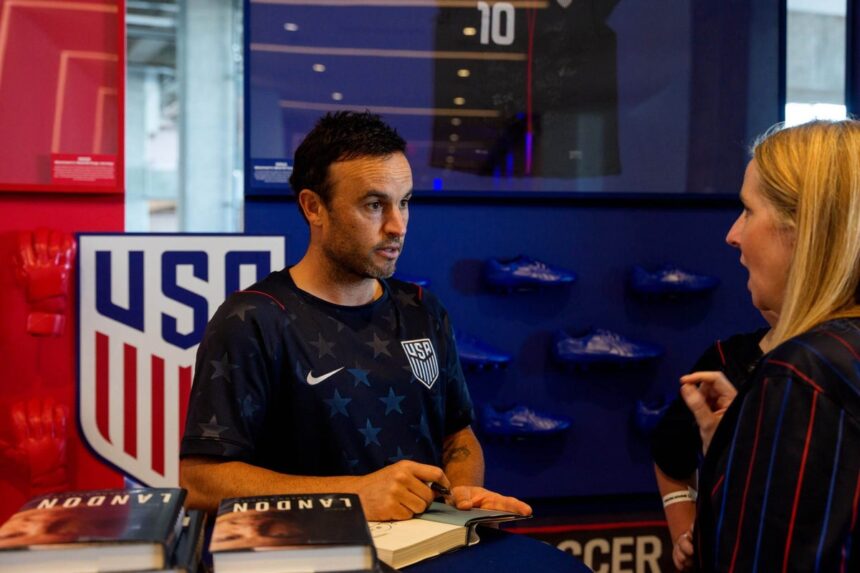
Landon Donovan is not who you think he is.
Or, at least, not all of who you think he is.
In a memoir released last month, Donovan writes about his relationship with his father, his mental health and his battle to prove his value on the field. And all of it was a journey to embrace that he’s more than just the soccer player most people know him to be.
It’s why, he said, he settled on the title, Landon, for the book, not Landon Donovan. And why much of the story focuses on his life away from soccer and not on his career.
“The book is me, it’s Landon,” the U.S. men’s national team legend said. “It’s not Landon Donovan. Through therapy, I had to find ways to differentiate the two because they had been tied up together as my identity. And Landon is the real me. That is the real me. And Landon Donovan shows parts of me when I was competing and playing and all that, but that’s a whole different part of me. That is actually not the core. … So I had to find my true identity through a lot of work. And I think a lot of people can resonate with that too, because a lot of people are caught up in what they do. That what they do defines them.”
For fans, there are aspects of the book that will be surprising. Donovan recounts growing up in a home mostly raised by his single mother, and how a mostly unsteady relationship with his father impacted him. A scene where Donovan, outside the courthouse where a custody hearing was being held, realized his father wasn’t showing up was especially powerful in understanding where Donovan’s motivation — his desire to be successful, and maybe to be loved, as well — came from .
The all-time leading point scorer in U.S. men’s history said he didn’t want to run from those difficult moments in this book.
“If I was able to do (a memoir) in a way that was really authentic and very vulnerable and open up and share it all, then I figured it was valuable to do,” he said.
Those who worked around Donovan likely won’t be surprised by the former San Jose Earthquakes and LA Galaxy forward’s openness in the book. Donovan was one of the first athletes to talk publicly about mental health. At a press conference ahead of the 2010 World Cup, he opened up about some of his struggles to cope with the pressures of representing a country and the personal trials in his life that added more layers to those burdens.
This book, though, peels back those layers. They also dispel any ideas that Donovan was a pampered star who represented the rich suburban soccer culture that colors many of the youth fields around the country.
“The odds of growing up the way I did and getting to where I got were less than zero,” Donovan said. “I mean, that should not have happened. So I enjoy the humanization aspect of saying, ‘Look, I was like many other very poor Americans growing up, and I certainly had a unique skill and a unique talent for things, but it took a lot of hard work to achieve what I achieved.’
“I think people will really relate with that, that aspect of it. There’s people who grew up with a single parent, there’s people who grow up with their dad not around. There’s people who grow up dealing with depression. There’s people who grow up really poor. And then the flip side is there are parents who grow up with all those things. They’re single moms. There are dads who are estranged from their kids, who really want to reconcile. There are lots of pieces of the story that I think people will resonate with.”
Donovan does go into some aspects of his career. He writes about his sabbatical to Cambodia and his experiences using psychedelic drugs. He also writes about deciding to come back to MLS from Bayer Leverkusen.
“In the end, do you want to play soccer or not?” said Donovan, who lamented that he wasn’t getting chances to get on the field and play. “Gio Reyna is a great example. Do you want to play soccer? Do you not? For me, I wanted to play soccer because I knew that’s where a lot of my happiness came from. So it was an easy answer for me. I just wanted to play soccer and enjoy it and have fun.”

Landon Donovan scored one of the USMNT’s most iconic goals, in the 2010 World Cup group stage finale vs. Algeria (Kevork Djansezian / Getty Images)
He also dives into Jurgen Klinsmann’s decision to leave him off the 2014 World Cup roster.
”I wish he had just come to me and had an honest conversation and said, ‘Hey, you’re not going to start,’ or ‘You’re not going to play as much, but I really want you part of the team because I know you can help.’ If he actually felt that way,” Donovan said. “But that’s me just kind of guessing if I’m giving him the benefit of the doubt. If I’m not, then there were more nefarious reasons. But I’m not inside his brain.”
Much of the book delves into Donovan’s relationship with his father and how it colored much of his career — and sometimes his approach to coaches and teammates. Through therapy, Donovan wrote that he realized his relationship with his father impacted his frustrations with David Beckham when the England star first arrived in Los Angeles.
“I said all those things publicly, which was a massive mistake,” Donovan said. “But then we got in a room with Bruce (Arena), and we had a 20-minute conversation, and it was easy. From then, it was just like, ‘OK, we get each other. We understand each other.’”
The book takes on an even stronger meaning when you learn that Donovan’s father passed away last December, just as Donovan was in the final stages of the book. The National Soccer Hall of Famer said he was able to reconcile with him and build a strong relationship over the last 10 years, but that his father’s passing also brought more perspective to his life.
“I was grateful that I had any time with him the last decade,” Donovan said. “We had developed such a phenomenal relationship, and it was just really nice to have had that when he did eventually pass away, because I can only imagine how much more painful it would have been. … I use this phrase now often when I, or when other people, are going through something and are trying to make a decision. I just say: ‘When you’re on your deathbed, is this going to matter?’ And very, very few things do.
“If you really boil it down, you’re like, ‘No, none of this s*** is gonna matter.’ And then once in a while, something does, and you go, ‘OK, I better put some real energy into this, because this is gonna matter.’ It makes life pretty easy because you view it through that lens, and you just don’t worry as much about a lot of the little things.”
More for the World Cup reading list
Among other World Cup-related books released this spring and summer there’s We Are the World (Cup): A Personal History of the World’s Greatest Sporting Event, a memoir from Men In Blazers’ Roger Bennett. It paints World Cups as the spine of his life and traces his path from his childhood in Liverpool to his emigration to Chicago ahead of the 1994 World Cup and eventually finding his voice in American soccer. Bennett’s own journey coincided with the growth of soccer in America, but this book is really about the power of the World Cup to tie itself significantly into one’s life and to generate seminal memories in your own journey.
“It’s a telling of the power of this tournament, the power of sports, and it’s a global eclipse that strikes the entire planet for the duration,” Bennett told The Athletic. “That’s the power of the World Cup; the depth of the storytelling that, when two teams take the field, their nation’s histories, politics, cultures, take the field alongside them. And so (the World Cup) makes the most searingly beautiful and profound memories.”
Alan Rothenberg, the former U.S. Soccer president who oversaw the 1994 World Cup and 1999 Women’s World Cup and launched Major League Soccer, has written The Big Bounce: The Surge That Shaped the Future of U.S. Soccer (Triumph Books), which chronicles an inflection point in the story of the sport’s modern era in the United States … A number of longtime journalists have also produced books tailored for a World Cup summer. There is Jonathan Wilson’s The Power and the Glory: The History of the World Cup (Bold Type Books); Simon Kuper’s World Cup Fever: A Soccer Journey in Nine Tournaments (Pegasus Books); and Leander Schaerlaeckens’ The Long Game: U.S. Men’s Soccer and Its Savage, Four-Decade Journey to the Top, or Thereabouts (Penguin Random House) … And for children, there’s Carlos Mojica’s Goal!: Awesome Soccer Stories and Fun Facts for Kids.
Full disclosure: The author of this piece also has a book released on June 2, The Messi Effect: How the Global Legend Changed the Future of American Soccer (St. Martin’s Press).