


The Athletic has launched a Cricket WhatsApp Channel. Click here to join.
The last time Harry Brook batted in a Test for England his performance was so chaotic, frenetic and, frankly, irresponsible that New Zealand’s players laughed at him.
“What are they doing?” said an incredulous voice in New Zealand’s bemused huddle after Brook had slogged his way to 21 off nine balls in the final Test at Trent Bridge before holing out in an England display that degenerated, post-Ben Stokes’ sudden retirement, into a parody of Test cricket.
Brook’s cameo was the worst of it. Confirmation, if any were needed, of the presumed immaturity and recklessness that made him the poster boy for those who had long become disillusioned and despairing at the worst excesses of England’s Bazball style.
It did not matter that Brook was averaging in excess of the 50 runs per innings mark that, over a more than long enough sample size of 38 Tests, put him in the company of the truly great Test match batters. He was just, as Stokes called him ahead of his debut, “a bit dumb”.
But maybe that low point and the unexpected departure of Stokes and the return of Joe Root as Test captain ahead of the white-ball skipper has proved a turning point for one of the most gifted but infuriating batters of his generation.
England, perhaps, saw a new Brook at Headingley during the thrashing of Pakistan in the first Test, one who will retain his positive and imaginative style but who will also be more selective in his shot selection and not give it all away all too often by going just a little too far.

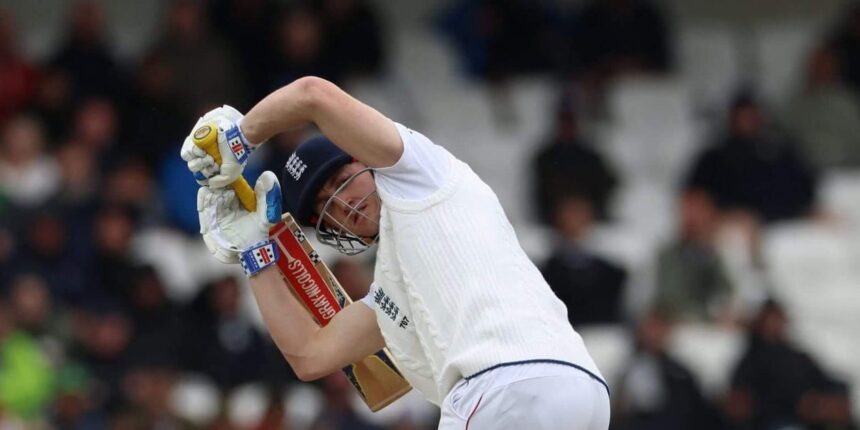
Harry Brook was excellent at Headingley (Stu Forster/Getty Images)
It must be remembered that Brook should have been dismissed for just one at the start of his 91 off 93 balls when he played an indiscriminate dab at Khurram Shahzad and should have been caught at slip by stand-in Pakistan captain Salman Agha.
But with that slice of luck came a sudden outburst of responsibility from Brook, who then scored at almost a run a ball but did so sensibly and without taking any undue risks.
Only when he got himself in a contorted position against the spin of Ali Usman and was somehow bowled when trying to speed his way to his first Test century on his home ground before the close of the second day did Brook err.
The close of that second day — admittedly of what became an all too short and one-sided Test because of Pakistan’s alarming frailties — brought a fascinating debate on the BBC’s Test Match Special podcast. Veteran commentator and broadcaster Jonathan Agnew had become frustrated by the looseness of Bazball long before it disintegrated in Australia last winter, but now he was enthused by the performance of Brook, saying: “That’s how he should bat.”
But injured England fast bowler Mark Wood, making a guest commentary appearance, pointed out, in the polite manner of one of the nicest men in cricket, that Brook must have been doing something right before now to average 53.63 with an incredible strike-rate of 87.08. He has hit 10 Test centuries including a triple hundred against these same Pakistan opponents in Multan two years ago.
“He plays these big shots to set the tone and force the field back and then milk the ball around and keep the scoreboard moving. The way he plays has worked for him and us,” said Wood.
There is no doubt Brook, at 27, has reached a crucial point in his career. His altercation with a bouncer outside a Wellington club the night before he captained his country in a one-day international last October was a low point that brought alarming focus on England’s nocturnal habits.
So grim are the full details from that ill-fated night out which also featured Jacob Bethell and Josh Tongue, some of which have never reached the public domain, that Brook was extremely fortunate not to be sacked from the captaincy on the spot.
Coach Brendon McCullum should have gone with him for instigating the cover-up that meant the incident only came to light when it was revealed by The Telegraph at the end of an Ashes series that had become a woeful tale of indiscipline both on and off the pitch.
There is no question that the incident was the major reason why Brook was then overlooked for the Test captaincy, firstly when Root had to step in for the suspended Stokes for the second Test at the Oval earlier this summer and then when a permanent leader was required. His workload as captain in all three formats was secondary to his immaturity.
But clearly being overlooked now when, in truth, the obvious move would have been to promote the vice-captain seems to have turned a lightbulb on in Brook’s head.

A disappointed Harry Brook returns to the pavilion after his 91 (Stu Forster/Getty Images)
Before the first Test Brook gave an interview to the BBC’s new cricket correspondent Stephan Shemilt and sounded far more mature and sensible. Either he has had a new bout of media training or he really has learnt from his mistakes. On getting out far too easily and all too often playing what he himself described in the winter as “shocking shots”, Brook said: “It’s something I’ve really been trying to work on.
“I’m trying to assess conditions quicker and trying to read the surface better to know what shots are going to be harder and which ones are easier. If supporters get frustrated at some of the ways I get out, imagine how frustrated I get. One day you can be blitzing it everywhere and then get out, but it’s trying to work out those little nuances in-game that give me the best chance of scoring runs.”
On losing out on the Test captaincy in favour of a former captain in Root, Brook said: “I honestly don’t know if I’d be Test captain if Wellington hadn’t happened and I don’t look at it like that. I think the decision to make Rooty captain is the right one and I’m really excited to see what he can do.
“He’s definitely the right man to take over that job. He’s got a hell of a lot of experience and has the most Test victories of any England captain. I’m really looking forward to working alongside him.”
It looked it, too, at Headingley where Root constantly liaised in the field with his friend and vice-captain in Brook and involved him throughout in the decision-making process.
Brook is clearly evolving into an astute tactician and has developed a strong relationship with McCullum, who has remained as white-ball coach, that will see them working towards next year’s 50-over World Cup in South Africa.
Perhaps, after Root has had one final crack at winning the Ashes as England captain next summer after three failed attempts, the time will be right for Brook to become Test captain and, if England have any sort of succession plan in place, to hand over white-ball responsibilities to Bethell after the World Cup that follows the Ashes.

Harry Brook has become Joe Root’s right-hand man (Darren Staples/AFP via Getty Images)
Until then he will be Root’s strong right hand and help him in the way that Root himself helped Stokes when he gave up the captaincy first time round and, instead, turned into a loyal lieutenant for the new leader.
The best way he can do that is bat with the maturity he showed at Headingley, get that average up even more towards the giddy heights of 60 while setting an example off the field too in a more mature England Test side.
Then Brook really will have fulfilled his vast potential.