

The elite of the sailing world may have launched into hyperspace with their flying machines in SailGP and the America’s Cup, but for most sailors their passion still lies in racing slower but more tactical keelboats.
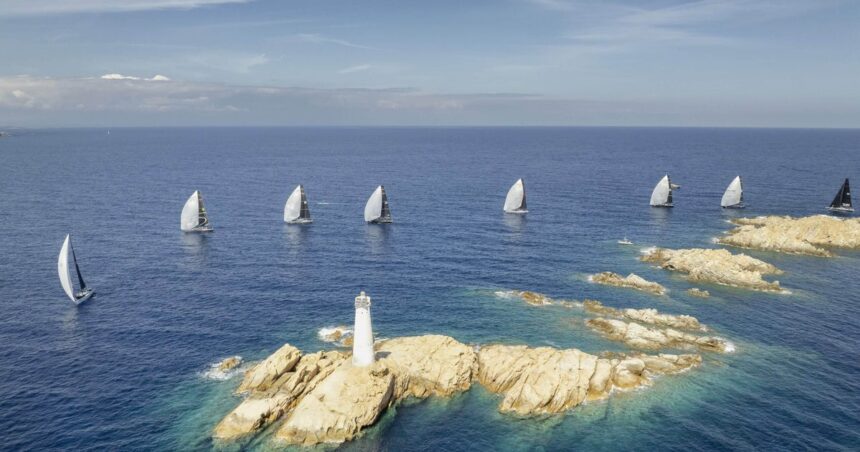
The Swan Cup takes place every two years on the Costa Smeralda, Sardinia’s glittering northern Italian coastline, and this September a record 170 yachts will line up on a hectic start line.
Unlike most yachting regattas, where there is a panoply of different brands competing against each other, the Swan Cup is run purely for the owners of yachts built in Finland by Nautor’s Swan. Where older racing yachts go out of date the moment they’re no longer capable of winning races, this does not apply to Swan yachts which have taken on a classic status, ensuring they will never be considered obsolete.
Hosted by the Yacht Club Costa Smeralda, arguably Italy’s most prestigious yacht club, the regatta has attracted all sizes of Swans. But how does the regatta work and who takes part?
What exactly is the Swan Cup?
There is no overall winner, just class winners, i.e., those with the best set of aggregate scores in their division across the whole week.
The schedule begins with registration and measurement on Sunday and Monday, followed by practice sessions early in the week. Competitors generally participate in four to five days of active racing from Wednesday through Saturday, with potential lay days (days off) depending on weather and division organization.

The crew with the best set of aggregate scores in their division across the week win. (Rolex Swan Cup)
The exact number and type of races vary significantly by fleet division. Rating divisions, including Maxi, Grand Prix and Classic Sparkman & Stephens classes, compete primarily on long coastal and navigational courses through the Archipelago of La Maddalena, typically completing one race per day for a total of four to five coastal races.
On the other hand, high-performance One-Design classes, such as the ClubSwan 50, ClubSwan 42, and ClubSwan 36, race short windward-leeward (up and down) tactical courses, completing two to three races per day for a scheduled maximum of eight to 10 races over the regatta.
Why are Swan yachts so special?
Most significant of all these yachts is the oldest and smallest, a humble 36-footer called Tarantella, although it wasn’t humble for its time.
In 1966, an ambitious young businessman from Finland, Pekka Koskenkylä, decided to build yachts not from wood but out of a pioneering new material called fiberglass.
He commissioned the well-respected American design firm Sparkman & Stephens to draw the lines, and the Swan 36 was born. A radical shift in construction material and in hydrodynamic design, the combination was spectacular. It changed the conventional yachting industry of the time and propelled it in a new direction.
Traditionalists scoffed at the ‘plastic’ boats, but the Swan 36 featured a revolutionary underwater design. Rather than one long keel and rudder arrangement, as used by most racing yachts of the time, the Sparkman & Stephens design featured a separate fin keel and skeg-hung rudder, a configuration which radically reduced wetted surface area and drag. Launched in 1967, that first Swan 36 was blindingly quick, winning practically every regatta it entered.
Six years later and the first edition of the Whitbread Round the World Race saw a fleet of ocean-going yachts depart Southampton, England in 1973. When Cornelis van Rietschoten skippered Sayula II, a Swan 65 ketch, to victory, the Nautor’s Swan brand was well and truly established.
Around the same time as the Swan brand was born in Finland, so was the Yacht Club Costa Smeralda (YCCS) in Porto Cervo. While Nautor’s Swan was fast becoming established as one of the fastest and most seaworthy brands in yachting, the YCCS was equally ambitious in its bit to drive yachting excellence and high performance at the top level of the sport.

The Yacht Club Costa Smeralda is one of Italy’s most prestigious yacht clubs. (Rolex Swan Cup)
In 1983, the 12m yacht Azzurra — flying the YCCS burgee — represented Italy for the first time in the long history of the America’s Cup, the oldest sports trophy in international sport, finishing third in the challenger series at its first attempt. Italy has been a strong player in the America’s Cup ever since, with the 175-year-old event set to take place in Naples in the summer of 2027.
It was in the 1980s that Swiss watchmaker Rolex first started to show an interest in grand prix yachting, and a meeting between the three brands — Rolex, Nautor’s Swan and the YCCS — culminated in the first edition of the Swan Cup in 1980.
A lifestyle and a race
It is a regatta that shouldn’t make sense: a collision of bleeding-edge grand prix racing and lovingly preserved maritime heritage. Yet, the event proved an instant hit and now, on the 60th anniversary of Nautor’s Swan, it is looking stronger than ever.
Someone who has competed regularly in the Swan Cup is one of America’s most decorated professional yacht racers, Paul Cayard. A former Olympian, many-time America’s Cup skipper and winner of the Volvo Ocean Race at his first attempt, Cayard finds himself drawn back to Porto Cervo time and again.
“I’ve sailed for probably 30 years or more in the Swan Cup and maybe done half of them in that time,” he told The Athletic.
“Swan is a very special brand in our sailing industry, in the sailboat industry. It has a very long heritage, standing for quality, seaworthiness, excellence, comfort and performance. It’s hard to do all those things at the same time, but Swan has managed to do that for over 60 years.”
Where some of the super-serious regattas have fallen by the wayside, the Swan Cup seems to have a sweet spot with its customers.
“Yes, it’s a race, and many take the race very seriously. But if you go 30,000ft above sea level, what you see is what I’m talking about: Swan represents a lifestyle. It represents a window for people to go and experience life on the sea with their families in comfort and safety and, yes, even at high-performance racing levels.”
‘A super competitive fleet’
Another high-level sailor who loves the vibe of the Swan Cup is British professional Dee Caffari. She has sailed around the world seven times, more than any other woman, both on fully crewed boats as part of a team, as well as solo non-stop.
Some solo offshore sailors do what they do because they love the solitude, but Caffari is naturally gregarious.
“It’ll be my third time at the Swan Cup, and I’ll be on board Wavewalker, which is a Swan 58,” she said. “Looking at the entries, it’s going to be a super competitive fleet because there are maybe 12 to 14 of them in our class.
“The boats are not all identical, but close enough that it’ll be really close racing around the course, so it will be a real test. It’s a bit of a swan song, literally, because Wavewalker is up for sale, so we want to finish on a high.”

The course can be difficult to navigate with rocks and wind accelerations testing sailors. (Rolex Swan Cup)
Not all professionals adapt to the different demands of racing with an amateur crew, but Caffari relishes the challenge. “I’ve been sailing with Wavewalker for a couple of years. They are really lovely American owners, and they’re keen to sail with their family, so we often have the kids on board as well — well, ‘kids,’ they are all in their 20s!”
For all the fact that in the evening, the sailors are treated to some swanky parties in the luxurious surroundings of the Yacht Club Costa Smeralda, there is nothing luxurious about the race course.
“It is a really testing racetrack,” said Caffari, who will be navigating Wavewalker safely around the course.
“It’s not just windward-leeward races; the coastal courses are infamous in sailing, especially for Mediterranean sailors. The Sardinia coastline, the wind accelerations, and the rocks mean you have to get used to pushing the limits. But you don’t want to hit the rocks around here. It’s granite, so there’s no room for error with your navigation. It’s unforgiving. It’s not like you can have a soft beach landing or touch a little bit of mud; you’re going to hit it hard, and it’s going to hurt!”
However beautiful the Costa Smeralda appears above the surface, below the water is much more treacherous.
“That was one thing that was interesting to me when I first went to Europe and started racing: they love to race around rocks. I grew up sailing in San Francisco Bay, racing around buoys. But the idea that the marks of the course are rocks is something that I first encountered in the ’80s when I went over there,” said Cayard.
Cayard will be racing on a Swan 50 alongside Leonardo Ferragamo, part of the Ferragamo fashion empire. In 1998, Ferragamo bought a controlling interest in Nautor’s Swan, and has been combining business with pleasure ever since.
However, he has yet to take a victory at the many Swan Cups in which he has competed. “I think for Leonardo, winning at this event is a ‘bucket list’ item,” said Cayard.
“As much as we want to recognize the Swan Cup as a big celebration and a bringing together of passionate people… Leonardo has set the target for his Cuordileone team to win the Swan Cup.”