

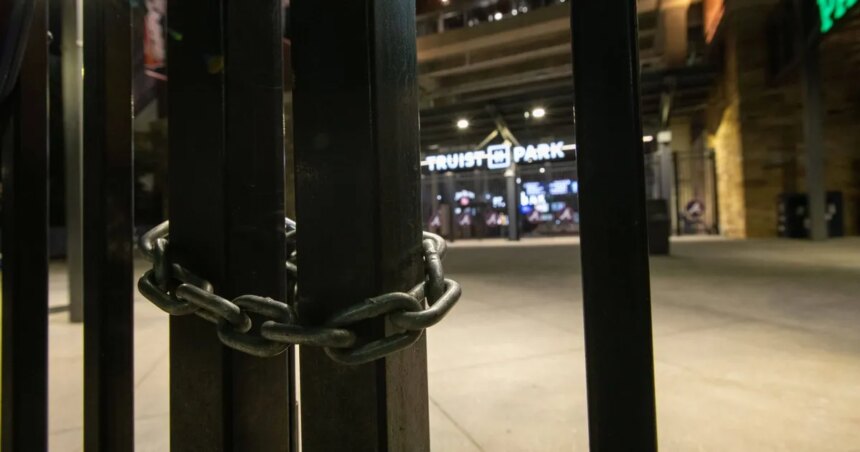
When the Atlanta Braves opened their third-quarter earnings call to questions on Wednesday, the first analyst on the line described Major League Baseball’s impending lockout as “the elephant in the room.”
The Braves said earlier during their presentation that their third-quarter revenue in 2026, $324.6 million, was a record, up 4 percent from the year prior. But as the team’s officials wound through their mostly glowing review, they did not address the expectation that a core part of their business will soon shut down until they were prompted to do so in the 21st minute of the call.
Even then, they didn’t say much.
“The CBA ends on Dec. 1,” Braves chairman Terry McGuirk said. “There have obviously been lots of conversations and discussions between the commissioner’s office and the MLBPA, and in fact, what you allude to, the commissioner made another proposal yesterday of a revised cap and floor and delayed implementation into 2028. Given that these discussions are obviously very fluid and ongoing … I will not be commenting on them.”
MLB indeed made an altered offer to players on Tuesday, but it didn’t move the needle on the other side. The players have repeatedly said they don’t want a salary cap at all, and the sides are steamrolling toward a work stoppage at midnight entering Dec. 2.
Later on the earnings call, another analyst tried to compel Braves officials to discuss labor, asking how the league’s favored cap-and-floor system could change the sport.
“Do you think that this would be a situation where there’d be a lot more parity in terms of which teams get into the postseason?” Barton Crockett of Rosenblatt Securities asked. “Would you expect the dispersion to narrow and the appearances in the postseason to kind of broaden?”
While that’s a seemingly simple question, MLB’s definition of competitive balance — and what a cap would do to change it — is complex. The league is not so much concerned with changing results as it is with a starting point: what teams can spend.
“I’m going to be a little general in the response, and this is tending more towards no comment,” McGuirk said. “But the commissioner (Rob Manfred) has been on the record as saying that he’s seeking competitive balance, and so to whatever end you look at the results of that, that’s where he’s going. … These are truly fluid conversations. It makes little sense to comment along the way while they’re happening.”
McGuirk did briefly reflect on the Braves’ playoff run and the unpredictable nature of postseason baseball.
“We lost to the Dodgers in the Division Series, and our season ended in Game 4,” McGuirk said. “Previously, we swept a three-game series in L.A. ending on Aug. 27, and felt that this divisional series was very winnable. But short playoff series are often decided by a fortunate turn of events, and this was one of those.”
Profit and loss
Braves earnings reports remain a unique source of information for fans and media because all other teams are privately held and are not required to disclose their financial information.
Through the first nine months of 2026, overall revenue for the Braves was up 5 percent to about $701.8 million. Some but not all playoff games the team hosted were included in the quarter.
The team divides its revenue into two main buckets: “baseball” and “mixed-use development,” the latter encompassing the team’s holdings around the ballpark at what’s called The Battery.
Mixed-use development revenue was up 19 percent through the first nine months of this year to about $84 million. Baseball revenue was up 3 percent through the same period to about $617.7 million.
The team’s operating costs also showed a bump, with an 18 percent jump on the baseball side for the first nine months of this year to $553.5 million, and 31 percent on the real-estate side to about $13.1 million.
Overall, the team said its operating income shows a $51.1 million loss for the first nine months, compared with a $36.3 million profit through the same time in 2025.
But a different metric, adjusted operating income before depreciation and amortization, puts the team in the green at $34.8 million during the first three quarters — yet still down from that stretch last year, when adjusted OIBBDA was $104.3 million.
“Baseball operating costs increased primarily due to higher major-league player salaries, BravesVision production expenses, variable concessions and retail operating expenses, and postseason game-operating costs,” Braves chief financial officer Jill Robinson said.
Regional matters
This is the first year of BravesVision, the team’s in-house local media operation. Team president Derek Schiller said the team expects the new venture “will exceed the annualized revenue of our prior local rights arrangement.”
But it remains difficult to compare the new Braves’ TV setup to the previous arrangement with a third-party regional sports network. BravesVision’s TV distribution contracts started in April and run through March of next year, and some payments won’t come in until the second quarter of 2027.
“Our free cash flow has definitely looked different this year than it has in the past, and the biggest change there is the new BravesVision model,” Robinson said. “Under the old local-rights-fee arrangement, we recognized all the revenue by the end of the season and received all the cash by the end of the season. Under our new model, the cash comes in after the revenue is recognized.
“Now that’ll all catch up once we cycle through the 12-month period, but it has had a significant impact on free cash flow this year, resulting in more borrowing.”
Tax man
The Braves are continuing to lobby to change a part of the tax code that could “have an unintended impact on our ability to fully deduct the salary of our highest-paid players,” said Mike Plant, who oversees the Braves’ government relations.
If unaltered, the tax provision known as “162(m)” — which applies to public companies — could cost the team roughly $20 million starting next year.
“Since our last earnings call, a lot has happened,” Plant said. “We continue to have very positive discussions on both sides of the aisle, and really in all branches of the government. A bill was filed — bipartisan bills in both the Senate and the House.
“We continue, through our team’s efforts, to generate additional sponsors for both those bills, and we’re very confident that there is a legislative or regulatory fix, because everyone we talk to continues consistently to say the same thing: This was a total unintended consequence of the bill that was presented in 2021.”