

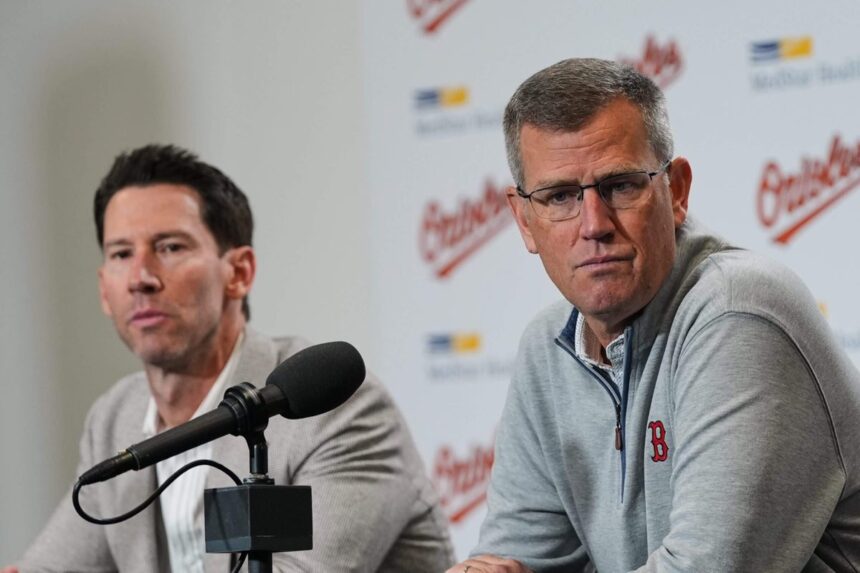
BALTIMORE — At 10:40 a.m. on Sunday, Boston Red Sox chief baseball officer Craig Breslow sat in a checkered suit jacket and collared shirt, occasionally sipping from a water bottle. CEO Sam Kennedy was in a light gray Red Sox pullover, to his left. The Orioles backdrop behind the two men responsible for attempting to deliver an explanation for Saturday night’s seismic firing of Alex Cora and five coaches would have been funny if the situation hadn’t been so dire.
Twice, Breslow sidestepped his own previous comments that in-season moves of this caliber often make things worse.
Twice, Kennedy danced around the whereabouts of his boss, owner John Henry, who was at Camden Yards on Sunday morning and, for whatever reason, didn’t feel like his presence was needed to explain the organization’s most stunning change in years.
“Look, Craig and I have a job to do, and this is our job,” Kennedy said when The Athletic asked whether he thought it was important that Henry speak to the changes.
Sure, Henry — who last spoke at a news conference after the 2020 Mookie Betts trade — doesn’t owe the media anything. But what about the players? Some of them found out about the firings via social media, and many were upset both about the way it went down and that beloved franchise icon Jason Varitek (who will be reassigned) and third-base coach Kyle Hudson — a player favorite — were also included in Saturday’s purge.
Henry, Kennedy was quick to point out, was included in Sunday morning’s team meeting with the players, along with himself, Breslow and interim manager Chad Tracy.
That sounds encouraging until you actually ask the players.
Pitcher Garrett Whitlock mentioned that only Breslow and Tracy spoke. Trevor Story said the explanations weren’t good enough and the franchise’s direction was “up in the air.” Having Henry stand there quietly is about as awkward and tone deaf as it gets.
And what about the fans, who have been riding this rollercoaster of rotating baseball operations heads for a decade, with a 2018 World Series ring, yes, but still far too many downs than ups? Henry’s silence does little to quell the loud chants of “Sell the team,” or the perception that this once-proud franchise has become nothing but another asset in his burgeoning sports portfolio. (Remember when the team’s social media flaunted the team’s luxury tax reset several months after dealing Betts?)
The Red Sox are a mess on the field and an even bigger disaster off of it. Kennedy spoke almost proudly about Cora’s firing being a front-office driven decision, like handing the reins to Breslow — who is in charge for the first time in his life — is enough for him and Henry.
Never mind that this was done a mere 27 games into the season. Or that Breslow said several times he believes the Red Sox’s goal is the same as it was in spring training — to compete for the division — despite ridding themselves of a veteran manager and five coaches, while bringing in a guy with zero MLB experience to steer a clubhouse already panned for its lack of leadership and experience.
“This is a decisive and convicted demonstration of the confidence we have in the team,” Breslow said robotically from his perch, an $18 word salad of a statement that basically put the entirety of the team’s failures on Cora and the coaching staff.
Looking back, there were signs that something was amiss. Cora was 45 minutes late to media availability on Friday and reportedly in an uncharacteristically bad mood. The typical phone call between Breslow and Cora after Friday night’s embarrassing 10-3 loss also didn’t happen, team sources say. Still, to say the longtime manager knew this was coming wouldn’t be accurate.
Cora and his staff, many of whom were making dinner preparations Saturday night, had their worlds flipped upside down. Breslow, who certainly had been thinking about firing Cora earlier this week, told Henry and Kennedy of the decision Saturday morning.
Cora was able to meet with some players in his downtown Baltimore hotel room to say goodbye. There were hugs from staff in the lobby, but no final team speech. Just a quiet slip into a van, on a rainy Saturday night, hours from home in the middle of a series three-plus weeks into the season.
In dismissing Cora, Breslow said he acknowledged to the manager that this roster — the one Breslow himself put together — was a challenge. He had no real answer for why every coach fired was a Cora guy, or that the pitching side — which has also wildly underperformed — with ties to Breslow, stayed pretty much intact.
Still, Breslow maintained he had a good working relationship with Cora and to characterize the stunning April firing as a power struggle would “be unfair.”
Cora took to social media at 4 a.m. Sunday morning with the message, “Happy!” and a smiley face. Certainly doesn’t sound like someone missing their boss. It sounds like someone thrilled to be out of a toxic situation and not upset to be out of Boston’s dugout before May.
Maybe I’m misinterpreting it. After all, it’s just one word.
But it’s one more word than Henry spoke to the media, the fans or the players. The owner’s silence isn’t golden, it’s cowardly and speaks volumes of how one of the sport’s most iconic franchises has become rudderless.