

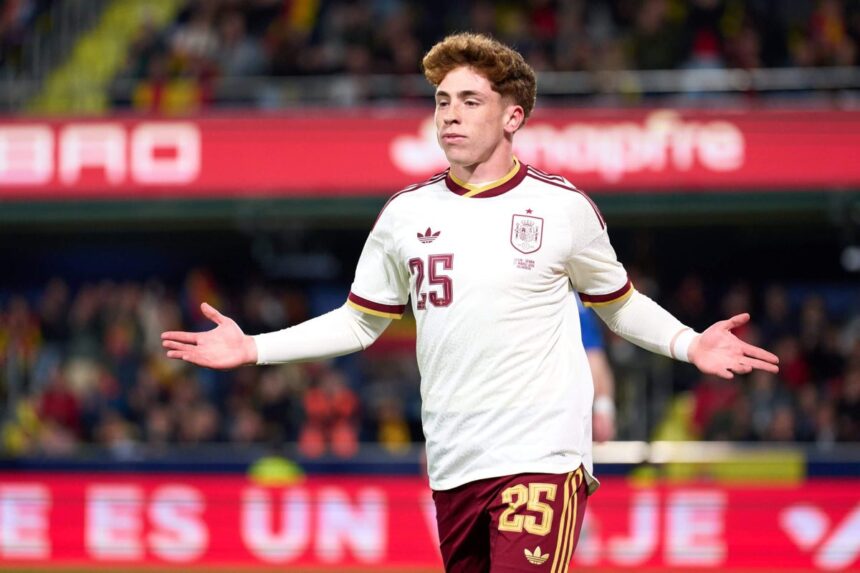
Liverpool confirmed the signing of Osasuna and Spain winger Victor Munoz on Thursday, meeting his €40million release clause and beating Newcastle to his signature.
Real Madrid could have signed the 22-year-old for €8million (£6.9m; $9.2m) this summer — but they chose not to.
Some figures at the Spanish club, particularly within the academy, where Munoz was trained, have been left with mixed feelings. There is a sense of surprise over Madrid deciding against giving Munoz, now at the World Cup with Luis de la Fuente’s side, a chance to show what he can do at the Bernabeu. This is a feeling shared by the player himself.
So why did Madrid turn him down? And how come they had the option to choose?
Informed by conversations with several sources familiar with the case, who all spoke anonymously to protect relationships, The Athletic explains.
Munoz is a graduate of Madrid’s La Fabrica youth academy and the club sold him to Osasuna last July in a €5million deal (including a further €1m with potential add-ons, of which almost all were triggered). That agreement also included several buyback options valid over the first three seasons of the five-year contract he signed.
The first of those options stood at €8million this summer.
When Madrid sold Munoz to Osasuna, he had played just 47 first-team minutes across four appearances, including a debut as an 88th-minute substitute in a 4-3 La Liga defeat at Barcelona in May 2025 — in which Munoz had a great chance to equalise but fired over the bar.
Following criticism he received from Madrid’s fanbase over that miss, he closed the comments section on his Instagram account for a long period.
Munoz’s progress over the following 2025-26 campaign with Osasuna was dazzling, with the winger emerging as one of the breakout stars in Spain’s top flight, making his international debut in March and attracting interest from Barcelona — where he spent three years as a youth player from 2014 to 2017.

Munoz playing in El Clasico for Madrid on May 2025 (Alex Caparros/Getty Images)
Barca’s interest eventually faded, in no small part due to Madrid’s positioning. Madrid would not have been happy for Munoz to end up at their direct rivals, even if Munoz was born and grew up there before arriving at Real Madrid in 2021, just before turning 18.
In theory, if Barca had indicated their intention to trigger Munoz’s release clause, Madrid would have been able to step in and activate their own option instead, as another condition of his sale to Osasuna last year gave them right of first refusal.
There were voices within Madrid who were in favour of his return. They liked the idea of bringing an academy graduate back, and a Spanish player at that, also appreciating his skill set as a pure winger — a role not particularly well represented in the squad.
When some reports in Spain suggested it would happen, the response from all parties to The Athletic was that no final decision had been made and, consequently, no formal communication had taken place.
Munoz himself did have reservations about a return, aware of how difficult it is for academy players to break into and progress in Madrid’s first team. Sources close to the player said that they saw a more stable path to the top at Barcelona than at Madrid.
Madrid were opposed to him joining Barca but following Jose Mourinho’s appointment as manager and internal discussions over squad strengths and recruitment for next season, it became clear they did not see bringing him back as a priority.
Barca were not the only interested party, though. Premier League clubs began to appear and this began to be seen as Munoz’s most likely destination.

Munoz pictured with Spain team-mates Lamine Yamal and Nico Williams (Florencia Tan Jun/Getty Images)
Another factor behind the decision not to re-sign Munoz was financial. Madrid’s deal with Osasuna last year also included a 50 per cent sell-on clause, meaning they would earn €20million if his release clause was met.
Madrid’s board believes receiving a total of around €26million (including his €5million sale with add-ons in 2025) for a player who made just four first-team appearances represents good business.
Munoz can play on either wing and his versatility was admired, but both flanks are considered to be covered by Vinicius Junior, Rodrygo (once he returns from injury), Brahim Diaz, Franco Mastantuono (whom Mourinho likes) and Endrick.
Mourinho wants to try the latter on the wing, where he at times featured for Lyon on loan during the second half of this past season, as well as in the No 9 role. The versatile Bernardo Silva, who has just arrived, is another option out wide.
As other transfer priorities were identified, Madrid closed agreements with Ibrahima Konate and Silva (both free transfers), the €60million deal for Marc Cucurella and are ready to spend €20m on Inter right-back Denzel Dumfries.
Madrid and Mourinho still want to land another centre-back and one more creative midfielder. For this reason, sales such as Munoz’s will be required.
Even still, not everyone sees it that simply, especially in the academy.
While the board celebrates success, some coaches and staff believe it sends a disappointing message to the club’s younger players: even if you do very well, making it into the first team is impossible.