

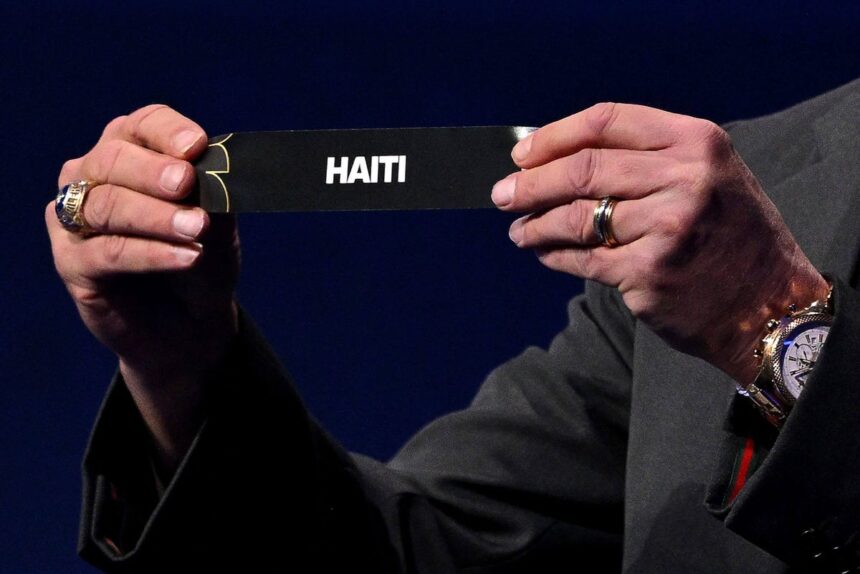
Haiti are looking forward to their first World Cup appearance for 52 years, with games against Brazil, Morocco and Scotland on the horizon. But it is a different story for their fans.
Haiti is the only Western hemisphere country whose supporters are banned from traveling to the U.S., and a significant proportion of those already in the country face an uncertain future.
“Being a Haitian in America right now is pretty frightening,” says Wanda Tima, founder and CEO of two networking platforms: L’Union Suite and the Haitian American. “Everything feels like we’re on a pause. Fear, limbo and a whole lot of uncertainty.”
On Wednesday, approximately 350,000 Haitians in the U.S. will closely monitor a Supreme Court hearing centred on their right to remain in the country.
President Donald Trump ended Temporary Protected Status (TPS) for Haitians after being re-elected, but a Columbia District Court decision issued an 11th-hour reprieve in February. Now, Supreme Court justices will decide the next steps.
Lawyers claim Trump and key members of his administration have openly displayed “disdain for Haitians” and showed a “desire to eject” them from the U.S.. They point to “extreme anti-Haitian invectives (highly critical language)” as “strong evidence” that the cancellation is “motivated by animus (prejudice or ill will).”
Documents submitted prior to the hearing by the Haitian American Lawyers’ Association argue that forcing Haitians to return to “highly dangerous conditions in their country” shows a “disparity in treatment” and continues a “shameful tradition” of “demonising” people from the Caribbean island nation.
Trump claimed Haitians were eating pets in Springfield, Ohio, in a live presidential debate with Democratic candidate Kamala Harris in 2024 before his re-election. He has also used offensive terms to describe the nation. The pet claims — which amplified a baseless online rumour — led to the speech being sampled in songs that received millions of views.
“This stuff is viral for people and then it goes away,” says Tima, who engages with thousands of Haitians on her online platforms. “But they don’t understand, for us it doesn’t go away. It remains a stench on who we are.”
The Springfield Neighbours Union — representing 400 Haitian residents — highlight in court documents that Trump’s speech led to bomb threats and white supremacist groups visiting the local community. They call his words “derogatory” and “dehumanising.”
The impact of the rhetoric — and the uncertainty over immigration status among Haitians — makes it hard for some to get excited about the World Cup.
Tima says “people are afraid to gather in large groups” because “Haitians are petrified of ICE (U.S. Immigration and Customs Enforcement).”
She calls Haiti’s success in reaching the tournament “bittersweet” because “a lot of us won’t be able to celebrate in the way we would like” and the team “won’t be able to feel our presence in the way that we know.”
TPS was initially granted by the Obama administration in 2010 following a devastating earthquake in the capital, Port-au-Prince, which killed approximately 300,000 people and injured the same number. Gang warfare has dominated the country since then and intensified following President Jovenel Moise’s assassination in 2021.
Medecins Sans Frontiers (Doctors Without Borders) — an organization that has worked in Haiti for 35 years — calls it “among the most dangerous places to live in the world”. It says the country has “collapsed into widespread conflict” while “a resurgent cholera epidemic” and recent natural disasters (including another destructive hurricane in October 2025) contribute to “an unprecedented public health crisis”.
Wolverhampton Wanderers and Haiti international Jean-Ricner Bellegarde has never been able to visit relatives in Haiti “because the security is not good.” Since 2021, the team have been in exile, playing the majority of their designated home games in Curacao. “People suffer a long time,” he told The Athletic. “I hope one day it’s peaceful for the country.”
World Cup qualification in November — after beating Nicaragua 2-0 — did have a temporary impact, though. “The war stopped for one or two days,” he said.

Haiti fans in Port-au-Prince celebrate qualifying for the World Cup. (Clarens Siffroy / AFP via Getty Images)
Just over a week later, former secretary of homeland security Kristi Noem — the face of Trump’s immigration crackdown until being removed from post last month — announced that TPS for Haitians would expire on February 3 because “extraordinary and temporary conditions” no longer exist and it is “contrary to the national interest.”
District Judge Ana Reyes — who stayed the decision (effectively putting it on pause) to end TPS, leading to this week’s Supreme Court hearing — was damning of Noem’s reasoning. “There is an old adage among lawyers. If you have the facts on your side, pound the facts. If you have the law on your side, pound the law. If you have neither, pound the table,” she said in her conclusion.
“Secretary Noem, the record to date shows, does not have the facts on her side — or at least has ignored them. Does not have the law on her side — or at least has ignored it. Having neither and bringing the adage into the 21st century, she pounds X (formerly known as Twitter).”
The Department for Homeland Security (DHS) responded on the social media platform. “Supreme Court, here we come. This is lawless activism that we will be vindicated on,” said DHS spokesperson Tricia McLaughlin. “Temporary means temporary and the final word will not be from an activist judge legislating from the bench.”
In Supreme Court filings, lawyers representing the government highlight their frustrations over “stop-and-start litigation over TPS terminations” that they say “has become endemic.”
Haiti — who last appeared at a World Cup in 1974 — play their opener in this year’s tournament on June 13 against Scotland, and it is unclear whether the Supreme Court will have adjudicated by then. Even if it does, the matter may remain snarled up in further court proceedings.
Haitian American Ruthzee Louijeune is a city councillor in Boston, where the first game will take place, but she says a “political dampener” and “cloud” hangs over “an important moment for the country, diaspora and sports in general.”
Working on local World Cup events — and holding discussions with the Haitian Embassy in the U.S. — she notes fans’ concerns over travel due to “xenophobic immigration policies” that are “hurting the economy” and says the chance for an “economic boom” has been missed.
She is hoping “work on a diplomatic level” — potentially involving FIFA president Gianni Infantino speaking with Trump — can allow more Haitians to be able to get to games, and feel safe in doing so. But as with so many aspects of life for Haitians in the U.S. at the moment, uncertainty remains.