


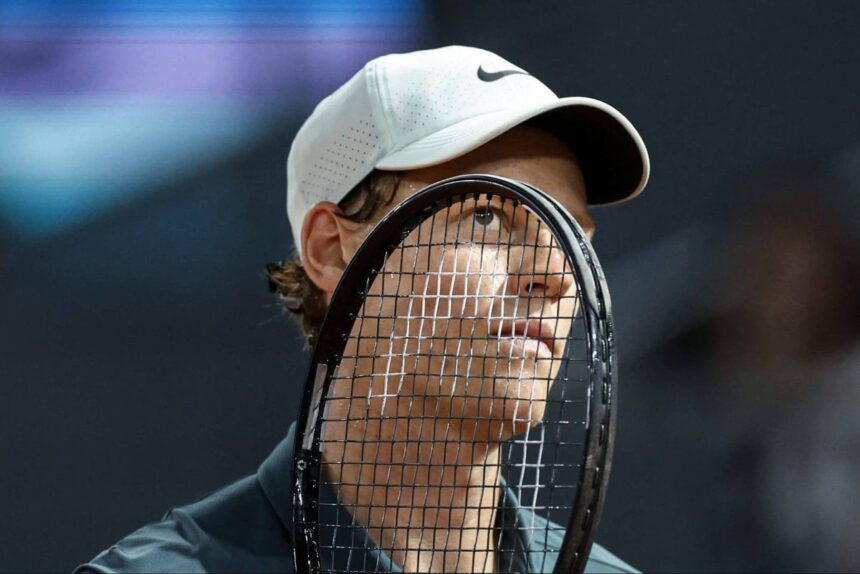
MADRID — As in so many other chapters of the modern tennis record books, the standard-bearer for win streaks is a familiar one: Martina Navratilova.
In 1984, Navratilova won 74 consecutive matches. Hana Mandlíková beat her at the Virginia Slims of California Oakland tournament in January. No one else did until that November, when Helena Suková upset her from a set down in the semifinals of the Australian Open.
No man has cracked 50 consecutive wins. Björn Borg holds the tour record, with 49 wins in 1978. Novak Djokovic was the last man to pass 40, reaching 43 in 2011. He and Roger Federer are the only men to reach that mark in the past 40 years.
Men’s world No. 1 Jannik Sinner, who is on 21, likely won’t come close to touching Navratilova’s record. Borg’s also seems like a serious stretch, however dominant Sinner may appear at the moment.
Sinner, who is 27-2 this season, hasn’t lost since February. He hit 21 consecutive wins Wednesday with a 6-2, 7-6(0) triumph over Rafael Jódar, the 19-year-old Spaniard. It was far more stressful than the score might suggest.
Jódar, a Madrileño who turned this tournament into his living room this past week, forced Sinner to endure a sweaty late afternoon in Manolo Santana Stadium, where the closed roof made for dank air that had Sinner soaking his shirt. He likely hasn’t sweated that much since he won the Miami Open. The Spaniard, who has become a main character just when his country desperately needed one to salve the pain of Carlos Alcaraz’s wrist injury, which has ruled him out of clay season, made his opponent work.
Sinner responded by mixing drop shots with strokes that cleared the net by just under three feet before diving into the last inches of the court, to survive an arsenal that can suddenly pelt and smother opponents.
“What a player,” Sinner scrawled on the camera lens when it was over.
He narrowly avoided the prospect of a decider, climbing out of a 15-40 hole at 3-4 in the second set with a combination of majestic defense, an absurd backhand crosscourt pass, and a little help from Jódar, who went for broke when he needed to be patient and was too patient when he needed to go for broke.
“All his shots are really complete,” Jódar said of Sinner in his news conference. “That’s what makes him different.”
And just when Jódar thought he might still have a chance to take things to a third set, Sinner switched his return position, moving closer to the baseline around 5-5. When they got to a tiebreak, and when Jódar had to hit second serves, Sinner jumped across the baseline to go on the attack from the first ball, just as Jódar had been doing to people all week. The result was a whitewash.
It was no accident. Sinner said he desperately wanted to avoid a third set, because the match “was getting more physical.” Doing so preserved something even more remarkable than the 21-match streak. In that time, Sinner has only lost two sets, mostly delivering wins of such efficiency that they call into question one of the central truths of the sport.
Winning tennis match after tennis match to compile a streak is really hard, even for the world No. 1. Sinner is under no illusions about the difficulty.
“Before the match I was the favorite, but you need to handle the pressure,” he said in his news conference. “I felt a bit of tension.”
Aryna Sabalenka, the women’s world No. 1, showed plenty of that tension Tuesday night. Going into her quarterfinal against the talented and fast-improving Hailey Baptiste of the U.S., she had won 15 consecutive matches across three tournaments. She was 26-1 on the season, with her only loss coming against Elena Rybakina in the Australian Open final.
The hard, dry clay and high altitude in Madrid suit her power game perfectly. She held six match points against Baptiste, but Baptiste took most of them from her, serve-and-volleying with the bravery and conviction required to make Sabalenka even the slightest bit uncomfortable.
On the last of the six, Sabalenka had an open backhand down the line for a 16th consecutive win, but missed it by inches. Two points later, Baptiste smacked a crosscourt forehand winner onto the line and Sabalenka’s streak was over, 22 wins short of Iga Świątek’s tour record for this century of 37.
“I was just trying to find a way in this match,” Sabalenka said as she cradled her puppy, Ashe, for comfort in a news conference. “It didn’t work today.”
It had for Sinner earlier that day, though he too has tried not too think too much about winning one tennis match after another for more than two months.
“You have one opponent every day, and you just try to have the best, the better day than your opponent. Different conditions, depending also the time slots you play. Different opponent,” he said in a news conference after beating Cameron Norrie 6-2, 7-5 in the round of 16.
“Today it was a lefty, so you have to change a couple of things.”
Norrie knew what was coming at him before he stepped onto the court. He tried to play the ball, not the reputation or the winning streak. It wasn’t terrible, but he ended up where Sinner’s past 21 opponents have — on the losing side.
“I gave him a little bit too much, too many free points, and he gave me nothing back, so that was quite tricky,” Norrie said in an interview afterward. “He pushes you to play the perfect shot.”
Sinner often doesn’t appear to be pushing all that hard, even though he almost always is. When Jódar dialed in for the second set Wednesday, staying in rallies and extending points instead of resorting to the exuberant firepower of youth, Sinner accepted the invitation for a battle of consistency. He made just one unforced error on his backhand all afternoon.
The match was still something of an aberration in another way. Sinner is often off the court after roughly 90 minutes, and on many days, the outcome appears certain very soon after the start.
On Tuesday, he broke Norrie twice in his first three service games. He had a brief hiccup in the second set, coughing up a a lead at 3-2. Norrie did well to stay even until 5-5 and looked like he was going to force a tiebreak.
But all Sinner needs these days is the slightest of openings. A few rushed groundstrokes. A missed first serve. Then he gets a backhand return deep into the corner he’s been aiming at and missing for several games. And the error comes, and it’s all over a few minutes later, as though he’s pushing at an open door.
Winning so much does have a down side. He has played a lot of tennis the past two months, he said, and he’s getting tired. That’s little consolation for the rest of the tour. To them, his efficiency has become mind-bending. Few can imagine what winning that many consecutive matches feels like.
“For me, for now, it’s not possible,” Arthur Fils, who picked up a a career-high ninth consecutive win on Wednesday by beating Jiří Lehečka in straight sets, said during an interview after his eighth, over Tomás Martín Etcheverry.
“Maybe one day I will get it, but for now, no.”
It’s rarely possible for anyone, even players who end up being among the best in the world. Fils doesn’t think he has ever won 10 consecutive matches, even as a junior, and he will have to break Sinner’s own streak in their semifinal Friday to do it.
On the ATP Challenger, WTA 125 and World Tennis tours, the second and third rungs of the sport, an absurd win streak is one of the more reliable measures of sustainable success at the top level. But repeating that kind of form there means breathing some of the most rarefied air in tennis.
Mirra Andreeva, who beat Leylah Fernandez Tuesday to make her first Madrid Open semifinal, against Baptiste, said she remembers the best streak of her tennis life very easily. It was last year, when she won back-to-back WTA 1000s, at the Dubai Tennis Championships and BNP Paribas Open at Indian Wells. She then got her winning run up to 13, before losing to Amanda Anisimova at the Miami Open.
The memory of that hot run has become a double-edged sword. How good she was during that stretch, the confidence she had and how she played aggressively through every match can be a little haunting. Eventually, she felt the pressure of the success.
“A little bit of expectations as well, and then you’re not so confident in your game anymore,” Andreeva said in a news conference. “It takes time to feel that again and takes time to feel confident in your game and yourself.”
“Let the past stay in the past,” she said. “Try to just not bring that back, but to create something new.”
That, of course, is the great challenge in the life of a professional tennis player. Every week brings another tournament. In the middle of a tournament, every win produces the challenge of doing it again.
Just under two weeks ago at the Stuttgart Tennis Grand Prix in Germany, Leylah Fernandez was in tears as she walked with her father to her hotel after edging Zeynep Sönmez in a third-set tiebreak. Her father tried to calm her down with the coin-flip metaphor. She fought and ended up on top.
The next night she had match points against Elena Rybakina before losing a third-set tiebreak, which made winning matches this week feel as hard as it ever has.
“Now you have all these thoughts running through your head,” she said in a mixed zone after losing to Andreeva. “I got to do this to win this match. I don’t want to choke like I did last time. You kind of think of all these things and when you get through that finish line there’s a little bit of a sigh of relief and then there’s that confidence like yeah, I did that, so let’s move on to the next match.”
For Stefanos Tsitsipas, who has been to Grand Slam finals and felt some of the highest highs tennis can bring, just winning three matches in Madrid has been something of a gift. He couldn’t make it four, losing to defending champion Casper Ruud Tuesday, also in a third-set tiebreak.
On Monday, after beating Naomi Osaka to set up the match with Baptiste, Sabalenka claimed not to know her streak, though she figured she could count them pretty quickly if she wanted to. Still, she declined. Better, she said, to focus on playing good matches. Hopefully the results will flow from that — and her hatred of the alternative.
“You never forget that feeling,” she said of losing. “This is the worst feeling for an athlete.”
She looked like she was headed for a quick night at the office Tuesday after blazing through the first set 6-2. But then Baptiste, who plays a smooth all-court game with a dangerous mix of power and spin, caught fire in the second set. Her slice backhand and power forehand confounded Sabalenka, putting her head on a swivel as balls kept flying past her.
If it were basketball or soccer or football, Sabalenka could have held a lead and run out the clock. In tennis, unless the opponent lends a hand, every winner needs one more shot. She swore the pressure to keep winning had not gotten to her.
“I was just playing tennis,” she said.
It’s not easy. Sinner just makes it look that way.