

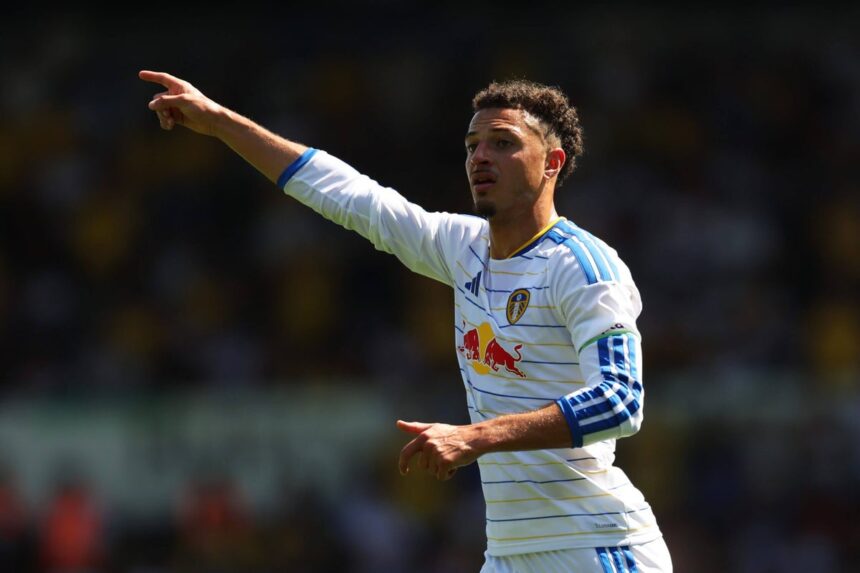
Within two weeks of last season ending, Leeds United secured arguably their most important business of this summer’s window. Ethan Ampadu, the team’s 25-year-old captain, had a year remaining on his contract and a hugely impressive season under his belt in the Premier League.
His future could easily have become a saga. Except Ampadu was clear-minded. “Everyone could always get to a point where they might have some interest,” Ampadu tells The Athletic. “But I wanted to renew here. I am very excited about where this club could go. I was focused on that rather than taking an interest in what else was out there.”
Ampadu was the first Leeds signing under Daniel Farke in the summer of 2023, now appearing a relative snip at £7million ($9.5m). Yet at the time, he was searching for direction and continuity. Ampadu signed for Chelsea from Exeter City in 2017, joining at the age of 16, but made only 12 appearances and had mixed experiences during loan spells at Sheffield United, RB Leipzig, Venezia and Spezia.
By the age of 22, he had played in the Premier League, Bundesliga and Serie A, as well as having made 44 appearances for Wales, including appearances at Euro 2020 and the World Cup in 2022.
Leeds, he says, is the club that finally feels “like a home”. His contract discussions included conversations not only with manager Farke but also with chairman Paraag Marathe at the top of the club.
“It was never a forced conversation. It’s always quite an open dialogue. I know how the manager feels, how the owners feel. I like to think they know my vision as well and it’s all pretty aligned. When you make a big decision, you have to weigh up everything. But it was a good, healthy conversation.”

Daniel Farke trusts Ethan Ampadu to be his leader on the pitch (Matt McNulty/Getty Images)
Ampadu continues: “I’ve found somewhere and settled. I’ve played my best football but I’m hopeful the next four or five years are going to be better than the previous three years. The owners and investors are pushing really hard to take the club back to the heights of European football.
“There’s a lot of work in progress and we still have so much more potential to give. Then we’ve also got a fanbase that wants to do that, so collectively it’s a really big thing.”
Last season, Leeds finished 14th but never appeared in danger of relegation during the closing months of the campaign. The team’s form picked up spectacularly from December onwards, losing only five of their final 25 Premier League matches.
Ampadu’s tenacity in the tackle, composure on the ball and his long throw — an emerging weapon — all contributed to the team’s strong showings. A particularly significant 4-1 win over Crystal Palace in December was helped by two goals from long throw-ins and during pre-season, Leeds scored two more against Liverpool in Chicago from Ampadu’s long throws.
Tarik Muharemovic, the new Bosnian defender, then scored an overhead kick from an Ampadu long throw in a 4-0 win over Augsburg as Leeds completed pre-season on Saturday.
Only Brentford’s Michael Kayode (164) sent more long throws into the penalty area than Ampadu (135) last season, but Brenden Aaronson believes his captain is looking even more dangerous. The American midfielder told The Athletic in Chicago: “Ethan came back and started throwing it about 20 yards further and 20 yards harder; it’s incredible.”

Ampadu’s long throws became one of Leeds’ most effective weapons last season (Stu Forster/Getty Images)
Ampadu says it started by accident.
“In my career, I had once taken a long throw, and it really wasn’t that far. So I didn’t even know I had a long throw. Then there were times in the Championship with Leeds where I was playing centre-back, and maybe (full-back) Junior Firpo had a bad finger, so he couldn’t take a throw. I would take a throw down the line and it was decent. But it was never like we were going to work on this to attack in the box.
“Then we came to the Premier League, where set pieces have become crucial. We were doing it one day in training and everyone looked and said, ‘Oh, that’s not too bad’. I got a bit of stick at the start of last season for having the shortest long throw. But it was getting better and better, just through repetition.”
He says there has been no specific technique training. “It is just natural and the best thing to do is not ever think about it and just throw as far as you can. I could always throw a tennis ball quite far as a child. I’m not Rory Delap, and I would not say I am a throw-in specialist but we’ve got a few goals and it’s a big part of football.”
He grins: “There’s something fun though about going to take a throw-in at an away stadium and hearing the stick. I probably seem to smile a lot when I go over. It is just a good bit of banter with the opposition fans.”
Leeds scored five goals from long throws in the Premier League last season, eclipsed only by Brentford’s six — but they are not the only team to prioritise set pieces. Arsenal are at the forefront of the trend, so what makes the league champions’ free kicks and corners so difficult to defend?
“Their routines, their desire to win the ball, their delivery. They obviously created fear. Whenever they had a corner, it got to the point where their fans were celebrating like it was a goal. I don’t think it (brought fear) to us because we want to make sure we defend the box as well as we can, but maybe that’s another reason why they could score so many goals (from those situations).”
Does Ampadu expect the set-piece obsession to be as strong this season?
“You have to prepare for it to be as important because if you don’t prepare, then you’re behind.”
In open play, Leeds are also seeking to make strides. Last season, Leeds struggled for results early on, with a change of system to a back three appearing to suddenly ignite their campaign in November away at Manchester City. Two goals down at half-time, Farke changed the formation and Leeds recovered to 2-2, before eventually losing in injury time.
Ampadu says there are “always going to be some speeches and some truths” said at half-time in that situation, but he says the system change, combined with a collective refocusing, gave the squad renewed confidence. Leeds lost two of their subsequent 14 Premier League games.
“We really showed how together we were,” Ampadu says. “We were willing to work day in, day out to make Leeds the best possible club it can be.”
Even at 25, Marathe describes Ampadu as the “father” of the group, setting standards every day at the training complex. Ampadu says the team, carefully recruited to meet the physical and psychological demands of the Premier League, is “tight-knit”. This Leeds group under Farke has had its challenges, most notably when losing the play-off final against Southampton at the end of the 2023-24 Championship season, a day Ampadu describes as “one of the worst days I’ve had in football”.
That team has since been built upon, largely with physically imposing and robust characters including Jaka Bijol, Anton Stach and Dominic Calvert-Lewin. This summer, Leeds moved quickly to nab Harry Wilson on a free from Fulham and have spent big on James Trafford in goal and Muharemovic from Sassuolo.
“It is just great guys who are willing to work hard for each other,” Ampadu says. “It helps when you’re in a place that allows me or other people to find that home, because I think that’s when you can play your best football. It is not stress-free but a place where you can feel comfortable in the environment to then play your best football.”

Ampadu helps set the tone for a combative Leeds team (Charles McQuillan/Getty Images)
Ampadu has played various roles across defence and midfield in his career, but he is now sufficiently comfortable in his own skin to say he belongs as a holding midfielder.
“I’ve still got a lot (of room for) growth when comparing myself to other Premier League midfielders but it’s one thing that I want to do,” Ampadu says. “I want to take everything I can out of my career. They are different profiles but I look at a lot of (videos) of Rodri, a lot of Sergio Busquets, the way they control the game. Declan Rice has got a lot of quality in his power. His strength dominates midfield. I look at a combination of a few players and pick out what’s good and what gets me to be the most complete player that I can be.”
What makes Rodri so difficult to play against? “Composure, timings, his retention of the ball, the space he picks up, his work off the ball, his tenacity, his aggression. Everyone saw that again at the World Cup.”
Leeds’ resilience and organisation proved crucial last season but their German coach Farke aspires to more dominant displays. Ampadu says the coach “wants to take control of games”.
“But he is adaptable. He wants to win by being controlled, by being aggressive, by playing with intensity. He’s been obviously massive for me. I’m very grateful for the trust he’s put me in, even when I’ve maybe not had so many good games.”
What are Leeds looking to be better at this season? “Everything!” Ampadu says. “We did well last year, how compact we were in a lot of games, but then there are some weaknesses that we can do better.”
What are the weaknesses?
“I can’t say because then people are going to focus on it!” he says, laughing. “You want to dominate games more; we want to put our stamp on games. It is the overall package of what we believe we can do. One thing that a Leeds United squad can never lose is that hunger, that desire to play for the badge, to play for the fans, to make sure that you go into every duel wanting to win.
“You give 100 per cent every single game to the very last. That never-die attitude, the fans resonate with it; it’s very important for the DNA of Leeds.
“The minimum is understanding that the second year in the Premier League can be as hard as the first year, so first, we need to make sure that we stay up. Then we want to push on from where we finished last year. We feel like we can.
“We felt like there were results last year where if we had just done maybe a one or two per cent better, then we could have picked up more results. You never know where it could take you.”