

What do you give a tennis star who has done everything in their discipline? In the case of the U.S. Open mixed doubles, it’s a qualifying entry.
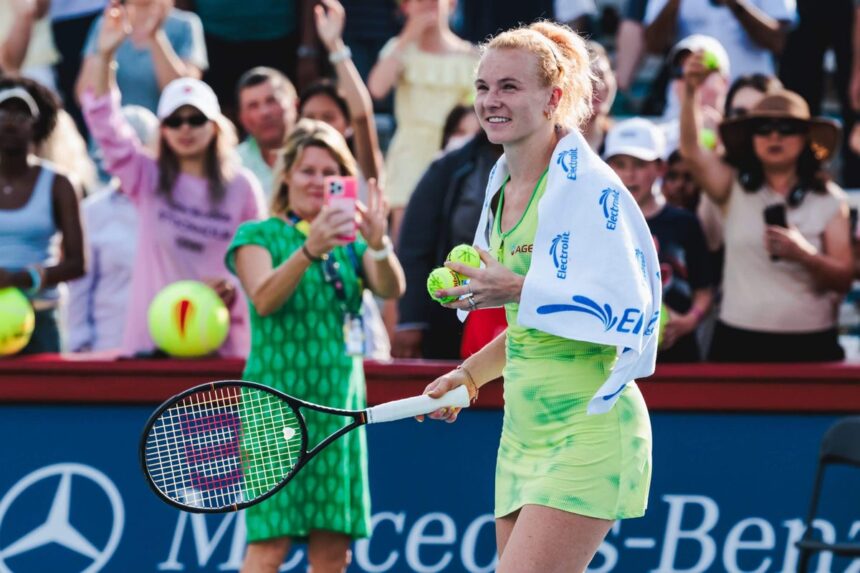
At the second edition of the yassified event, which was redesigned to focus on singles stars in 2025, women’s doubles world No. 1 Kateřina Siniaková was asked on court how she stays motivated when she has done it all.
The 11-time women’s doubles champion, who has spent 180 weeks at world No. 1 and who won Olympic gold in mixed doubles at the 2024 Paris Olympic Games, said she “still needs to do more.
“Because I’m still playing qualies,” the 30-year-old Czech said.
Tuesday afternoon in the main draw, Siniaková and her partner, Henry Patten, the joint men’s doubles world No. 1, will face women’s singles world No. 1 Aryna Sabalenka and 24-time Grand Slam singles champion champion Novak Djokovic. For the tournament, the matchup is both perfection and peril. Mixed doubles showcases one of tennis’ greatest strengths — seeing the best athletes in the world share a court — but this version of it also pits the masters of a discipline against the biggest stars of a sport.
It’s the masters, who had to qualify for the event that they dominate, who will start as favorites. The draw has turned out such that the semifinals could be composed entirely of doubles pairs, which would represent a vindication of singles vs. doubles as a compelling matchup, but would also undercut the U.S. Open’s overarching vision for the event that it reconfigured to platform singles stars.
Why the best singles players lose at doubles
Matthew Futterman
At last year’s inaugural edition, Italy’s Andrea Vavassori and Sara Errani were defending champions, having won the traditional title, which featured 32 doubles teams and was played during the singles main draws, in 2024.
They needed a wild card to enter the new star-spangled version, and slammed the changes to the event in early 2025.
“In the last few weeks we received the news that the U.S. Open mixed doubles tournament will be completely turned upside down, cancelled and replaced with a pseudo-exhibition focused only on entertainment and show,” they wrote in a joint statement on Instagram, describing the decision as a “profound injustice.”
In a statement sent to The Athletic at the time, a USTA spokesperson said: “We acknowledge that change is difficult, however overall we believe this reimagined Mixed Doubles Championship will elevate mixed doubles with a bigger spotlight.” In an interview, then-chief executive Lew Sherr said that the event was not an exhibition.
Come August, Errani and Vavassori ran the table, taking home the title and $1 million in prize money (5x more than they won in 2024) by beating pairs composed of top singles players with ease. Only Iga Świątek and Casper Ruud offered meaningful resistance in the final.
Come 2026, Errani and Vavassori once again needed a wild card to enter the main draw. Siniaková and Patten, along with a clutch of other top doubles teams, had to come through qualifying, because main-draw entries were allocated by combined singles ranking.

Andrea Vavassori (left) and Sara Errani (right) won the mixed doubles event in 2025, retaining their title. (Timothy A. Clary / AFP via Getty Images)
The two pairs are joined by Kristina Mladenovic of France and Marcelo Arévalo of El Salvador, and Erin Routliffe of New Zealand and Lloyd Glasspool of Great Britain. Routliffe and Glasspool will face wild-card pair Carlos Alcaraz and Serena Williams, while Errani and Vavassori will take on Mirra Andreeva and Andrey Rublev.
Taylor Townsend, who regularly partners Siniaková in women’s doubles, is playing with Alexander Zverev. They received a direct entry into the main draw, and will face Belinda Bencic and Flavio Cobolli — who won the BNP Paribas Open at Indian Wells mixed doubles title this year, defeating Errani and Vavassori along the way.
The hybrid pairs — Townsend has three Grand Slam doubles titles, all with Siniaková, while Williams won 14 with Venus — might be as compelling to watch as the pure singles vs. doubles matchups. Sabalenka has two Grand Slam doubles titles too, even reaching world No. 1 in February 2021, but she has not played a doubles major since that year.
As Alcaraz found out the hard way at the Paris Olympics, being two of the best singles players in recent history doesn’t always mean much. He and Rafael Nadal were taken apart by Austin Krajicek and Rajeev Ram, who used precise serving, honed patterns and mastery of the geometry of the doubles court to dismantle “Nadalcaraz”.
“We’re not doubles players,” said Alcaraz in a news conference. “If you hesitate a little bit, it’s not easy. We’ve only played together a few times, and it made a difference.”
Nadal and Alcaraz ultimately felt the feeling that they have inflicted on countless opponents: That the people on the other side of the net were playing a different sport. At last year’s U.S. Open, Errani and Vavassori did the same to Taylor Fritz and Elena Rybakina; Karolína Muchová and Andrey Rublev and Danielle Collins and Christian Harrison. Though Świątek and Ruud pushed them to a match tiebreak, it was Errani and Vavassori’s pattern recognition and execution that won the day.
Siniaková’s partner Patten, 30, has recently been outspoken about doubles himself. After winning the Wimbledon men’s title with Finland’s Harri Heliövaara, Patten said in his on-court interview that tennis “should be growing the sport rather than taking opportunities away.”
His words came after ATP Tour proposals to cut draws on the tour in half and to redistribute prize money from doubles to singles. In a statement, the ATP Tour said: “We are assessing the doubles product, draw sizes and player compensation distribution with the aim of creating a more sustainable long-term model while maintaining doubles’ important role on the Tour.” The changes would not impact doubles at Grand Slams.
For both Patten and Siniaková, the chance to face Sabalenka and Djokovic is a chance to show what doubles is really about. Siniaková, who is also a top-40 singles player, is not a fixture at mixed-doubles majors: She has played eight of 15 between 2024 and 2026 to date. She was in line to play last year’s U.S. Open with Jannik Sinner, but the Italian had to withdraw due to illness and Siniaková could not re-pair.
The U.S. Open’s mixed event has indisputably put the discipline under a far brighter spotlight than it previously enjoyed, and the absence of doubles’ biggest women’s star from so many mixed events might be used as proof of that. So too the buzz around the event last year and this, with first-round matches in 2025 attracting large and engrossed crowds.
“It’s important to show also that doubles players are great players,” Vavassori said after making the semifinals last year.
Come Tuesday, he and Errani and Siniaková and Patten will again have the opportunity to let their rackets do the talking.