


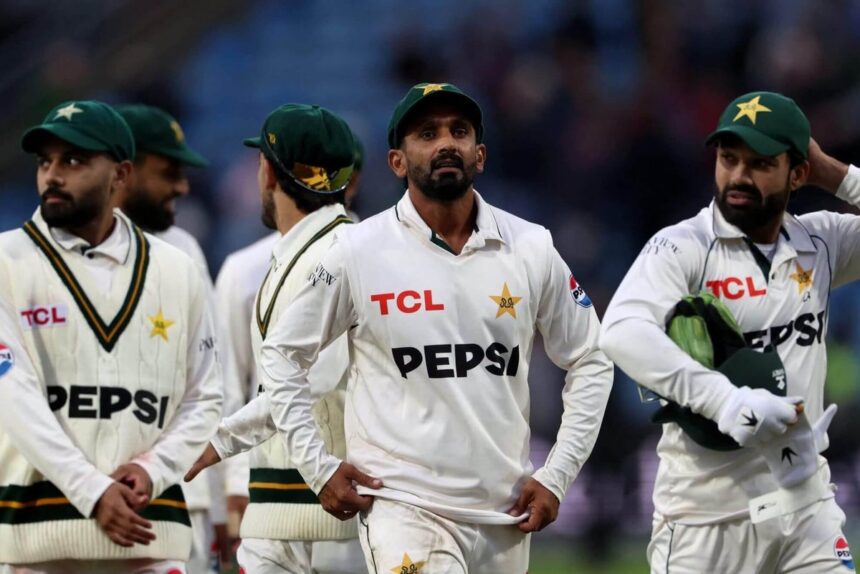
It might seem a distant memory, but the last time Pakistan played a Test match at Lord’s, they won.
Back in 2018, captained by current head coach Sarfaraz Ahmed and spearheaded by current attack leader Mohammad Abbas, Pakistan ran out winners by nine wickets, crushing a Joe Root-led England who were still licking their wounds after a disastrous Ashes tour. Much changes, much stays the same.
Since then, however, touring has not been a joyful experience for Pakistan. In the eight years following that win, they have played 17 Tests in ‘SENA’ countries (South Africa, England, New Zealand, Australia) without registering a single victory. Alongside that, they only managed two draws, both rain-affected contests in England during the pandemic, on surfaces prepared under the most unique of circumstances.
The most recent of these defeats, last week’s innings-loss at Headingley, took place in rather different conditions.
Ball was always going to dominate bat in Leeds, and line-ups far more equipped than either on show would have struggled. England may have come out victorious, but their batters still played a false shot — an edge, or a play and miss — to 21 per cent of the deliveries they faced, a figure much higher than the average for Test cricket.
The issue for Pakistan was that their batters managed a figure of 32 per cent. A batting side was, essentially, not in control of their shots against a smidgen under a third of the balls they faced. It’s the highest false shot percentage Pakistan’s batters have recorded in a Test match since Opta first began collecting the data in 2006; there are only 11 instances, among the near 2000 Test matches that have occurred in that time, where a side has recorded a worse false shot percentage. Truly dire.
So in response to the last week, but also the last eight years, how can Pakistan turn this around?
For one, hold your nerve with the bowling selection. CricViz’s Expected Wickets model uses ball-tracking data to calculate how deliveries “should” have performed, if you disregard the batter’s performance. For Pakistan at Leeds, their bowlers’ xAverage was 27; for the England attack it was 26.
On the one hand, this is somehow worse for Pakistan than first felt, collapsing twice against bowling that was simply solid, rather than exceptional.
However, those numbers suggest that, despite what the eye may have told us about some underwhelming bowling from the visitors, they constructed some sort of threat, one largely focused on the spinner Ali Usman on an increasingly turning surface. If they hadn’t batted so appallingly at Headingley, and had held their catches, then Pakistan would have been in with a fight.
Ubaid Shah, 20, is a highly exciting fast bowler but this is unlikely to be the week to blood him in England on a Lord’s surface which has excessively rewarded accuracy. Trust those underlying numbers from Headingley, and do not panic.

Ali Usman carried a threat for Pakistan (Darren Staples/AFP via Getty Images)
Batting selection is also a red herring.
Fans always call to pick domestic performers in international cricket, but Pakistan already have. Barring the odd name, the lads in this squad are the lads who have been scoring runs and taking wickets in domestic cricket, and with decent effect. Saud Shakeel averages 42 in Tests. Abdullah Shafique averages 41. Mohammad Rizwan averages just a tick under 40, the same as his opposite number Jamie Smith.
All being well, Babar Azam will return to the side this week, bringing with him an average in the mid-60s in Tests in England.
Nobody is claiming this is a vintage batting order, but there is enough quality to compete. To pretend otherwise, to act as if survival in these conditions is simply beyond this group, underrates them but is fundamentally far too kind to them. It removes their agency. If they collapse twice like they did at Headingley, it’s because they have underperformed.

Babar Azam should return to the Pakistan lineup at Lord’s (Randy Brooks/AFP via Getty Images)
On technical matters, the bedrock of red-ball cricket is defence against good lengths. Since the start of 2024, when defending good length deliveries from seamers, Pakistan’s batters are out every 36 balls they face. Among those teams to play a sizeable number of Tests in that time, only Australia perform worse. Pakistan are not good at defending length.
From the perspective of Sarfaraz and his coaching staff, when you are bad at something, you have two choices: do it better, or do it less.
If they want to do it better, then there are technical lessons for these conditions. During a Sky Cricket masterclass from a few years ago, Kumar Sangakkara reflected on some fundamentals for when the ball is moving. Contrary to the classic wisdom around ‘playing straight’, the Sri Lankan great actually encouraged batters visiting England to “avoid playing straight lines … When there is swing, if you’re trying to hit back straight, you’re actually hitting across the line.”
Pakistan did not follow this more subtle template.
At Headingley, 30 per cent of Pakistan’s boundary runs came down the ground in the straight ‘V’ behind the bowler. When New Zealand beat England 2-1 earlier this summer, that figure was 14 per cent. When India toured in 2025 and drew the series, it was 19 per cent. Pakistan played far straighter than the teams who have had success in the last 12 months, and the results spoke for themselves.
Pakistan’s boundaries against pace at Leeds

There were some tasty on-drives struck at Headingley, several of them from the bat of Abdullah Shafique. You would be a miser to deprive Pakistan fans those moments of optimistic style, but they may be cautionary rather than visionary. Shan Masood’s first-innings dismissal is a prime example of how the “play straight” truism can scupper you when lateral movement abounds, per Sangakkara.
So, if they are unbothered by defending better, then at least defend less. England’s batters attacked around 23 per cent of good-length deliveries bowled to them in the opening Test; for Pakistan, it was 10 per cent. The state of the game contributed, the tourists struggling, but they were stuck doing something they are bad at: attempting to survive, defending length.
Lord’s has been by some distance the worst pitch in England and Wales, and with that fall in batting returns comes a sense of lottery: the shorter the game, the narrower the gap between the two teams. For Pakistan, an attempt to hit England’s attack off their length on a venue where said length is the absolute key would be a pragmatic response to the mire in which they find themselves.
Play squarer, with greater proactivity, and Pakistan may find the dice fall in their favour.
Data and visualisations from CricViz