

FAYETTEVILLE, Ga. — An emotional Mauricio Pochettino said Friday that leaving the U.S. men’s national team for Manchester United was “one of the most difficult” decisions of his career.
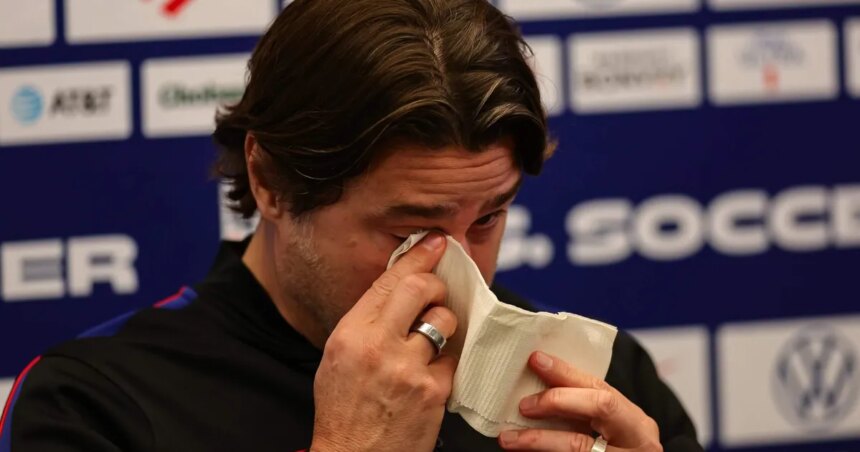
At a news conference here at U.S. Soccer’s National Training Center, sitting between federation CEO JT Batson and president Cindy Parlow Cone, with staff filling the back of the room, Pochettino choked up, eventually wiped away tears with a tissue, and later hugged both Batson and Cone, as he addressed his decision to jump back to England just three months into his second USMNT contract.
“I want to say thank you, thank you, thank you so much … for the last two years,” Pochettino said. “You made me feel really well, really happy doing my job, sharing an amazing project, being part of this family.”
After a whirlwind week of negotiations, U.S. Soccer and Manchester United both announced Friday that Pochettino will leave the States next week to take charge of the Premier League club.
His last two U.S. games will be the two Concacaf Nations League quarterfinal legs on Saturday and Tuesday against Haiti. He’ll then fly to Manchester ahead of United’s trip to Liverpool on Sunday, Nov. 22.
Pochettino said he first heard about the possibility of the Manchester United job on Sunday, and that he informed the staff and team of his departure on Thursday in a team meeting after the agreement was finalized.
“We were very transparent,” Pochettino said. “The first thing (is) that we were talking with JT and the federation, and of course, yesterday when the (agreements) were positive in that way, we have a meeting and I communicated to the players and the whole staff. I want to say thank you, because they were very supportive and they really understand the situation. And they know us, how committed we are to the next two games.”
An awkward week for U.S. Soccer, Pochettino and Man Utd
Henry Bushnell
Pochettino will leave just three months after signing a new four-year contract with U.S. Soccer through the 2030 World Cup. Soon after he did, on a Zoom call, he told The Athletic and a small group of other reporters: “Every time we sign a contract, it’s to go to the last day of the contract. If we sign a four-year contract, we need to think to arrive there. And we signed the contract because we really believe that we are going to be (here) four years.
“Because if not, it’s bad. If we don’t believe in that process, if we don’t believe in that journey, why we sign four years? Only to be sure that we are going to receive a salary on the end of the month? That is not nice. It’s not the way that we think. We really signed that contract because we really believe that we can arrive to the end.
“But in life,” he added, “nothing is sure. Less in football.”
In the days after Pochettino signed his new deal, Batson pushed back on those who questioned the coach’s long-term commitment to the program.
“I know from the moment we announced Mauricio, there were lots of folks skeptical that they actually were committed and that they cared about soccer in this country,” Batson told a small group of reporters in New York City at a Major League Soccer event in August. “And they wanted to do all the things necessary to make us successful as a men’s national team, but more broadly as U.S. Soccer. … Obviously, this summer they got to see the Mauricio and staff that we all knew, and of course now we’re seeing with their very long-term commitment to U.S. Soccer. They believe. And it’s going to take them believing and a whole lot of people believing for us to achieve what we want to achieve.”
Pochettino and his staff then took charge of a September-October camp, and led the USMNT to four friendly wins. The Argentine manager marked the clear start of a new cycle by introducing 13 players to the senior national team, including eight teenagers. They prepared for this November camp as if nothing had changed. But earlier this week, as United prepared to sack Carrick, Pochettino and his representatives engaged with the Manchester club, and finalized a deal a few days later.
Asked why he is leaving just a few months into a new four-year contract, and why he committed to a long-term deal when he aspired to return to Europe, Pochettino said there are “not too many opportunities (that) can happen in your career like Manchester United. And of course when that arrives, it’s difficult to turn down that situation.”
He added that, “we never think that that happened too quick.”
Pochettino pointed out that he could have been fired if his results dropped at any point in the next four years, or U.S. Soccer could have simply wanted to head in a new direction.
“What I want to make clear, when we decide together to extend our commitment, always was the commitment for the federation, just in case if that didn’t work,” Pochettino said, alluding to a buyout that is north of $10 million, according to multiple sources briefed on the terms. “Because rather (than) to win the four games (in September-October), if we lose the four games, maybe you start to put pressure (to make a change), maybe something can be in a different way. Or even if in the future things can happen, like in all the companies.”

Mauricio Pochettino addressed his decision to leave flanked by U.S. Soccer CEO JT Batson and president Cindy Parlow Cone. (Colin Hubbard / AP Photo)
Was the Pochettino era a success?
Pochettino will depart with a complicated U.S. legacy. He arrived at a low point, months after the Americans crashed out of the 2024 Copa América group stage. He left having “definitely raised the standard,” forward Folarin Balogun said. But, in the end, he is the only USMNT coach since the turn of the century to not win a trophy. And in his biggest match, against Belgium in the World Cup’s round of 16, his team delivered a generational letdown.
Still, the U.S. won their group at the World Cup, scored more goals than any previous men’s side, and at times during the competition, played some slick attacking football. Pochettino had said during the run up to the tournament that his side’s best football would appear on the biggest stage. A 4-1 rout of Paraguay in Los Angeles to open the World Cup campaign captured the attention of the football world. His philosophical stamp on the team was clear: high intensity pressing and direct attacking play.
Pochettino became the face of U.S. Soccer and appeared to enjoy the American spotlight. The players bought in. The squad had fully embraced Pochettino’s style of play and personality until crashing out against Belgium.
“You’ve contributed to the entire federation being better. I wanted to give you a heartfelt thank you and we’re going to miss you,” Parlow Cone said. “We are in a stronger place today than we were two years ago.”
Added Batson: “Mauricio and his staff raised the standard at U.S. Soccer every day they have been here. The culture that Mauricio helped set within our team and even more broadly within the federation is something that will last for many years to come.”