

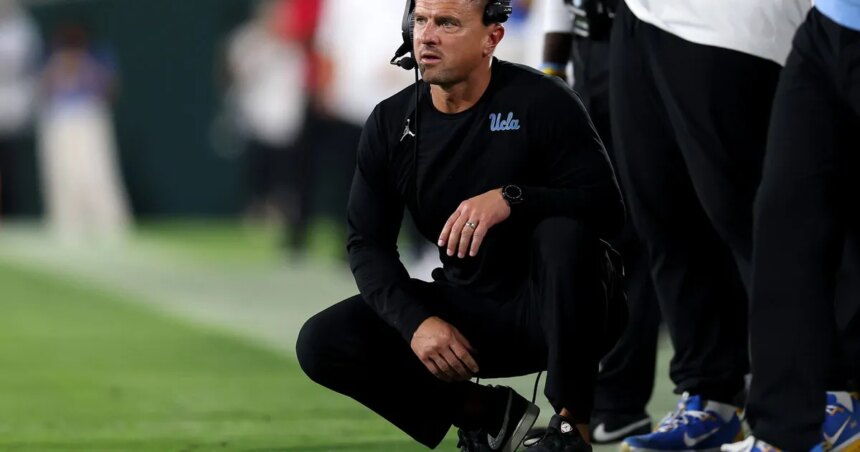
Before Bob Chesney could install a winning football culture at UCLA, he wanted his players to quit losing at life.
“You don’t have to do anything else,” Chesney said this spring, “just stop leaving the locker room a mess. Stop leaving the weight room in a mess. Stop talking down to people. Stop missing class. Stop being late to everything. You just stop all these things, all of a sudden you’ll find yourself in a pretty good spot.”
Whether it was picking up towels or adding a daily “thank you” to training table servers, No. 4 UCLA quickly adapted to Chesney’s expectations and has taken pretty good to borderline great. With their highest ranking since 1998, the Bruins (9-0) can tie the school record for wins with a victory against Illinois (6-3) on Friday night at the Rose Bowl.
With 63 new players under a first-year coaching staff, UCLA’s season has storybook potential. Yet the humility that permeates the program is shaped entirely by Chesney. He boasts Hollywood charisma and a facial resemblance to Jeremy Renner, but what has fueled Chesney — and, in turn, UCLA — is a work ethic and earnestness shaped by his small-college roots.
Chesney, 49, spent 22 seasons either playing or coaching Division II or Division III football before accepting his first FCS job at Holy Cross in 2018. A native of Kulpmont, Pa., Chesney played defensive back for Dickinson College and worked as a D-III assistant for 10 seasons. In 2010, he became head coach at Salve Regina in Newport, R.I., where he had roles beyond football including overseeing the athletic department’s work-study program and serving as the softball program’s game manager.
Salve Regina had eight consecutive losing seasons before Chesney’s arrival. After three years, the Seahawks were 23-9 with three straight winning campaigns. In 2013, Chesney moved to Assumption University, which had endured 15 losing seasons over a 17-year period. During his five seasons leading the Greyhounds, Chesney was 44-16 with two league championships, three straight D-II playoff berths and five straight winning seasons.
Big Ten’s CFP Bids, 9-0 Survivors: Winners and Losers
Ira Gorawara
Chesney moved on to Holy Cross in FCS. Beginning in 2018, he coached the Crusaders for six seasons and won five straight Patriot League titles, a first for any league program. Before arriving at UCLA, Chesney followed Curt Cignetti at James Madison for two seasons. Last year, he took the Dukes to the College Football Playoff as the Sun Belt champion.
Those stops, along with playing high school football for his father, gave Chesney the foundation of his coaching philosophy beyond the whistle.
“There’s jobs I had to do as a head football coach that probably a majority of these coaches or any assistant coaches never had to do,” Chesney said. “I think that to me allows you to understand just the amount of work that goes into it.
“One of the first things I did is making sure our players understood those people that are there to help with our lunches and dinners. They’re not there to serve you, but they’re there to do a job. They’re someone’s mother, someone’s sister, someone’s father, someone’s cousin, someone’s brother, and you got to treat them that way like they’re yours.”
Chesney’s players took notice of his high-energy personality and tenacious work ethic right away. He lifts with them in the weight room and relays a daily message that’s designed to instill confidence. Whether they were holdovers excited for a fresh start or newcomers working toward making a positive impression, the Bruins immediately bought in.
“He knows everyone’s name,” said quarterback Ty Dieffenbach, who began the year as a third-string transfer from Cal Poly. “He’s going to come up to you and build a real relationship with you. I’ve been places where it doesn’t happen, and just seeing him, he’s a real player’s coach. You just want to go out there and win for a guy like that.”
Taking the UCLA job was not without risk for Chesney. The Bruins are in their third Big Ten season, and travel is difficult — home and away. They play their home games in Pasadena, which is roughly 25 miles, and thus an hour’s drive, from campus. The program has sought to move its home games to SoFi Stadium, which would be half the distance and drive time.
In fiscal year 2025, the football program ranked 14th among the Big Ten’s 16 public schools in football ticket sales, and over a six-year period, UCLA reported $222.24 million in athletic losses. In August, the school fired athletic director Martin Jarmond.
The football program has mirrored that chaos. Chip Kelly quit as head coach on Feb. 9, 2024, and after what was described as a “comprehensive search,” UCLA named former running back DeShaun Foster as head coach three days later. It was a disaster. Foster went 5-7 in 2024 and was fired after a 0-3 start in 2025. Interim coach Tim Skipper guided the Bruins over the final nine games.
In less than two calendar years — Chesney’s hire was announced on Dec. 6, 2025 — the Bruins employed four head coaches. Chesney continued coaching James Madison through a CFP first-round loss at Oregon, then organized an attack plan for the portal, which opened Jan. 2. As a quarter-system institution, UCLA started classes Jan. 5. Between the portal and incoming freshmen, Chesney said 45 new players showed up within 10 days.
The transfer class earned praise at the time, but the impact has soared beyond expectations. Former James Madison running back Wayne Knight leads the Big Ten in rushing yards (789) and total touchdowns (15). Linebacker Sammy Omosigho, who was solid last year at Oklahoma, leads the nation with five forced fumbles while collecting 10.5 tackles for loss and 5.5 sacks. Safety Ta’Shawn James, who left Iowa State for Westwood, boasts a Big Ten-high four interceptions.
UCLA leads the Big Ten in rushing yards per game (213.2) and ranks third in rushing yards allowed per game (87.7). Those areas mark improvements of 73.5 yards and 102.7 yards, respectively. In addition, the Bruins are plus-14 in turnover margin, which ranks third nationally.
“We’re just gonna be a tough, physical team,” said UCLA linebacker Jalen Woods, one of the team’s holdovers. “It’s just like just toughness, toughness, toughness, and (Chesney) preaches that to us every day.”
UCLA’s year-over-year improvement
| Category | 2025 | 2026 |
|---|---|---|
Points scored/game | 18.2 | 33.6 |
Points allowed/game | 33.4 | 14.1 |
Rush yards/carry | 4.5 | 5.3 |
Rush yards/game | 139.7 | 213.2 |
Rush yards allowed/carry | 5.2 | 2.7 |
Rush yards allowed/game | 190.4 | 87.7 |
Pass yards/game | 180.3 | 218.7 |
Pass yards allowed/game | 196.6 | 177 |
Third-down % (offense) | 37.3 | 46.0 |
Third-down % (defense) | 54.8 | 26.5 |
Average time of possession | 29:09 | 32:57 |
Turnover margin | Minus-3 | Plus-14 |
Chesney told Woods and other players when he arrived that if the Bruins “don’t do what losers do” in their daily lives, then “we could get to .500.” But once UCLA started winning, any artificial ceilings vanished. It didn’t matter that the Bruins lost starting quarterback Nico Iamaleava to a season-ending torn ACL. Dieffenbach has delivered four straight victories, all by double figures.
With its physicality and line-of-scrimmage prowess, UCLA plays more like a traditional brand of Great Lakes Big Ten football rather than the stereotypical West Coast finesse. Chesney loved the mix of cool temperatures and power football on display in his team’s 34-20 win at Minnesota last weekend. It fits Chesney’s personality. But so does winning. The Bruins are on the doorstep of a Big Ten championship appearance. If UCLA wins, that will mark Chesney’s ninth conference championship in 13 seasons.
But that’s not on anyone’s mind right now. Illinois (6-3) has won four straight games, including a 21-10 win against Oregon. UCLA travels to Michigan next week before closing the regular season against crosstown rival USC, which it hasn’t beaten at home since 2018. The Bruins have never started a season 10-0 and have finished unbeaten and untied just once, in 1954.
“This month of November,” Chesney said, “it’s going to be extremely physical, and we’ve got to understand that. And the air keeps getting thinner and thinner and thinner as you climb to the top of this mountain. And they have to understand that.”
Thanks to the message Chesney has conveyed since his arrival, it seems they have.
“We’ll worry about the history once the season’s over,” Woods said. “Game by game. That’s our approach.”