

“Guinness!” a man exclaims as he springs off the train at Euston station. He and his party are Twickenham-bound, but plan boozy refreshment stops along the way.
It’s late morning, and people are arriving at the London rail hub from across the country, many in white and red England shirts.
They are heading for the largest dedicated rugby union stadium in the world — one which has filled the south-west London skyline for 117 years.
Twickenham, the home of English rugby union, is drenched in history. It is a sell-out as Steve Borthwick’s team demolish a New Zealand side ranked second-best in the world.
Surrounding the fabled pitch is a vast complex of bars, restaurants, hotels and a museum dedicated to the sport, which originated in England. It is something like rugby’s Disneyland.
Entrance to this Magic Kingdom does not come cheap.
Some fans paid up to £200 ($261) for an official ticket, making it a strong contender for the most expensive team game to watch in the U.K.
Then consider this competition, the Nations Championship (between 12 countries), is in its inaugural year and neither as significant as the World Cup nor as absorbing in Northern Hemisphere terms as the Six Nations (which is played between England, Scotland, Wales, Ireland, France and Italy).
Yet here they are, 81,953 supporters from England, New Zealand and around the world, to revel in an epic contest, drink ridiculous amounts of Irish stout and perhaps try not to worry about the cost.

England beat New Zealand 37-12 at Twickenham on Saturday (The Athletic)
“The crowds are good,” says Philip Griffiths, with his son and two-year-old grandson outside Twickenham station before the 15-minute walk to the ground.
For the 66-year-old, it is still a special occasion, despite the fact he is local to Twickenham and a long-time attendee of England games.
“The behaviour and the mixing of all different nationalities is always great,” he says. “There’s never any trouble, or certainly not that I’ve ever seen. People can drink, unlike (at) football, where they can’t drink in the stadiums (while watching the game). Here you see people drinking everywhere and we all get on. Rugby is a good community globally.”
He is quick to acknowledge that the good fun comes at a price, but one Philip says he is willing to swallow.
“I’ve paid £200, £198 and a £2 booking fee, for my ticket,” he explains. “There are less expensive tickets higher up in the stands — but we’re low down near the pitch.
“So if you had a family and two kids and you’re paying £100 a ticket, then it is a lot.
“But last weekend (when England played Japan here in the same competition), I looked around 10 days before and found one for £43. So there are often decent tickets.
“Today New Zealand is a premium game, but I think you can get tickets at a reasonable price for others.”
The three regularly come to watch England’s Red Roses women’s team here too, and Philip says he often pays less than £30 for a ticket. “We’ve seen them win the World Cup here (against Canada last year) and play good teams like America. It’s a great day out.”
If that sounds like Twickenham hosts a stacked calendar of games, it is misleading.
For 340 days of the year, the stadium is empty, and so the Rugby Football Union (RFU) needs to make money elsewhere.
It wants to boost revenue by persuading the local council to increase the number of non-sporting events it is allowed to host — especially lucrative concerts. Currently, Twickenham can host between three and eight major events a year. Wembley, the football team’s national stadium in north London, welcomes 54 a year.
The RFU says winning that permission — and the funds that come with it — will be vital to remaining at Twickenham. It would allow them to enact their £660million ($863m) expansion plans that include building the longest stadium bar in the world, a tunnel club and a roof garden.
But some residents and politicians in the affluent suburb, part of the London Borough of Richmond upon Thames, oppose the expansion.
Attending a council licence hearing last year, London’s Evening Standard newspaper reported on these objections. Councillor Alexander Ehmann said: “The RFU has repeatedly failed to maintain effective control over crime and disorder linked to its events. Residents have reported persistent antisocial behaviour, alcohol-fuelled aggression, public urination, shouting in residential streets and damage to property.” He added: “This is not an expansion. It is a fundamental shift in how the stadium operates, with far-reaching consequences for the people who live there.”

An aerial shot of Twickenham in south-west London (Ryan Pierse/Getty Images)
“I don’t understand it,” says Philip. “Locally it (Twickenham stadium) is good for trade. You see the cafes, the restaurants and cars busy, and probably a third of them wouldn’t survive without this (expansion).
“Trying to stop the plans to let them have more non-sporting activities here is crazy. As a local, yes, it can be annoying, but then it develops the whole area.
“The council indirectly makes money from it. If a third of those hospitality businesses closed, the revenue would drop. I used to live near Heathrow … and people moaned about the runway happening. Well, don’t live there then, I’m sorry.
“If people want the wealth of the area, why would you want to destroy it?
“If they have specific complaints of people messing up your garden then the council needs to sort it, or Twickenham can. The money is there to do that.”
Kiwi Leva Havili is not worrying about anything other than soaking up the atmosphere at his first overseas rugby game with daughter Sia since he moved to the U.K. last year.
“It’s one of the most iconic stadiums in the world,” he says. “The tickets aren’t cheap, but it’s a massive game and obviously it’s prime-time world rugby. You’re paying to see the best athletes in the world.”
It’s midday now, two and a half hours before kick-off, and the smell of fried meat from the hot-dog stalls and, curiously, South African barbecue kiosks wafts through the air on Whitton Road, leading to the stadium.

‘You’re paying to see the best athletes in the world’: Leva Havili and his daughter Sia (The Athletic)
Hordes of supporters, mostly groups of men but interspersed with families with children of all ages, wind their way along the street. “Hot dogs, burgers, sandwiches,” bellows one trader “Last chance before stadium prices!”
Since 2024, the ground’s official name has been Allianz Stadium, after the RFU struck a long-term deal with the German firm. It joins seven other sporting arenas, including German football champions Bayern Munich, named after the global insurance giant.
“I do wonder if it’s now going to start getting a little bit commercialised,” says Rebecca, who is on her way to the match with son Rufus. “Now it’s the Allianz and although it was a great atmosphere last week for the Japan game, it’s also very ‘fireworky’ and I wonder what will happen in the future; whether it’ll become more corporate and further from the grassroots of rugby. It makes me wonder whether rugby is going to become like football, which it shouldn’t.”
The pair got their seats for the game through their local rugby club in Ealing, west London, as part of the RFU’s scheme to distribute tickets through the grassroots and attract younger supporters.
So, too, did Ben Clarke, here with his wife Tash and sons Idris and Tighe. “I’m half Welsh so I have got a massive soft spot for the Principality Stadium (where Wales play) because it’s so central in Cardiff, whereas this is a bit out on the side (of London),” he says. “But the atmosphere here is just as good as Cardiff (where Wales stunned New Zealand last weekend).
The trip from Euston involves a ride on the London Underground before an overground train to either Twickenham or Richmond stations, both of which feel too small to handle the thousands of supporters who pass through at peak times on matchdays.
Ben Clarke and his friend Carl Cahill— along with Ben’s wife Emma and their children Kelly and Callum — have chosen to avoid the crowded train carriages by making the 187-mile (300km) drive from Devon, a six-hour round-trip.

Ben Clarke (left) and his friend Carl Cahill (right) with their families (The Athletic)
“Sporting events in general are just expensive these days,” Ben says. “Although at the Principality, it changes for certain fixtures so you can even get £10 tickets.”
Carl adds: “We go to a lot of different sporting events and there’s no better feeling than being in that stadium. It gives me goosebumps just walking up to it. We knew it’d be a good fixture and we wanted to make memories for the kids.”
On the stadium concourse, brothers Gerald and Mario Marsam and their friend Thomas Wesenauer are here from Vienna.
“We just wanted a weekend in London so we searched for big sporting events,” says Gerald. “We paid £166 each for our tickets.
“It’s very expensive but it’s a one-time occasion for us, we’re not that often in London. We actually noticed not so many young people here. Maybe it’s the prices.
“It’s very different to a football game, although you can also drink in the stadium in Austria.”

Brothers Mario (centre) and Gerald (right) from Vienna with their friend Thomas Wesenauer (The Athletic)
Ah yes, the drink.
At times it seems Twickenham is fuelled by Guinness, one of the ground’s official sponsors. Thirsty supporters queue by self-serve machines to pour their own pints of the black stuff, or fill cardboard carry cases shaped like rugby balls with plastic cups of the stuff. A pint from the concourse bars costs north of £8 ($10).
To pick your way through the inner concourse of the sprawling ground is also to slalom past punters, some unsteady on their feet, and avoid spilling their beer or wading through previous spillages. One fan apologises after accidentally knocking half a pint over The Athletic’s leg.
At their seats, they are provided with plastic St George flags (the red cross on a white background, representing England) and encouraged to wave them by the pitch-side DJ, who plays a crowd-pleasing mix of The Beatles’ ‘Hey Jude’, Queen’s ‘We Will Rock You’ and Oasis’ ‘Wonderwall’.

The self-serve Guinness taps at Twickenham (The Athletic)
Before kick-off, former England player Lewis Moody, a World Cup winner who was diagnosed with Motor Neurone Disease last September, joins the current players on the pitch. He stands next to them as they face the haka, a foot-stomping Maori dance delivered by the All Blacks.
The game does not disappoint. England rip into their opponents, who are still smarting from a historic defeat by Wales last weekend, and the home fans regularly launch into their anthem, ‘Swing Lo, Sweet Chariot’. Theirs is a songbook of one. Aside from the national anthem, England rugby fans tend to stick to a short portion of the African-American spiritual song, which has a complicated legacy.
At other times these supporters are content to sit back and savour the day, reserving their cheers for the five tries their team runs in.
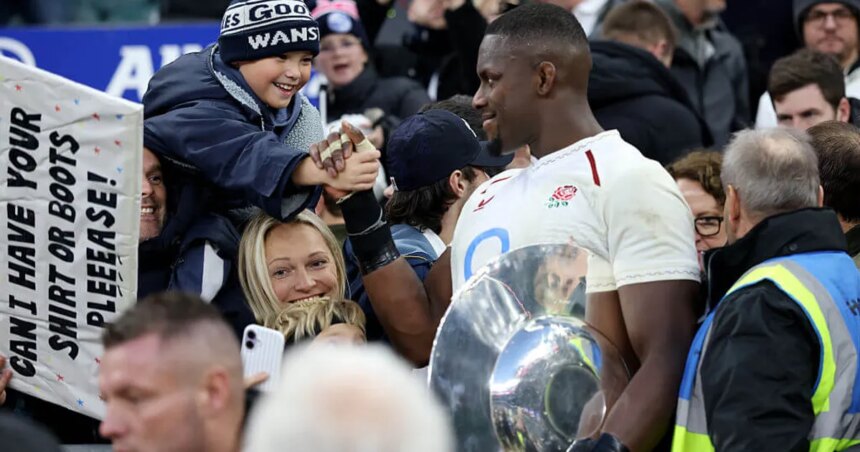
For New Zealand, it is thoroughly chastening. But after the final whistle, Kiwis in black shirts mingle with England supporters as young fans toss rugby balls to one another, emulating heroes like Ollie Chessum and Fin Smith, while the ground begins to empty. If their red and blue balls were bought from the nearby merchandise stall, they cost £31 ($40). A replica England jersey there will set you back £90 ($117).

It has been a thrilling encounter: one high on attacking rugby from the hosts, who boast a promising mix of youthful talent and more experienced heads. England are peaking at the right time; the World Cup in Australia is less than a year away.
England try-scorer Seb Atkinson was once a starry-eyed youngster here, like the kids spinning the oval ball to one another beside the stands. “I’ve dreamed of playing at Twickenham my whole life,” he says.
“I had my first opportunity two weeks ago against Australia, and for my second time to be the way it was, just blew it out of the water. I look forward to the next time I get to play here. I’ve got no complaints.”
Even Borthwick, who can seem intense and stern, allows himself a chuckle in the press conference afterwards, gently chiding the reporter who asks if he has “won back” those who doubted him after a tough Six Nations.
It is all fairly genial. After all, England have won and Twickenham has done a roaring trade. The fans troop out into the brisk November night with smiles on their faces. Their wallets are lighter, yes, but they have no complaints — and they nurture hopes of more big wins to come.