

When Newcastle United release their annual accounts, stories always abound — and their financials for 2024-25 are no different, with the club having sold their St James’ Park stadium to another company owned by their shareholders.
Record turnover of £335.3million ($443.8m) is impressive, given Newcastle did not have the added income that comes with playing in one of the three European competitions last season, though the club’s ability to generate a profit after tax of £34.7m was largely driven by what they describe as “the reorganistion of its property holdings and group structure”.
David Hopkinson, Newcastle’s chief executive, sat down with journalists to discuss the latest set of books, and also answered questions on the future of their stadium, head coach Eddie Howe’s situation, potential summer transfer business, the prospect of key-player sales and his ‘Vision 2030’ plans.
The Athletic analyses the meaning behind Hopkinson’s remarks on the big topics facing Newcastle.
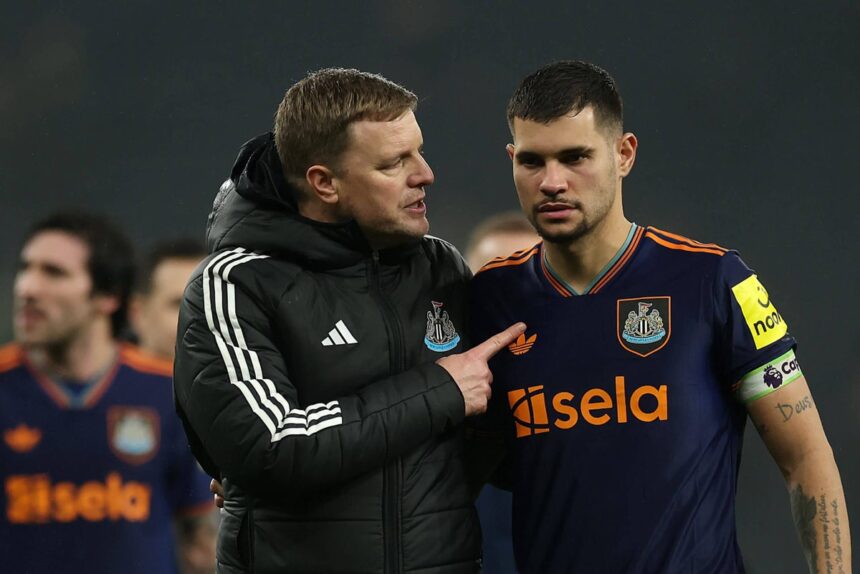
Howe’s future
The overriding narrative during this international break has been about Howe’s future, following the Champions League round-of-16 exit to Barcelona — losing 8-3 on aggregate, including 7-2 away in the second leg — and the damaging 2-1 home defeat by neighbours and arch-rivals Sunderland four days later in Newcastle’s most recent match.
With Newcastle 12th in the Premier League after 31 of the 38 games and with some fans expressing their displeasure following the Sunderland loss, there has been increased external scrutiny surrounding Howe’s position.
Privately, senior figures at St James’ have, speaking under the condition of anonymity to protect relationships, made clear that the head coach is safe and that they still believe he is part of their future, but this was the first opportunity for the hierarchy to offer an on-the-record response.
Hopkinson’s answer was not as unequivocal as the one he gave to UK radio station talkSPORT last month, when he declared, “Eddie’s our man and he has our total support.”
“I don’t have a stance on his future,” Hopkinson says. “What I can tell you is that the derby loss hurt. We take it seriously. There’s nothing within us that thinks, ‘Well, it’s just three points and on we go’. It has resonated.
“I spent a couple of hours in a one-on-one lunch recently with Eddie, and we talked through a multitude of things, including that. Eddie’s our manager. I expect to have a great run to the end of the season here, and we’ll talk about the future when it’s time. Right now, we’re focused on this season’s competition.“
Confirmation that open dialogue is continuing between Howe and Hopkinson — and Ross Wilson, Newcastle’s sporting director — was encouraging, though that initial response implied all options regarding the head coach position remain open.

Newcastle lost the Tyne-Wear derby before the international break (Andy Buchanan/AFP via Getty Images)
“I would not frame it that way,” Hopkinson said, when it was put to him that Howe’s future will be assessed in the summer. “We are not looking to make a change at the moment. We are not having those conversations. We’re still in the midst of the season.
“Right now, we are focused on the seven matches we have remaining and not distracting ourselves with speculation about what we may or may not do in the summer. Right now, all of us have only got so much bandwidth, and we are focused on this season and finishing strongly.”
Behind the scenes, following the briefing on the club’s latest accounts, there was pushback against the idea that Howe’s job security was tied to these final seven games. But increasingly it does feel as if that is at least partly dependent upon how Newcastle perform between now and the end of the season.
Should Newcastle’s form pick up and they qualify to play in Europe again, Howe is expected to stay. But should Newcastle labour to a mid-table finish, he and the club may have respective decisions to make.
Player sales possible — but on Newcastle’s “terms”
Significant squad turnover is anticipated this summer, with sales an important part of that plan — and Hopkinson did not try to pretend otherwise. As a club, Newcastle have spent three years trying to explain that they need to be ‘better sellers/traders’ — and have struggled to ever strike the right tone, given how that concept jars with the idea of the team making on-field progress.
“Going forward, our strategy is to buy well and sell well,” Hopkinson says, becoming the latest Newcastle executive to try to recalibrate expectations regarding the club’s trading model.
For a fanbase still scarred by the exhausting and badly-handled Alexander Isak saga last summer, constant speculation surrounding the futures of Sandro Tonali, Bruno Guimaraes, Anthony Gordon and Tino Livramento has left some fearing a mass exodus, given Champions League qualification from their current position seven points behind fifth-placed Liverpool appears highly unlikely.
While Hopkinson could not confirm whether a star player would need to be sold — suggesting that may depend on whether Newcastle secure European football — he did stress the club would be “proactive” in their approach. The implication was that, unlike last summer, when Newcastle’s owners insisted for months Isak would not be sold before relenting at the last and doing a deal with Liverpool, negatively affecting their incoming business in the process, the club will make an early call on potential exits.
In a purely financial sense, Hopkinson described Isak’s departure to Anfield as a “good sale”, given it was for a British record £125million. Many would argue the collateral damage caused by the protracted nature of the Swedish striker’s exit — much of which is still being felt on the field now and which could lead to other big players pushing to leave in this year’s summer window — means the economics alone cannot merely be considered when reviewing that transfer.
“We haven’t got an overall strategy with regards players out, necessarily,” Hopkinson says. “We think through what players might or might not want to do this summer. But if an Isak-like scenario presents itself again, any player under contract is going to leave on our terms, and we’re going to maximise the opportunity that might represent for the club.”
There is an appreciation inside Newcastle for the way in which fellow Premier League sides Manchester City and Chelsea generate profits from player sales, which allows those clubs to reinvest in the market. And Hopkinson pushed back against the perception that Howe would not accept the need to trade players outwards, insisting the head coach is “aligned and understands this”.
European qualification (or not) will affect transfer plans
“We have two directions of planning,” Hopkinson says. “Two scenarios with a multitude of strategies that follow either scenario.”
Essentially, whether Newcastle qualify for Europe — be that Champions League, second-tier Europa League or third-tier Conference League — will affect their business. Keeping hold of their star players is more likely if they are in one of the top two European tournaments, while Newcastle would also be able to attract higher-calibre targets, too.
Being in Europe would also be more restrictive for Newcastle from a financial-regulation perspective, given that governing body UEFA’s 70 per cent revenue ratio is harsher than the 85 per cent limit included in the Premier League’s new squad-cost rules (SCR).
“We’ve got seven matches to go, and we don’t know what regulatory regime we’re going to be operating (within),” Hopkinson says. “If the season ended today, we’d be outside European competition, although that is not our ambition.”
That final point is critical. Although many fans have been disparaging about the Conference League, the revenue uptick and increased gate receipts Newcastle receive from European qualification mean the hierarchy wants those additional matches, even if they are in the least-prestigious of the three tournaments.
Interestingly, Hopkinson also hinted at a shift in approach, perhaps even reverting to targeting a profile of signing from earlier in the club’s post-2021-takeover cycle.
Newcastle tried to sign elite-level players last summer — Hugo Ekitike, Bryan Mbeumo and Joao Pedro among them — but every time they went head-to-head with an established club, they missed out on their target. With the CEO acknowledging that bringing in a so-called “box-office signing” may require a sale of a current star first, he wants Newcastle to take an alternative route to the top — by being smarter and more creative than their rivals.
“Buying well does not necessarily mean spending the most money,” Hopkinson says. “It means working in the marketplace for the players that generate the most value for this club, rather than the fee paid for them. So there are a multitude of strikes we need to employ, including developing our own, looking for opportunities in the marketplace and making sure we are maximising our opportunity within the available price we can produce.”
For the most part, post-takeover, Newcastle’s hit-rate with signings has been impressive. But after a difficult summer following on from five successive transfer windows without an addition to the first XI, they simply have to buy well this time.
Stadium and training ground future — and selling St James’ Park to themselves
If supporters were hoping an announcement would finally be forthcoming regarding a new training ground or stadium — be that a renovated and expanded St James’ or a state-of-the-art replacement nearby — they will be disappointed (again).
But, while Hopkinson has spoken boldly about his ambitions for the club, he has always insisted he will not raise expectations surrounding those big-ticket issues publicly until there is something concrete (pun intended) to announce. “Not today” was his response about whether he had an update to provide on either situation.
The Athletic reported in January that Newcastle have identified a site in Woolsington, near the city’s airport, as their preferred location for a new training ground, and an announcement on that may arrive in the coming months.
Regarding the stadium, many insiders, speaking under the condition of anonymity to protect relationships, prefer a move to Leazes Park, which is right next door to St James’, though renovating the current ground remains a live option and no final decision has been made.

Further renovation of St James’ Park remains a live option for Newcastle (Stu Forster/Getty Images)
Theoretically, Newcastle insist, either stadium option has now become ‘easier’, due to their controversial move to sell St James’ to another company owned by the club’s shareholders.
The club deny the motivation behind this was PSR (the Premier League’s profit and sustainability rules) compliance. Simon Capper, Newcastle’s chief financial officer, said it was to “reorganise our property assets and get them into the correct legal boxes to allow us to go forward with our potential development, and to facilitate that with financing and other similar items”.
Seemingly, Newcastle believe they are now better placed to secure investment for their stadium works moving forward, even if the trade-off is that they no longer officially own their own home. It is now under the control of a business controlled by the club’s owners.
Vision 2030 — and PIF
Hopkinson has been unashamedly aspirational since arriving on the scene last September. He has repeated, publicly and privately, his goal to turn Newcastle into one of the best football clubs in the world by 2030.
If Newcastle’s record turnover appears impressive (£335.3million), it is still less than half of Manchester City’s £716m and significantly behind Chelsea’s £492m (the lowest among the so-called ‘Big Six’). Newcastle are also the first club outside that group to record annual commercial income in excess of £100m (at £102.2m), but that is still half that of those above them.
But when the size of the gap Newcastle need to bridge in the next four years to achieve his goal was floated to Hopkinson, he did not flinch, nor shy away from the task.
“The size of the challenge you’ve underscoped — because those other clubs are also going to be moving forward,” he says. “Our competitors are formidable and have already got a head start. But all they’ve got is a head start.
“We’ve got a tremendous opportunity for growth right in front of us. We use the phrase ‘head room’ in terms of player budget, but what I also look at is the commercial opportunity. We have significant head room to catch up… but we can get there quickly, into a group that is credibly competing for those top prizes.”
From the start, Hopkinson has promised new sponsorship deals, and fresh partnerships should be confirmed soon. Crucially, some will be with non-PIF (Saudi Arabia’s Public Investment Fund) companies, with £34.4million of present commercial income coming from associated-party transactions (APT).
Once again, Newcastle pushed back on the idea that PIF is failing to show commitment to the club, even if they did not directly address whether the ongoing conflict in the Gulf may affect decision-making and investment from the owners. “What’s going on in the Middle East is tragic, and we’re sensitive to that,” Hopkinson says.
The club did direct reporters towards recent remarks from Yasir Al-Rumayyan, Newcastle’s chairman and governor of PIF, at the Future Investment Initiative event in the United States.
Al-Rumayyan insisted there that “PIF remains committed to its investments around the world”, but such a general statement will do little to reassure those Newcastle supporters who suspect the club’s majority owners are losing interest less than five years in.