

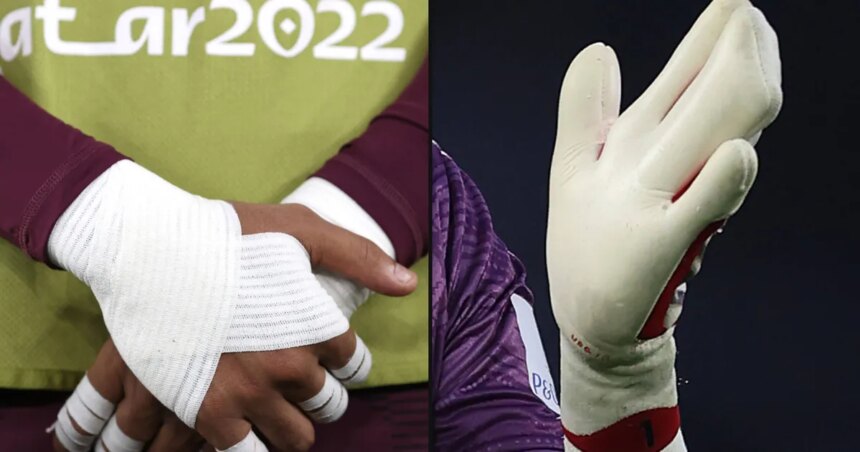
Emiliano Martinez’s right hand will never be the same again.
The 34-year-old broke his ring finger while playing for Aston Villa in the Europa League final last May and opted against having it surgically repaired in order to be able to play for Argentina at the World Cup. In the weeks leading up to the tournament, he could not train properly — diving with one arm to avoid the excruciating pain that came from putting weight through his right hand.
“I put my hand down, and I’d see stars,” Martinez said on journalist Gaston Edul’s YouTube channel. “Every night, until 12am, I’d be crying because my finger was like a blood sausage.”
The goalkeeper, who moved to Chelsea this summer, played every minute of the tournament in which Lionel Scaloni’s side reached the final, losing to a Ferran Torres goal in extra time. He is still suffering the consequences, and admitted he is still playing with pain.
While surgery will help ease the discomfort, he said his finger will never return to normal. Asked to compare the pain of the broken jaw he suffered while playing for Chelsea against Everton in mid-October to his broken finger, Martinez said: “The pain (from the jaw) is at one compared to how bad it (the finger) was…
“Those are the risks you take for the national team. I’d do it again.”
He is not the only one.
Newcastle and England goalkeeper Nick Pope was 13 when he first dislocated a finger while playing in goal. He had gone to make a catch when the ball caught a finger in the wrong way. He knew instantly something was wrong. “I pulled my glove off straight away,” he tells The Athletic, “and saw my little finger was pointing in the wrong direction.”
Pope ran over to show his manager, who kindly offered to pull the finger back into place, but the young keeper swiftly pulled his hand away and went in search of a doctor. “Luckily there was one on site, so I closed my eyes and let him pull it back into the socket.”
Finger dislocations are an occupational hazard for professional goalkeepers, who place their hands directly into the line of fire on a daily basis. Whether it’s thrusting them at the feet of an onrushing attacker, trying to position them firmly behind a swerving, whirling ball or hurling them towards the ground while diving to make a save, it’s their hands that often bear the brunt of the impact.

Nick Pope having his hands treated at pitch side (Robin Jones – AFC Bournemouth/AFC Bournemouth via Getty Images)
“The most common injuries are around the finger joints,” says experienced hand and wrist surgeon Mike Hayton, who has spent over 20 years treating many top-level athletes including goalkeepers, rugby players, boxers, golfers, tennis players and cricketers. “They can suffer dislocations where the joint comes out of its socket. They can have a fracture-dislocation where it comes out of its socket with an associated fracture, or you can just have finger fractures.”
They can also stub the end of their fingers (the end joint, which is called the distal interphalangeal or DIP joint), and pull off the tendon which straightens the finger, resulting in a mallet finger where it becomes impossible to straighten the fingertip. The thumb joint can also be damaged by the thumb getting jammed into the ground and the keeper then rolling over it, tearing the ligaments around the knuckle of the thumb joint.
“Most of the finger injuries are with a ball to an outstretched hand on the tip,” says Hayton. “Thumb injuries tend to be when they’re diving.”

David Raya’s hands are bandaged (Justin Setterfield/Getty Images)
Such injuries are not surprising when you consider how much cumulative force a goalkeeper’s hands absorb: Studies in sports science have shown that elite-level shots can exceed 100 km/h.
“While the gloves absorb some of that, the fingers still take the brunt of the load,” says goalkeeping coach Matt Pyzdrowski, who played in the United States and Sweden. “Over the course of a week — especially in heavy shooting sessions — that repetitive impact adds up quickly.”
During his career, Pyzdrowski would ensure every gym session was geared towards preparing not only his body but his hands, fingers and wrists for the demands of the week. He would include standard strength exercises like bench press, lunges, deadlifts and shoulder presses, all of which require you to stabilise and control weight through your hands. “That constant loading builds grip endurance and wrist resilience, which translates directly into how securely you handle the ball in training and matches.”
Bodyweight exercises such as push-ups (including fingertip press-ups to target finger strength), elevated shoulder presses, handstand push-ups and pull-ups were equally useful, he adds. The pressing movements force you to stabilise your body weight through the wrists, while the pull-ups challenge grip strength.
He also utilised explosive movements like plyometric push-ups (where the hands leave the ground on the concentric phase of the movement) and burpees to train the wrists not only to support weight but to absorb impact — something goalkeepers repeatedly ask of their bodies when diving.
Grip strength is also important: “Think about holding onto a powerful shot in wet conditions, or securing the ball in traffic,” says Pyzdrowski. To train that, he would use farmer’s walks (holding heavy dumbbells or kettlebells) and static holds, which place sustained demand on the hands and forearms.
“Hand strength isn’t isolated from the rest of the body,” says Pyzdrowski. “It’s integrated. Stronger shoulders, forearms and core all contribute to how effectively and safely you can use your hands.”
No matter how robust a goalkeeper is, though, hand and finger injuries are almost inevitable.
Brighton goalkeeper Jason Steele has the pinky finger to prove it.
“I dread to think what’s wrong with it,” he laughs. “It’s very bendy.” The 35-year-old has had surgery on his hands twice during his professional career, neither of which have anything to do with his smallest finger. “That’s just from the amount of balls that hit the ends of your fingers,” he says. “I think a lot of goalkeepers have them.”
Steele was in his early 20s when a ball struck from close range in training hit his hand with such force it broke his scaphoid bone (a small bone in the wrist, situated at the base of the thumb). “The pain was instant,” says Steele, who was playing for Middlesbrough at the time. As he started to remove his glove, one of the older keepers at the club regaled him with a story about how, when he broke his wrist, his whole hand was shaking. “Lo and behold, I took my hand out, and my whole hand was shaking,” says Steele, who still has the screws in place that were inserted to repair the break.
Last season, 13 years on, Steele was back in surgery to repair the ulnar collateral ligament (UCL) in the thumb of his other hand. Situated on the inside of the thumb joint, the UCL is a critical band of tissue that stops the thumb from bending too far away from the hand. The injury occurred again in training, when Steele was catching a “routine” ball that deviated in strong winds. It wasn’t the same sort of pain as his previous break, but Steele knew something didn’t feel right.
Now, he doesn’t put his gloves on without first strapping up his wrists (“three inches from where the scar is on my scaphoid”) and his little fingers, to which he applies strapping in a figure of 8 to add extra support.
Does he ever think about what his hands will be like post-retirement? “I try not to,” he laughs. “Even now, I can’t clench my fist properly with my left hand because my little finger doesn’t bend.”
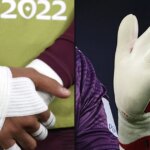
Catch a glimpse of any keeper’s hands without their gloves on at the end of the game and more likely than not, you will see some sort of taping around the fingers and/or wrists. “I’ve worked with goalkeepers who will tape every finger, even before every training session,” says former Brighton goalkeeping coach Jack Stern. “I can think of goalkeepers at Brighton who, sometimes, you’re waiting for them to finish taping all their fingers before you start training. That’s quite a common thing.”
That taping can fulfil numerous functions. It can add support to a finger recovering from injury, or simply general support to try and aid injury prevention.
Certain glove manufacturers have implemented extra support into gloves to provide that added feeling of security. Pope wears gloves that include a feature called Finger Save; plastic spines positioned down the back of the glove that are designed to help prevent the fingers going into hyper-extension.
Many keepers prefer to go without, though, says Stern, who says the inclusion of the splints behind each finger can feel too restrictive for some. “You see now that gloves are almost reducing in size. A lot of them look a bit like washing-up gloves. In terms of the grip, they stay the same, but in terms of the actual structure of gloves, they’ve reduced in bulk. That’s because most goalkeepers want the feel of the ball; they want their fingers to feel free and loose so that when they’re catching a ball, they can feel the fingers wrapping around it. If they’re at full stretch trying to make a fingertip save, the less restriction you have on your hands, the better.”
Stern says keepers prefer to use tape for the additional support. The ritual of applying the tape can become an important part of their pre-match routine. “It becomes a habit. Goalkeepers are quite particular in their structured build-up and the way they prepare. So even that process of taping each finger before a game or before training, I think a lot of that is psychological; it gives them confidence in the hands.”
Pyzdrowski went through periods when he experimented with taping preventatively before every session, but never committed to it long term. “The perceived stability didn’t outweigh the loss of feel,” he says. He understands those who do it religiously throughout their careers, though.
“For some, it’s about joint stability. For others, it’s psychological reassurance; the compression gives them a sense of security. Others feel the exact opposite — that taping interferes with their dexterity and touch. I was firmly in the latter camp unless injury forced my hand.”
Southampton’s Aaron Ramsdale feels similarly. He applies wrist tape before training and matches but will only tape or strap a finger “on occasion,” if he’s banged or knocked one.
The 28-year-old counts himself “extremely lucky (touch wood)” to have only suffered two hand injuries in his career so far. One being a small break to a knuckle in 2022 which didn’t require too much attention and the other a broken finger while playing for Southampton in 2024 which proved more disruptive.
“That was an operation break,” Ramsdale says, speaking to The Athletic. “So I now have three tiny screws in my middle knuckle on my middle finger” (an operation performed by Hayton).
One aspect of keepers that becomes increasingly clear from speaking to them and those around them is their determination to continue playing, even when finger/hand injuries strike. Ramsdale’s finger break occurred in the 15th minute of a match, and he continued playing until the end.
“The pain was high,” he says. “But as I’d never broken a finger before, I didn’t know for sure (it was broken), so I carried on playing.”
After surgery, Ramsdale was able to return to playing after around five weeks, thanks to the use of buddy taping (whereby the injured finger is strapped to one adjacent to it to provide support), and a bespoke pair of gloves made to accommodate that, with one hole accommodating both his left ring and middle fingers.

Pickford with wrapping on his wrists (Alex Pantling/Getty Images)
He describes the pain of playing through such injuries as “horrific” and “too much at times.” But for keepers, the pain of missing and potentially losing your place is always worse.
Buddy taping is common when recovering from a fracture or dislocation. But while it can help to stabilise the joint and manage pain, Pyzdrowski says he felt it impacted his performance.
“Taping two fingers together effectively reduced my surface area and limited independent movement, fundamentally changing my grip, while the flexion of the fingers felt restricted. At times it even made me feel clumsier, and I felt I was more prone to small spills because I couldn’t manipulate the ball as precisely.”
When pain became unavoidable, he says it turned into a management exercise: “Maybe you adjust your technique slightly — parrying more with the palm rather than your fingertips, opting for more basket catches, or subtly shifting more of the force into your stronger hand. These are small, almost subconscious adaptations goalkeepers make to survive through injury.”
Pope has plenty of experience with pain management. He has suffered a dislocated finger during the warm-up for a game and still played. During the 2022-23 season, he dislocated a finger during a training session and had it popped back in, only for it to become a recurring problem for the entire season, when it dislocated “four or five times.”
When it happened during a game, he would run to the sideline, have it popped back in, and carry on. In terms of pain, he says the first time you dislocate a finger is always the worst. Each time after that, the pain lessens. It’s also important to get it taped up swiftly to try and stop the swelling: “I think the swelling causes the pain because it’s such a small capsule,” he says. “As long as you can get your gloves on and off and maybe have a couple of painkillers, you’re kind of OK.
“If you did it in training, you’d probably leave it and not train for a few days. But when it’s within a game in that environment you’re keen to carry on.”
Does it not have an impact, even subconsciously, if you know you have a damaged finger? Would you not pull out of certain saves or avoid diving a particular way to prevent more pain?
Pope laughs. “You try and forget about it as best you can. You don’t want to let yourself or your team down, so you’re more concentrating on that really.”
Stern has also been in that situation, having to play knowing that there is damage already present in the hand or fingers.
“You still put your hand there,” he says, “because you’d rather feel pain than concede a goal, but it’s something that plays on your mind a little bit. I’m sure it gives you a split-second slower reaction time because your body’s trying to protect the area that hurts.”
He says that goalkeepers come to accept that they are going to have to deal with these types of injuries and still get on with the job. “Unless a ligament gets snapped or a bone is broken and there needs to be surgery, it’s very rare that a goalkeeper won’t just get on with it, whether that’s with painkillers or strapping.”
He also points out that the number of times in a game that a goalkeeper touches the ball with the hands can actually be quite minimal. “Say you have a keeper who bent a finger on his left hand back in training and he can hardly move it. Having that strapped up for a game and potentially taking painkillers, it might be that they’ve only got to make contact with the ball once or twice, sometimes not even at all, with just that single hand.
“So it’s something that you play through because you know that actually you might only have to do a couple of actions with that hand anyway over 90 minutes.”
Pope underwent ligament reconstruction surgery with Hayton at the end of the 2022-3 season to restore function in his finger, but he doesn’t need to look too far to see what can happen to those who suffer from repeated issues that are not surgically addressed. Hayton himself has an angulated finger from a rugby injury that was simply strapped up to allow him to continue playing.
And former West Ham, QPR and England keeper Rob Green has revealed since retirement that he played the last 10 years of his career with a finger brace and bespoke gloves (“with a paddle hand”) to accommodate a little finger that became permanently bent at almost a right angle after numerous breaks and dislocations.

Green’s finger has been impacted by his playing career (John Walton/PA Images via Getty Images)
“Players want to get back playing as quickly as they can, and sometimes they put the team before their own personal health,” says Hayton. When he treats players, their return to play is always discussed, as is the risk of returning early. “They could propagate a fracture,” he says, “or if it’s dislocated, it could re-dislocate and then re-dislocate with a fracture.
“We teach them about the injury so that they’ve got capacity to make their own decisions because they’re adults and they can make their own decisions. We just guide them; we can’t force them to either not play or to play.”
Long-term implications can include chronic instability (like Green’s) and eventually osteoarthritis.
Hayton has been looking after some goalkeepers for upwards of 20 years and says most are conscious of how their hands look. “At the end of their career, they say to me, ‘Doc, can you make these look better?’”
Finger joints can be replaced, says Hayton, in cases of chronic arthritis. They can also be fused, or permanently stiffened.
“Sometimes, footballers get such a bad fracture-dislocation of the middle finger joint called the proximal interphalangeal joint (PIP) that the only thing we can do is fuse it and put some tiny pins and screws or plates across the joint to stiffen it. Even though it’s an absolute last resort, salvage surgery, you can still make a fist afterwards, so you can still punch and you can span the fingers to make a save. I’ve done a lot of those over the years in footballers who’ve had terrible injuries that need salvage surgery.”
Stern, 37, retired from playing when he was 21, but still suffers from the consequences of his days in goal.
He has a wrist that still bothers him from having snapped a ligament in it, which required pins to be inserted for five months. The injury happened when he dived for a ball with his hands outstretched.
“The ball was on the floor, there’s me running towards the ball and an attacker running towards the ball. I just got there first, but pushed the ball away. And then his foot or boot made contact with my hand and my wrist, and it forced it back into a position where one of the ligaments snapped.
“My wrist has never felt normal after that.”
He also suffers from early-onset osteoarthritis in his hands, “where all the bones and ligaments have shifted a little bit, and they don’t quite sit in the right place anymore.”
“Almost any goalkeeper who’s had a long professional career, at the end of it, they’re going to have hand issues for the rest of their life,” he says. “Not to the point where it’s debilitating and they can’t use their hands. But their hands are going to feel a bit funky for the rest of their lives.”