


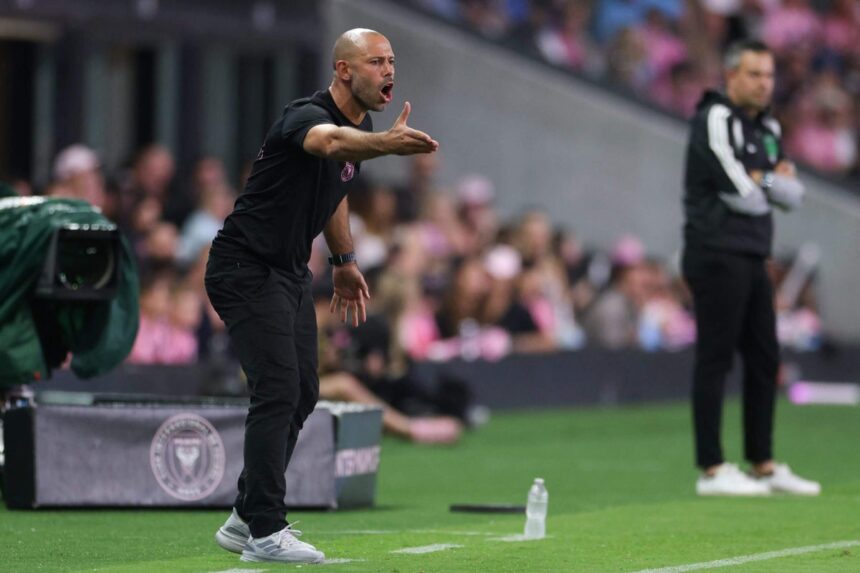
Javier Mascherano has left Inter Miami after 67 matches in charge and one MLS Cup title. For the American soccer world, the Tuesday announcement was a shock. But if you’ve been following Inter Miami since its origins, the news shouldn’t surprise you.
Now, it’s true that Inter Miami has underperformed and underwhelmed in 2026. After winning its first MLS Cup last December, the club spent a reported $15 million on center forward Germán Berterame. The Argentine and Mexico international has scored just once since his high-profile transfer from CF Monterrey.
Dayne St. Clair, the reigning MLS Goalkeeper of the Year, also arrived in the winter from Minnesota United, and Miami signed imposing Brazilian central defender Micael to solidify the back line. But both have been shaky and unsure of themselves to start the season. For any other MLS team, three wins, three draws and a loss to begin the regular season is not a reason to panic. And to be eliminated in the round of 16 of the Concacaf Champions Cup is a bitter pill to swallow, but certainly it’s no reason to hit the restart button.
But this is Miami. And more importantly, this is Inter Miami. Nothing should be out of the realm of possibility. Mascherano’s decision to leave in mid-April, just one week after Inter Miami opened its sparkling new stadium, is fittingly on brand. There’s a volatility that surrounds the club. The massive personalities of its decision makers, brothers Jorge and Jose Mas, David Beckham, and Lionel Messi, produce a gravitational pull is unlike any other team in the history of MLS. Messi and Beckham are global brands. The Mas brothers are multi-billion-dollar entrepreneurs who have long been entrenched in South Florida business and politics.
That combination of persuasion and brand equity has been part of Inter Miami’s strategic build to date. To survive within that orbit is not easy. Head coaches Diego Alonso, Phil Neville, Tata Martino, and now Mascherano, have come and gone. Former sporting director Chris Henderson, now Atlanta United’s chief soccer officer, was pushed out before the 2025 season following the arrival of Raúl Sanllehí as president of football operations.
Sanllehi, though, was later removed from all sporting decisions and replaced by Miami’s director of player development, Guillermo Hoyos, who is a close ally of Messi’s. Hoyos was Messi’s youth coach at Barcelona. When Messi was 17, he referred to Hoyos as his “footballing father.” On Tuesday, Inter Miami announced that Hoyos will take over the first team indefinitely.

Javier Mascherano coached Lionel Messi and Inter Miami to the 2025 MLS Cup title. (Leonardo Fernandez / Getty Images)
On the field of play, big swings, followed by multiple squad reboots, have come to define Inter Miami. The club moved heaven and earth to sign Messi in the summer of 2023. That was preceded by the arrival of France World Cup winner Blaise Matuidi in 2020.
The Matuidi signing led to an MLS investigation that found Miami culpable of violating the league’s roster rules. Between the MLS record fine and the league’s decision to slash Miami’s allocation money for the 2022 and 2023 seasons, the club received a penalty that exceeded $4 million. In pushing the envelope, Inter Miami has always embraced disruption. The chaotic nature of Inter Miami’s early life as a professional sports organization has also been anchored to its natural link to celebrity. Messi’s first matches at Chase Stadium in Fort Lauderdale featured guests like LeBron James, Serena Williams, Tom Brady, Usain Bolt and Kim Kardashian, among many others.
Messi himself has reached such a high-profile, nearly deity status in some parts of the world, that his lone presence can lead to an international incident. After Messi did not play in an Inter Miami friendly in China in February of 2024, the Hong Kong government accused Messi of “a deliberate and calculated snub.” But when FIFA created the expanded Club World Cup, president Gianni Infantino made sure that Messi and Inter Miami didn’t suffer a similar rebuff.
Mas would like Inter Miami to someday be mentioned in the same breath as global soccer powers Real Madrid, Barcelona and Manchester United. When people think of soccer in North America, he has proclaimed, they’ll think of Inter Miami. In time, Mas may be proved correct. But presently, the constant churn and instability within the walls of the club’s headquarters is as much a part of its DNA as the pink jerseys. At Inter Miami, disarray is not a crisis. It’s part of the brand. Mascherano’s sudden resignation is simply a symptom within the constant spectacle that engulfs the club. That spectacle will continue without him.
Mascherano, in the end, was a project whose proof of concept is debatable. He had never led a first-team side at the professional level. His hire was widely scrutinized due to his close relationship with Messi. He silenced some doubters with an MLS Cup, but perhaps even Mascherano needed to come up for air inside a sphere of influence in which he was never the main character.