



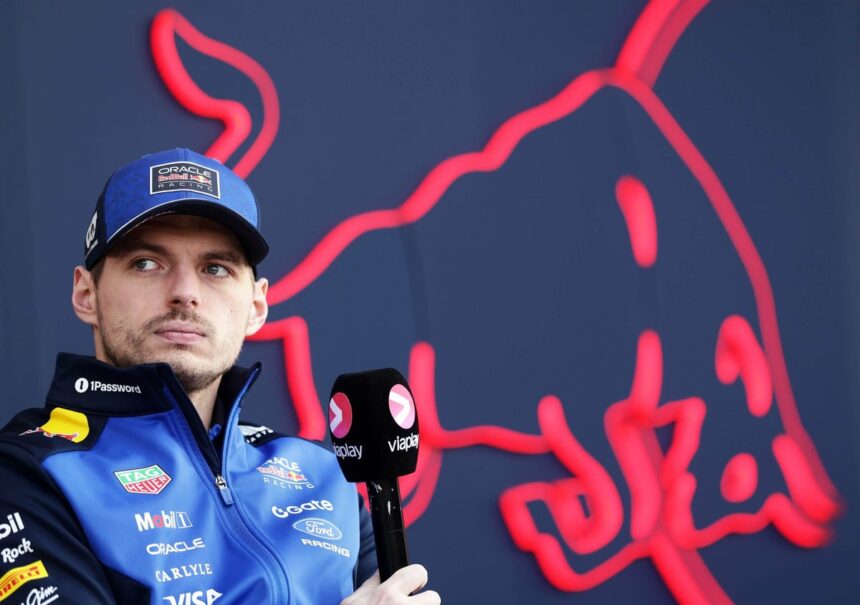
“I want to rely on my gut feeling. Isn’t that what makes great race drivers in the end?”
Max Verstappen was just 17 years old when he said those words, midway through his debut season in Formula 1. The four world titles were to come; the potential to deliver them had started to be shown.
Even back then, and for all the years since, Verstappen has always carried an air of burden, the expectation to deliver — the son of a driver, a possessor of otherworldly talent, a personality that will instinctively place pressure upon himself.
Eleven years on, perhaps it is not surprising that the 28-year-old is relying on his gut feeling again. This time, it is asking whether he wants to be a race driver at all.
Verstappen has cut an unhappy figure in the paddock this season. Outspoken about F1’s new battery-powered regulations and frustrated at Red Bull’s uncompetitive car, signs of his terseness were shown on Thursday when he ejected a journalist from a press conference over a question asked the previous year.
The Dutchman became a father for the first time last April, while his partner Kelly Piquet also has another child from a previous relationship. It all raises an obvious question: does he want to be here at all?
“That’s what I’m saying,” he told the BBC after the Japanese Grand Prix on Sunday, where he finished eighth. “I’m thinking about everything inside this paddock. Privately, I’m very happy. You have 24 races. And then you just think: is it worth it? Or do I enjoy being more at home with my family, seeing my friends more when you’re not enjoying your sport?
“Now I think I’m committing 100 per cent and I’m still trying, but the way that I am telling myself to give it 100 per cent, I think, is not very healthy at the moment because I am not enjoying what I’m doing.”

Max Verstappen is not short of fans (Greg Baker/AFP via Getty Images)
Athletes retire all the time — and, it should be stressed, this does not amount to a retirement announcement from Verstappen, more an acknowledgement the subject is on his mind. Ronnie O’Sullivan, the greatest snooker player of all time, first threatened his retirement in 2012. Like Verstappen, he had four world titles at the time; 14 years on, he has remained and won three more. Actually walking away from the life that has defined you is often harder than talking about it.
But there is a fascination to figures like these; true global superstars willing to quit at their summit. To the mortals, the question is nearly incomprehensible. In simple terms, these are people who have something everybody wants — and are prepared to give it away.
Some early retirements are more easily understandable than others.
There are the injured — the Indianapolis Colts quarterback Andrew Luck, unable to face another rehab, mentally or physically, and done at 29. Verstappen’s fellow Dutchman, the footballer Marco van Basten, three-time winner of the Ballon d’Or, was just 28 when he played his final game, the same age as the racing driver now.
Others stop for family. Tennis player Kim Clijsters won the US Open and announced her retirement in the same month, aged 23. Lorena Ochoa was the dominant force in women’s golf when she quit at 28.
Some, if they admit it, grow tired of an inability to compete that lies outside their control. Barry Sanders abruptly quit the doomed Detroit Lions, fully fit and in top form, at just 1,457 yards shy of the all-time NFL rushing record. Michael Schumacher, upon retiring from F1 for the first time in 2006, stated it was partially motivated by Ferrari’s decline in form.
“I also know that you can’t be dominating or be first or second every time,” Verstappen told the BBC. “I’m very realistic in that and I’ve been there before. But at the same time, when you are in P7 or P8 and you are not enjoying the whole formula behind it, it doesn’t feel natural to a racing driver.”
But, though Verstappen speaks to these frustrations, also alluding to family reasons in his interview, he would also belong to a separate camp, one more ungraspable and trickier to understand — that after a decade of success, he wondered whether he had lost the stimulation to remain in this elite and rarified world.
MotoGP rider Casey Stoner, like Verstappen, said he had grown tired of the racing. The superstar rugby union fly-half of the 1970s, Barry John, a man so loved in Wales that he was nicknamed “The King”, quit at 27 due to the pressures of public life.
Bjorn Borg is the most famous example, and perhaps the most unknowable. The brilliant, inscrutable Swede shocked tennis by walking off the court after the 1981 US Open final and never really came back. He was 26 when he formally retired two years later.

Bjorn Borg in 1983, shortly before his retirement (Charles Platiau/AFP via Getty Images)
Swimmer Ian Thorpe, having won five Olympic gold medals over the previous two cycles, explained his lack of motivation pretty plainly after retiring in 2006.
“Another way of looking at it, you can swim lap after lap, staring at a black line, and all of a sudden, you look up and see what’s around,” the Australian said in a press conference at the time. “That’s what it feels like to me. Ask more questions, ask what the relevance of swimming is in my life now.”
Replace swim with drive. Verstappen is young at 28, but as the youngest driver in the sport’s history, he has already raced at this level for 12 seasons.
The peculiarities of motorsport are such that its prospects in effect live the life of professional drivers from the moment they enter their teenage years; hear details of Verstappen’s upbringing at the hands of a demanding father, and it seems likely that, for him, this lifestyle began even earlier.
Unique in the demands its travel places on its drivers — and a sport, no less, that comes with real and frightening dangers, as Ollie Bearman’s crash showed on Sunday — and, if anything, it is a wonder that it does not see more early retirements.
Verstappen has already accumulated 30 more race starts than Nico Rosberg — who beat team-mate Lewis Hamilton to the 2016 world championship in his final race, before immediately retiring due to the toll of the battle. Even being on the other side of the media scrum is not close enough to truly comprehend the exhaustion and burnout that these careers do not just create, but often necessitate.
In this sense, Verstappen’s decision would not be unique. Successful people choose to step away in all walks of life. Lauryn Hill disappeared from the music world at 25. Daniel Day-Lewis turned down all film advances for eight years. Arthur Rimbaud wrote his final poem at 21. John Lennon left The Beatles at the peak of their creative powers.
Verstappen’s retirement is still a hypothetical. Perhaps it will come next year, perhaps it will come in a decade. Perhaps it serves to put Red Bull’s designers on notice, perhaps it is a ploy to force F1 to rethink its changes. And perhaps it is real; the unfiltered honesty that modern celebrity demands but so rarely gives.
Stars are stars because they think and act differently from us. The timing of when they leave? Sometimes it is easier to empathise than truly understand.