



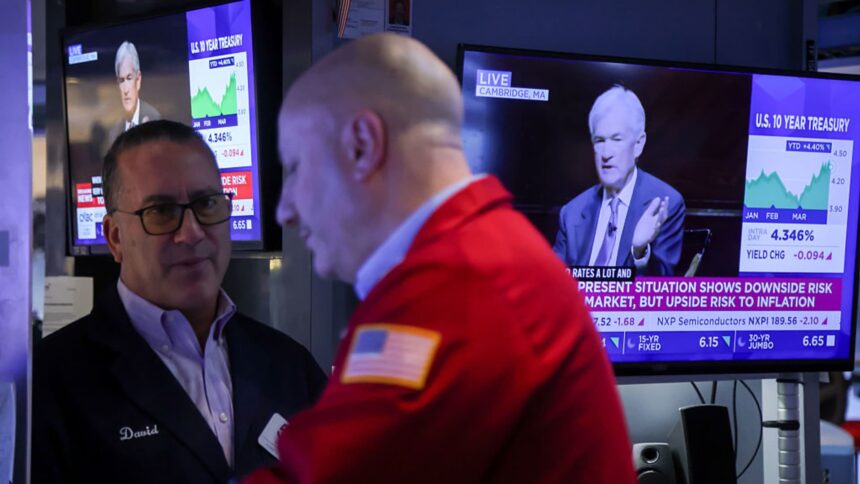
A television station broadcasts Jerome Powell, chairman of the US Federal Reserve, on the floor of the New York Stock Exchange (NYSE) in New York, US, on Monday, March 30, 2026.
Michael Nagle | Bloomberg | Getty Images
The S&P 500 traded lower on Monday as traders failed to sustain a rally following comments by Federal Reserve Chair Jerome Powell that assuaged concerns about a possible interest rate hike.
The broad-based index dipped 0.1%, though losses were capped by a more than 1% gain in both the financials and utilities sectors. The Nasdaq Composite dropped 0.4%, while the Dow Jones Industrial Average added 170 points, or 0.4%.
The CBOE Volatility Index, otherwise known as Wall Street’s fear gauge, traded above 30 during the session.
U.S. oil prices also rose to start the week, with West Texas Intermediate futures up 3% at above $103 per barrel. Brent crude futures were little changed, trading above $112 a barrel.
Fed Chair Powell said Monday that even with rising energy prices, he sees inflation expectations as “well anchored beyond the short term.” While he did say that the central bank could “eventually maybe face the question of what to do here,” he stressed that it’s “not really facing it yet, because we don’t know what the economic effects will be.”
The yield on the 10-year Treasury slipped following those remarks. The benchmark yield was last down more than 9 basis points at 4.344%.
Meanwhile, President Donald Trump offered some hope to investors that an end to the war against Iran could be drawing near. The president in a post on Truth Social Monday that the U.S. is “in serious discussions with A NEW, AND MORE REASONABLE, REGIME to end our Military Operations in Iran,” adding that “great progress has been made.”
However, the president also said that if a peace deal is not reached “shortly” and the Strait of Hormuz is not “immediately” reopened, the U.S. will “conclude our lovely ‘stay’ in Iran by blowing up and completely obliterating all of their Electric Generating Plants, Oil Wells and Kharg Island (and possibly all desalinization plants!), which we have purposefully not yet ‘touched.'”
This comes after Trump said Sunday that Tehran had accepted most of the U.S.’ 15-point plan to end the war and that Iran has agreed to allow an additional 20 oil ships to cross the Strait.
Traders have worried in recent weeks that higher energy prices could hurt the economy. But David Wagner of Aptus Capital Advisors is “not too worried,” saying that a sudden spike “can rattle investor confidence and stoke inflation fears, but the shock typically dissipates as the economy and the markets adapt.”
“The basics remain very strong,” the head of equities told CNBC, noting that earnings growth for the S&P 500 on a year-over-year basis is “still kicking well above [its] historical growth rate.” He added, “People are trying to make it a growth scare, and it’s not.”
Wall Street is coming off a losing week, with the Dow and Nasdaq tipping into correction territory. The Dow, Nasdaq and S&P 500 all posted their fifth straight weekly declines.
The market will be closed on Friday in observance of Good Friday, although the March jobs report is still scheduled for release that morning.