




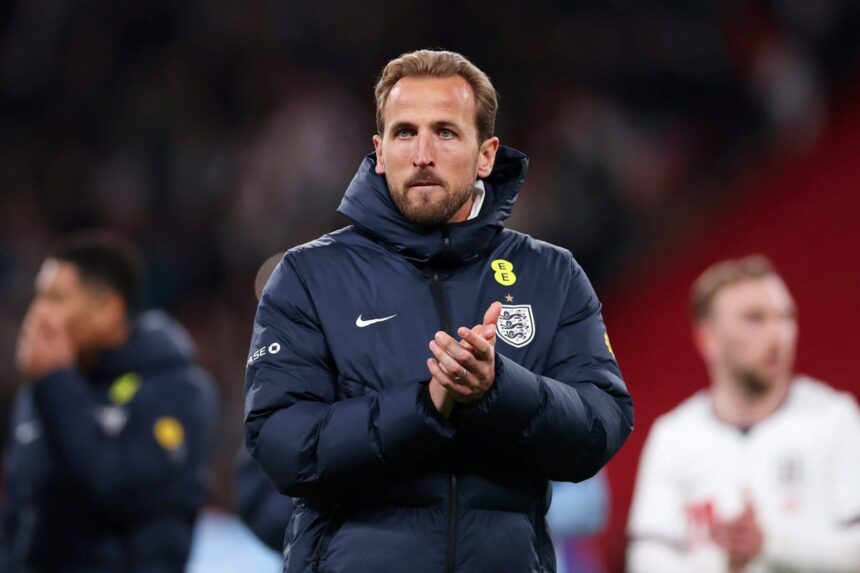
It can be tempting to over-complicate international football, to look at the deep roots of everything: youth coaching, goal sizes, player pathways, national traits, shared public consciousness. But sometimes it can be disarmingly simple. You don’t have to look at the historical factors. You can just look at the teamsheet.
When Harry Kane plays for England, they are good. When Kane misses out, they are not.
That, more than anything else, is the lesson of this international break. England have had two home friendlies against two competitive teams, Uruguay on Friday and Japan on Tuesday. Kane did not play either of them, missing the Japan game as a precaution. And across these two games, England managed just one goal, when Ben White tapped in on Friday. Against Japan, they created even less in open play.
Put these two games together and you have a sobering body of evidence about what England cannot do when Kane is not on the pitch. Tuchel has clearly worked hard to come up with solutions, ways of playing that he could deploy at the World Cup if Kane were not there. But they have not looked like working.
Against Uruguay, Tuchel tried to keep it simple. He played a conventional No 9 in Dominic Solanke, who worked hard and pressed well. He was replaced by Dominic Calvert-Lewin, who missed a good chance with his head. England needed a set piece to score when Cole Palmer’s corner was flicked on at the near post and White rolled the ball over the line.
But against Japan, Tuchel decided to try something different. Rather than playing with a conventional No 9, he went for a more elaborate system. There was no true striker for England. Phil Foden was playing as a false nine, often dropping alongside No 10 Cole Palmer, with Anthony Gordon and Morgan Rogers on the wings. It looked like a clever way to overload Japan in the middle of the pitch, to move their defenders around and attack the space.

Phil Foden struggled as a false nine against Japan (Adrian Dennis/AFP via Getty Images)
It was a disaster. England had so many players in attacking positions that they often looked confused, unsure where to make a run or where the next pass should go. They looked like the one thing they needed more than anything else was the reliable sight of Kane, the reference point, not just England’s best goalscorer, but their best football brain, too. The rest of them looked lost without him. They created almost nothing in open play.
Tuchel tried to put a brave face on it afterwards, insisting that every team in the world would miss a player of Kane’s quality, and that his England team have won games without Kane in the past and will do so again in the future. Even if it is, in his words, “easier to win matches with Harry”. But there is no point blaming Tuchel for this.
This sense of being listless without Kane is nothing new. More than anything else, this game was reminiscent of the 2-1 defeat by Greece here in October 2024 when Lee Carsley was in charge, just before Tuchel was announced as his permanent replacement.
That night, Kane was injured, and Carsley tried to pick the boldest, most talented team possible, with Jude Bellingham nominally up front, and Foden, Palmer, Gordon and Bukayo Saka in, too. It was a mess. England were torn apart and were lucky to only lose 2-1. The players struggled with no Kane on the pitch for them to cohere around.

Thomas Tuchel does not boast plentiful centre-forward options (Justin Setterfield/Getty Images)
Eighteen months on, Tuchel had effectively thrown down a challenge to these same players in his media activity on Monday at Tottenham’s training ground. When asked why England struggled to score in games against the biggest teams, he pointed to the fact that the numbers his attacking players were recording — with the explicit exception of Kane — were below expectations. It felt like he was giving Foden, Palmer, Rogers and Gordon the chance to respond on the pitch.
But instead, those players just proved Tuchel’s point. The worrying thing for England right now is that, just as Tuchel said, none of their attacking players apart from Kane are in sparkling form. That is as true of those four who started as it is of Eberechi Eze, Saka, and Noni Madueke, who were all injured.
So, where does this leave England over the next two months before they fly out to Florida? Frankly, watching the conclusion of Bayern Munich’s season from behind the sofa. Tuchel even admitted it will be “scary” to watch the climax of the season on TV, not with reference to Kane, but to his whole squad. If Kane makes it through safely and flies to the World Cup free of injury, then England can still be a good team. They showed that over the course of the qualification campaign, winning all eight games, the only team in Europe not to concede a goal.
But too many recent tournament campaigns have ultimately been determined by Kane’s fitness. He never looked right at Euro 2024, England progressed without playing well, and he was hooked for Ollie Watkins an hour into the final. At the Qatar World Cup, Kane picked up an early foot injury, which dominated the discussion. And at Euro 2020, Kane started sluggishly, finding his form in the knockouts, but then looked spent by the time of the final against Wembley.
Of course, Tuchel will have to keep thinking up plans in case he has to go into big games this summer without his captain. Maybe Solanke, maybe a false nine, maybe even trying Bellingham and having a different No 10 behind him. Although Tuchel admitted in his post-match press conference that there is no point looking for a “second Harry Kane” because no such player exists.
Perhaps those June friendlies in Florida will give him one more chance to experiment, but the simple reality is that any Kane-less plan will struggle to get off the ground. Sometimes the only rational thing is to keep your fingers crossed.