

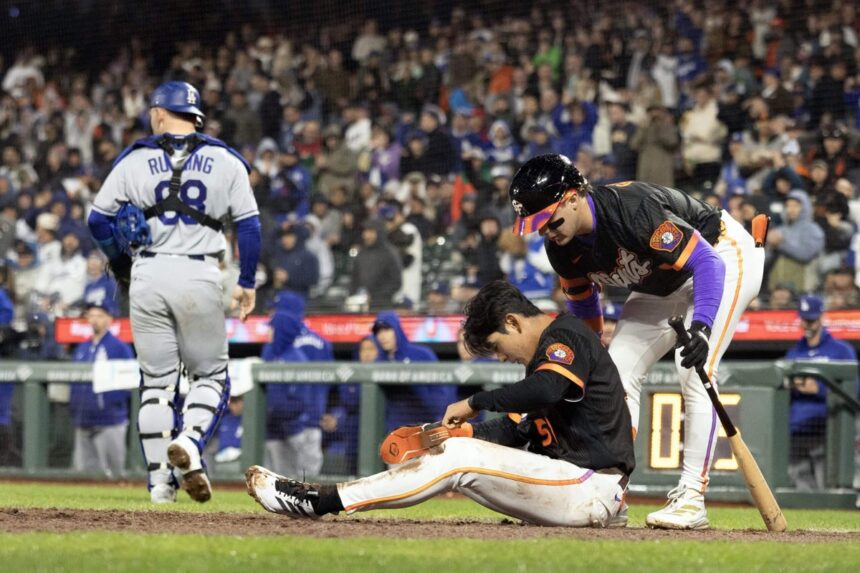
On Thursday, the San Francisco Giants were one-hit for the second time this season, putting them in rare company. Even though they’ve played just 25 games, they’re now just the 11th team in franchise history to have at least two one-hitters thrown against them. The last one to suffer the same fate was the 2010 Giants, if that makes you feel better, which it does not.
The 2026 Giants are supposed to be a team that can hit dingers, but they’re too often a team that can be shut down by just about anyone with a 97-mph fastball and an idea of where to put it. It’s also a team that just had an impressive series against the best team in baseball, series finale be damned, so it’s not probably not the best time to absolutely eviscerate them. They’ve become complicated, which is much better than they were just a week ago, but, well, it’s complicated.
So let’s look at where the Giants have been struggling or holding their own around the diamond, and we’ll use Wins Above Average, which accounts for park and defense, but also includes everyone who plays a position, giving you a good idea of how the team as a whole is doing. (Note that this isn’t the same thing as WAR, a different stat on a different scale. A completely unhelpful way to remember this is that WAR is what you bring to Wario’s front door, and WAA is what he says when you’ve brought it there.)
Here’s where the Giants rank among the 30 MLB teams in WAA at each position, along with what that says about the team’s direction and if there might be help on the way.
To start with, your palate is always getting cleansed. So let’s start with a palate dirtier and really muck that sucker up.
Overall — 29th out of 30 (-2.8 WAA)
Not ideal! If there’s any consolation, it’s there are a lot of would-be contenders keeping the Giants company. The Mets are below them, of course, and the Rays, Phillies, Blue Jays, Red Sox and Astros are all around the bottom of the WAA standings. This is a great place to start because it gives the numbers below some context. Some of the individual numbers won’t look so bad, but keep the collective results in mind. (Note that all plate appearances reflect those taken when the player was actively playing the position, not as a pinch-hitter.)
Starting pitching — 27th (-0.9 WAA)
Tyler Mahle’s recent start was more than a little encouraging, and Logan Webb has both pitched less effectively than normal and had buzzard’s luck, the sinkerballer’s eternal curse. They can both be true, so maybe there are glimmers of hope. Landen Roupp has been outstanding, and Robbie Ray has been as good as the Giants could have possibly hoped. There could be a rotation here, after all.

The jury is still out on whether Adrian Houser was a good signing. (Orlando Ramirez / Getty Images)
That’s the good news. There’s plenty of room to be concerned with Adrian Houser, and his positively Rueterian strikeout rate (4.6 K/9!), and he’ll get side-eyed until he has a proof-of-concept start like Mahle’s on Wednesday.
Bullpen — 9th (0.3 WAA)
One of the most unsettled parts of the team heading into the season, the bullpen was still completely disheveled into the first two weeks … and then they smoothed things out. Not entirely, but enough to look like the kind of bullpen that was built on purpose, with defined roles and everything. Ryan Walker has looked like the best version of himself in his last two outings, both saves, and that’s important because the best version of Walker was pretty remarkable.
There’s a long way to go still, but even though the Giants’ bullpen is somehow in the top 10, they’re trending upward. Yet another reminder that I should have been a basketball analyst.
Catcher — 24th (-0.4 WAA)
Patrick Bailey — 66 PA
Daniel Susac — 20 PA
This one was much higher before Thursday’s game, which shows how vulnerable all of these numbers are to relatively wild fluctuations early in the season. Bailey’s exquisitely timed three-run homer against the Dodgers on Wednesday got them out of the dungeon, and Susac’s absurd start (albeit in 23 at-bats) and their collective defense has made up for the overall abysmal offensive numbers from the starter. Bailey can have some of the worst slumps in baseball history, and that’s not hyperbole. When he’s cold, he can get as cold as anybody ever has been. Ever! He’s also better than anyone has ever been at stealing strikes, which helps even all of this out.
See? Complicated. But, more specifically, bad at hitting (unless it’s a high-leverage situation against the Dodgers, and this tradeoff is more than fair.)
First base — 28th (-0.8)
Rafael Devers — 63 PA
Casey Schmitt — 29 PA
Jerar Encarnación — 6 PA
You knew this was coming. The simple truth is that when Devers isn’t hitting, he’s one of the worst players in baseball. He doesn’t help on the bases, and his fielding at first base this season has been rougher and less promising than it was last year. He has to hit. He has to make fewer outs than almost everyone around him.
If you’re wondering about Bryce Eldridge, the good news is that he’s hitting .293 with a .396 OBP in Triple A. The bad news is that’s come with 31 strikeouts and two home runs, and his defense is also a work in progress. His slugging percentage is just 20 points above the Pacific Coast League average, as he adjusts to more advanced pitching. It’s probably a good sign that his method of adjustment is to continue getting on base at the expense of power, which you’re absolutely not worried about with Eldridge in the long run. Sacramento is still the place for him. Polish the big feller up before he inherits the full burden of a run-starved team.
It would be helpful if Devers could not be one of the worst regulars in baseball, though. At least he’s been hitting the ball relatively hard the opposite way lately, which is proof that he’s trying something different with (modest) success. If he’s not hitting baseballs very far and taking walks, he’s not doing much at all.
Second base — 8th (0.4)
Luis Arraez — 97 PA
Christian Koss — 7 PA
Arraez is having a fantastic season, offensively, defensively and in the court of public opinion. He had the one hit on Thursday, which means there’s a decent chance the Giants would have been no-hit by Tyler Glasnow without him. For the first time I can remember, you should be excited about the thought of extending a player with an OPS under .700 (he’s hitting .304/.340/.359).
If the defensive gains hold, Arraez can fit on any roster, any lineup. Every team needs at least one guy who makes the pitchers roll their eyes in annoyance. Here’s a guy.
Shortstop — 20th (-0.1)
Willy Adames — 107 PA
Adames looked like he was on the verge of breaking out, and then the baseball gods dumped a bucket of ice-cold Powerade on him, as they’re wont to do. If you’re worried about this, keep in mind that Adames has, somehow, been one of the most consistent players in baseball, with a WAR between 2.9 and 4.2 in every season since 2019, with the exception of the pandemic season, when he earned 1.8 WAR. … which was still pretty danged good.
He’ll be fine, and you can say this every April about Adames until you can’t. Throughout his entire career, he’s always mixed in enough hot streaks to be reliably valuable. One of these years, that’ll stop, but there’s no specific evidence to suggest it’ll be this year. He’s probably fine.
Third base — 3rd (0.7)
Matt Chapman — 105 PA
I’d say that defense doesn’t slump, but there was a whole lot of slumpy defense from Chapman to start the season. Still, while his ultra-high ranking hints at a thin overall third-base pool, it’s a sign that he’s doing what the Giants are paying him to do, more or less. They’d prefer more dingers, and they’ll likely come as the weather heats up, but for now, this is a position that’s a part of the solution, not the problem.
Outfield (all) — 29th (-1.3)
Almost half of the Giants’ 29th-place finish overall in WAA is due to the outfield’s low ranking. If this has a sense of familiarity you just can’t place, the Giants’ recent outfield history can explain it.
2025: 18th (-1.1 WAA)
2024: 19th (-2.2)
2023: 23rd (-2.9)
2022: 21st (-2.7)
Not since the halcyon days of 2021 have the Giants had an outfield worth a dang. There was a time before that when Mike Yastrzemski made up for a lot by himself, but overall the Giants have offered a vast, forever encroaching outfield desert since Barry Bonds left. You might have thought that was over. It was not.
Heliot Ramos and Jung Hoo Lee have done a lot of work recently to get back to the land of the living. Ramos has boosted his OPS nearly .200 points over the last 10 days, and Lee’s has jumped almost .250 points since his season low of .439 on April 8. They might not be trending upward like a rocket, but they’re not historically awful anymore. A player can build on “not historically awful,” and they’re doing it.

The Giants’ outfield has really struggled, but Heliot Ramos and Jung Hoo Lee have both been on the up-swing. (Eakin Howard / Getty Images)
Harrison Bader was one of my picks to click this season based on some early batting practice sessions in Scottsdale, which goes to show you that there’s a reason baseball doesn’t usually exist in February. During the regular season, he had about 50 of the worst plate appearances you’ve ever seen, then disappeared to the IL with a hamstring injury, which you were told to expect. The good news is that you’ve seen the floor, and there’s only one direction to go from here. The bad news is that you’ve seen the floor, and goodness, it is low. So much lower than you thought.
The full outfield playing-time breakdown by position goes like this:
LF (23rd, -0.3): Ramos, 90 PA; Will Brennan, 4 PA; Encarnación, 3 PA; Jared Oliva, 1 PA
CF (28th, -0.6): Bader, 54 PA; Drew Gilbert, 26 PA; Oliva, 5 PA; Jung Hoo Lee, 5 PA
RF (21st, -0.4): Lee, 90 PA; Encarnación, 6 PA
Aside from Bader, one of the bigger disappointments of the early season has been Encarnación, who is forever on the cusp of using his outlier tools to produce runs, but is rarely producing any actual runs.
There aren’t a lot of players forcing the issue in Triple A, either. Grant McCray’s newfound transformation into a contact-and-patience guy is meeting with some success (.378 OBP) and struggles (.194 BA, .242 SLG). Victor Bericoto’s spring breakout has become much more muted, and we’ve already seen Gilbert and Brennan.
The Giants have a lot of outfielders playing well in the low minors, which doesn’t help them a lick. As with just about every other position on the team, the only solution is for the underperforming players to stop underperforming. Because if they’re not underperforming, and this is just their new default level of production, the Giants just might be cooked. It’s been the worst part of the team so far, and it can get much better.
Designated Hitter (29th, -0.6)
Schmitt — 48 PA
Devers — 42 PA
Encarnación — 7 PA
Arraez — 4 PA
Brennan — 3 PA
Over 4,014 plate appearances in franchise history, Giants designated hitters have a .731 OPS, which is the seventh-worst mark in baseball. I’m not going to take the time to run the numbers without Bonds (1.034 OPS in 172 PA), but I’m sure he’s cooking even these numbers a little bit. The Giants have never had much luck with the DH, either in interleague play or after the rule was universally adopted in the NL.
The good news is that I’ve checked the rules, and teams can put literally anybody at DH. The Dodgers are using a pitcher to fill their spot, even though that’s the position that’s historically the worst at hitting. (Good luck with that, fellas. 🙄🙄🙄). That means this is the spot that’s waiting for someone to get hot, whether it’s Eldridge or Encarnación or Schmitt again.
Pinch Hitters (12th, -0.1)
Susac — 4 PA
Encarnación — 4 PA
Ramos — 2 PA
Oliva — 1 PA
Lee — 1 PA
Bader — 1 PA
Can’t have a bunch of negative value from your pinch-hitters if you don’t use them. Now that’s thinking one step ahead.
The Giants need to play better. They have been, but there’s still plenty of room for improvement. Right now, the only reason they’re as close to .500 as they are is the bullpen, Arraez and Chapman, all of whom are playing better than their peers at their positions. They’ll need a lot more players to join this group if they’re going to get unstuck, however. The Giants have won two series in a row, and they’ll need all hands on deck to keep it going. Most hands, at least.