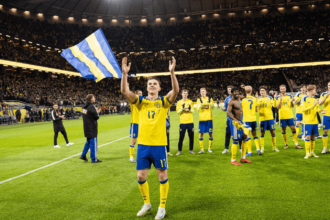





It was billed as the big farewell, yet it needed a major wake-up call.
The Melbourne crowd was subdued. Australia had been pegged back to 1-1 by World Cup qualifiers Curacao. Head coach Tony Popovic made a quadruple substitution.
Popovic would later say the situation merely brought forward his planned changes by a few minutes. The confidence that blossomed from what happened next might well carry through to the tournament itself.
Within 60 seconds, they had retaken the lead in front of the 16,764 AAMI Park crowd. Just 23 minutes later, they were celebrating a 5-1 victory.
This win was ignited by the introduction of Australia’s rapidly establishing spine and two attacking talents in Jordy Bos and Nestory Irankunda, who have the potential to make a similar impact on the global stage this summer.
Parma defender Alessandro Circati, 22, told The Athletic in the mixed zone following victory over Curacao: “We’re very young, we’ve got lots of energy… we’re quite explosive even, not only as individuals, but as a collective. That can be a strength of ours, and we should use that to our advantage.”
With 71 days until the start of the World Cup — and eight more before the USMNT faces Australia in Group D at Lumen Field, Seattle — this is where Australia finds itself. What will the USMNT come up against? A “mission to wreck.”
Those three words originate from Nike’s marketing campaign for Australia’s World Cup kit release at the end of March, but the sentiment is resonating much wider.
And the U.S. have played a role in why.
The imagery behind it matches the football principles Popovic is trying to instil in his team, so they become “second nature” at this summer’s tournament: front-foot, aggressive, and energetic.
There is an undertone, too. The aim is to disrupt the scripts and best laid plans of the teams they will come up against.
Those will include Panama, Turkey and the United States as hosts and Group D top seeds.

Tony Popovic wants his team to be front-foot, aggressive and energetic (Robert Cianflone/Getty Images)
The draw in December brought some enthusiastic reactions from numerous U.S. soccer commentators and media contributors, who described Australia as the weakest of the teams they could have drawn from Pot 2 and likened the second group game to a “layup … an amazing first team to have (drawn)”.
That was the initial reaction of former USMNT forward and CBS analyst Mike Grella on Golazo’s live coverage of the World Cup draw, and while those sentiments have not been shared openly by the current U.S. playing or coaching staff, they have been sitting in the back of Australian minds since the draw was made in December.
“If anything, their reaction gives us more motivation to get the win against them,” said Bos in the mixed zone following victory over Curacao. ”I’m looking forward to that game.”
Middlesbrough midfielder Riley McGree added: “I kind of find it funny and some boys find it motivational, some boys let it get to them, but from a personal point of view, it’s just fluff.
“They’re just another nation we are going to prepare for and try to beat. Go there and give our all. That’s competition, the competitive nature of the game. Bring it on.”
Bos, an increasingly influential 23-year-old winger with Dutch Eredivisie side Feyenoord, scored the opening goal in Australia’s 2-1 friendly defeat to the U.S. in a feisty affair at Dick’s Sporting Goods Park, Colorado, in October.
His own development in recent months has been visible to Popovic, seeing a high-impact player now beginning to sustain those levels for the majority of matches — exemplified by Bos scoring in the 85th minute on Friday as Australia beat Cameroon in Sydney.
Australia and the U.S. share a similar dynamic heading into this World Cup.
Both have promising young squads with popular head coaches still relatively fresh in the hot seat, looking to implement a proactive, aggressive style and hoping that will ignite a soccer supporter base far beyond the domestic hardcore.
They are countries used to demanding and achieving success, especially across sports they excel at: their own codes of football, and with bat and ball in baseball or cricket, for starters.
However, soccer — and men’s soccer in particular, given previous successes by their respective women’s national teams — has not reached the same bar.
Which is why it often takes a World Cup and the opportunity to satisfy the nation’s lofty sporting expectations to thrust the USMNT and Australia into its wider consciousness.
“We’ve had a couple of camps since (October) and we’ve learned a lot from them. We’re in a better position and better form,” added Bos. “The boys have jelled over the last couple of months, and we’ve still got a little camp before the World Cup as well to polish off.”
The white silk glove flew through the sky as if it came out of nowhere. But this was deliberate, and his team-mates knew what was coming. It had been rehearsed repeatedly through Australia’s training camp.
Fresh from putting Australia 3-1 up thanks to some fast feet and an assured finish, Irankunda produced a backflip to celebrate as he ran to the corner.
That’s when the glove arrived, thrown by a photographer friend and caught by the 20-year-old Watford forward, who took an almost awkward amount of time to put it on his right hand before performing a five-second Michael Jackson tribute act.
Nestory Irankunda, that is MAGNIFICENT 🤩
Sensational footwork. Tidy finish. Even better celebration!
🇦🇺 4-1 🇨🇼#Socceroos #AUSvCUW pic.twitter.com/XM58PXXNGS
— CommBank Socceroos (@Socceroos) March 31, 2026
Irankunda had already warned Bos against having the temerity to invade his space to congratulate him on the goal and disrupt the choreography.
Much of Australia’s World Cup enthusiasm is borne from a young playing group with potential for energy, excitement and flair.
Popovic has chopped and changed with every international window.
Across the victories over Curacao and a youthful Cameroon, Popovic gave 16 players a start. The first of those teams included four players aged 24 or under, while Colorado Rapids’ 18-year-old defender Lucas Herrington was among six players to start both games.
Speaking in his press conference following the win over Curacao, Popovic said: “We wanted to see certain things on the park, we wanted to expose some players, try some new players. There’s an 18-year-old who’s played two games in four days, which is extraordinary really.
“So everyone should go back to their clubs confident. We want to see them play well, finish the season strong, and have as many available and healthy for selection come June 1.”
Popovic himself is making progress, too. Brought in to replace Graham Arnold and save the country from a demoralising qualifying failure in October 2024, the former Australia and Crystal Palace centre-back delivered wins over a weakened Japan in Perth and then in Jeddah over Saudi Arabia to guarantee a World Cup finals berth at the first opportunity.
The defeat to the U.S. ended a 12-game unbeaten run, with March’s international window delivering their first victories since.
Not that Popovic’s influence has been limited to the pitch. Marginal gains, such as new pillows for the players to aid their sleep, have been given attention, too.
“I’m always looking at ways to improve, and Tony has opened even my eyes as to his level of professionalism,” said 33-year-old former Brighton and Arsenal goalkeeper Mat Ryan, who is preparing for his fourth World Cup finals.
“A lot of the things are not too different. It’s just the level of detail or what they demand of us is a bit more intense.
“We’ve had nutritionists, but our nutritionist Julie (Meek) is now in with us 24/7 in camp and monitoring things, basically following us all around the dinner table, lunch table, and breakfast table, making sure we’re fueling ourselves correctly.

Australia lost to the USMNT in October last year (Dustin Bradford/Getty Images)
“Tony knows the difference those one-percenters can make is the difference between achieving great things and not.”
Australia are scheduled to play a friendly with World Cup co-hosts Mexico at the Rose Bowl, Pasadena, on May 30, with a final preparation game against unconfirmed opponents to follow ahead of their opening Group D game against Turkey.
Another friendly, to take place before facing Mexico, is also in the pipeline ahead of Popovic inking his final 26-man squad; one that will carry Australian hopes of emulating their round of 16 appearances in Germany at the 2006 edition and then Qatar 2022 — and the dream of even more.
All of which would likely require a positive result against the United States.
“It’s not about upsetting (anyone),” said Irankunda. “I feel like we have one goal, which is to achieve something great, achieve something that’s never been achieved before. We want to be that group that goes all the way and potentially wins the World Cup.
“No one has the belief in us obviously, but we have the belief in ourselves to go do something great.”
The U.S. has been warned. First, Australia found its reason — now it’s finding its form.