


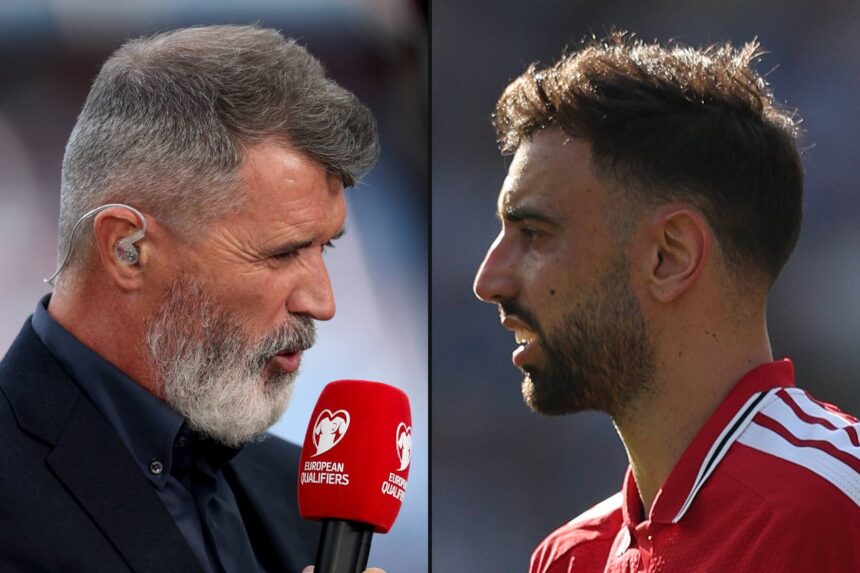
“I see a lot of ex-players doing talk shows and all that, and whilst I understand that some need the money and can’t chill out financially like I or other players could, it’s still sad”.
Those were the words of Roy Keane in an interview in Philadelphia in 2004. He was brilliant, completely engaging and more interesting than many ‘to be fair to the lads’ contemporaries. Manchester United fans loved the interview.
It gave an insight into what Keane, the player, thought of former players doing media. It was a different media landscape then, with money on offer to appear in OK or Hello magazine. Would he be the type to accept?
“If the offer was right,” he said, laughing. “No. If I ever did it, I would love them to come to my house at five o’clock on a Tuesday. I’d love that. They’d see the dog, mud, the kids screaming, my missus would have her jeans on, and I’d have a trackie on.
“It would be my real life, people would enjoy it more, and it would be very different from the ones you see of the footballers with lovely jeans and who change their shirts for every photo. You see them clean-shaven, and their missus looks stunning, their kids immaculate. That’s the image they want to send out, of a lovely family who never argues.
“I’m not really against these things because if someone is prepared to offer ridiculous money, then I can understand why some people take it. And I can hardly call them when I got dressed up as a leprechaun (in an advert) for Walkers (crisps) a few years ago, can I?”
It was said with a smirk. Keane does this a lot, the mock exasperation too. And the contrary stance. It’s one reason why he’s engaging and beloved by people who never saw him play.

Roy Keane’s wit and exasperation has made him a popular pundit since he retired (John Walton/PA Images via Getty Images)
He’ll happily hear a word said against Sir Alex Ferguson and even against himself. Take telling him that his performance against Juventus in 1999 was the best I’d seen. He seemed affronted.
“I did alright,” was his deadpan answer.
In the past two weeks, Keane has been at the centre of a storm around Bruno Fernandes and his assist record. Fernandes broke the single-season record for setting up goals when he provided Patrick Dorgu’s goal against Brighton on Sunday. It was the Portugal international’s 21st assist of the season.
In the days after Fernandes matched the record but before he broke it, Keane made it clear he did not agree with Fernandes actively pursuing the goal. Speaking on podcast The Overlap, Keane said: “When you’re the captain of a club, and you’re supposed to be driving the club forward, do not be getting bogged down by just your role in the team, just assists.
“What I heard at United at the weekend, honestly, I was raging with it. The whole chat about his assists… Everyone, the players were [talking about it], the game was about his assists. That’s the whole thing.
“After the game, he got interviewed, and he said, the captain of Manchester United, said, ‘A few times, I probably should have… shot, but I made the passes.’ Wow. How can your mindset be not to win the match but be about an individual record?”
Keane then added: “He won’t be winning trophies, not with that mindset of the team. They’re giving up two goals and everyone’s getting all giddy because he’s equalled the record for assists. It’s mind-boggling. It’s a circus act.”
Fernandes hit back during an appearance on The Diary of a CEO podcast: “People have an opinion, they think it’s good, bad, whatever. And, in this case, what Roy Keane said is a lie. Luckily for me, everything is recorded.
“Imagine if it wasn’t. People will think, ‘Bruno is the guy always trying to get the assist’. I accept his criticism, I accept that he might like me as a player or not, like me as a person or not.
“But what I don’t like is that he puts words in my mouth that have not been said, that’s the only thing I don’t like.”
And finally, Keane appeared to respond in an Instagram post which read: “Too much attention makes a donkey think he’s a lion.”
I disagree with what Keane said about Fernandes, but can see where he was coming from with the sideshow about assists. Assist records did not feel like anything significant a few months ago, but they are now. They’re to be celebrated because Manchester United don’t have any real trophies to celebrate, and the media need talking points. And who are the fun police to say Fernandes and fans shouldn’t enjoy it?
Keane’s been hammered for it in the court of public opinion. It’s partly because of that, partly because of a perception that former players overly criticise Manchester United. It has bred contempt, it annoys fans and it annoys current players too.
Fernandes was right to push back too, he had a superb season and hadn’t even said what Keane suggested.
He’s also not the only current player to push back publicly on what former players have said.
Lisandro Martinez went back at Paul Scholes after January’s Manchester derby. Before the game, Scholes and Nicky Butt had mocked Martinez’s size, especially in the context of facing Erling Haaland. A lot of fans didn’t like Scholes’ words — and there is a growing sense they will support those who represent their club over any individual. It might be the case that people are tiring of former heroes hammering something they care deeply about – Manchester United – especially if they weren’t, as is now the case for many younger fans, their heroes.
None of this is new. Former players and managers have always said things were better in their day. My uncle Charlie Mitten used to spend Sundays speaking about how everything used to be better when he played. He was appalled that a player could miss a penalty just…because he didn’t. But he was also angry because he’d left the game where he was a United star without enough money to buy a car.
Tommy Docherty was a hugely popular United manager in the 1970s. He lost his job after an affair with the wife of the club’s physio came to light. By the 1980s he was a talking head on what’s now called legacy media. In a precursor to the post-truth social media age, Docherty’s grasp of the truth wasn’t always firm, but he could be witty, and he thought he was speaking like the man in the pub. Because, for a long time, he was.
But his currency was criticism and, ultimately, it was worthless once Alex Ferguson started winning, given he actually knew what he was doing. Doherty had climbed up the hill of public criticism. And, unlike fans who’d done the same and could say ‘I’ve got to hold my hands up’, Docherty couldn’t meekly get off it, no matter how many times he complimented Ferguson. It was set in stone.
Inevitably, when someone of Keane’s status says something, people take notice, especially if it is spliced and served up for people to take notice and react and rage over. Ex-players might not realise the extent to which this is happening, their words cut into juicy pieces of bait to be digested and dominate the narrative around the club. Or even if they care. Publish and be damned — or whatever the modern-day equivalent is.
Why do former players/managers do this? Relevance? Enjoyment? Work? Money? Telling it how it is? Platforming their views to get back in the game? Only they know.
A declining tabloid world has also pushed the online views of former players to prominence.
Questions that begin with “X (a former player) said Y” have become normal at press conferences. Current managers or players can ignore or react to stoke the fire.

Bruno Fernandes broke the Premier League assist record on Sunday (Steve Bardens/Getty Images)
I loved Keane’s two autobiographies but pay almost no attention to the new shock jock soundbites (except when my editor asks me to write articles like this), but millions do. And they clearly enjoy it all. Are the players damaging their legacies? Yes and no. Some former greats did awful things after they stopped playing — but they’re remembered as great footballers.
Keane in person is polite, friendly and funny. You can tell him that Jesper Blomqvist was upset that he didn’t speak to him for seven weeks after what he considered a misplaced pass that led to Keane’s yellow card, which caused him to miss the final in that Turin 1999 game.
“And it wasn’t even a bad pass,” explained the softly spoken Jesper.
Keane was taken aback. “Hell of a player, Jesper,” he reminisced, ready to go to war for the Swede.
In any industry infused with bullshit and criticism, there are those who played with Keane who won’t hear a word against him. There are multiple stories of him attending the bedsides of dying fans and sitting with them for two hours. Keane has dealt with rude fans who come up to him, considering him public property — they are told exactly where to go. Courteous fans are greeted in return.
Keane’s opinion is clearly one that people want to hear. What they might never hear is the other side of the person.