

If this was a normal World Cup year, Christophe Gleizes would be busy.
As a reporter specializing in African football, he would be reading, traveling, talking to people, checking in with sources and looking for offbeat stories around the tournament that he could bring to life in the pages of the Paris-based magazine So Foot.
But for Gleizes, this World Cup year has been like no other. With the tournament looming, the 37-year-old Frenchman is languishing in an Algerian prison after being handed a seven-year jail sentence in June 2025 for “glorifying terrorism” and “possessing propaganda publications harmful to the national interest”.
His supporters and human rights groups are adamant the charges brought against him were a nonsense, cooked up by an Algerian regime eager to inflict harm on France – the north African nation’s former colonial ruler – at a time of profound diplomatic tension between the countries.
After an appeal against his conviction was dismissed last December, Gleizes’ family recently abandoned attempts to overturn the verdict via judicial avenues and have squarely pinned their hopes on obtaining a pardon from the Algerian president, Abdelmadjid Tebboune.
Signs of a thaw in Franco-Algerian relations have raised hopes that Gleizes might soon be allowed home. But for now, he remains behind bars at Kolea Prison, 22 miles south-west of the Algerian capital, Algiers.
With France and Algeria among the 48 teams due to participate at the World Cup, there is optimism in Gleizes’ homeland that the tournament will serve as a tipping point in the quest to secure his freedom.
“The World Cup represents a fantastic opportunity to raise awareness,” Thibaut Bruttin, the director general of Reporters Without Borders (RSF), told The Athletic during an interview in Paris.
“We think it would be a disgrace if France and Algeria played at the World Cup without saying a word about Christophe. I hope we’ll be able to count on FIFA (football’s governing body) to allow this message to be heard.”
As the world prepares to turn its gaze towards Canada, the United States and Mexico, all that Gleizes’ loved ones can do is wait.
Wait — and hope.
With a ping on her phone early in the morning of May 21, 2024, Sylvie Godard’s life changed forever.
Gleizes’ mother was at home in the second-floor apartment that she shares with her husband, Francis, in the 13th arrondissement of Paris. The message came from an unfamiliar number, but it had been sent by her eldest son, Christophe.
“It was a long message,” she tells The Athletic while perched on a brown leather sofa in her artfully-decorated living room.
“He said that he was having trouble, that his computer and his phone had been seized and that he was going to try to contact the French Embassy in Algiers.”
As she speaks, her phone repeatedly chimes with incoming messages. In the two years since that fateful May morning, the quest to bring Christophe home has become the driving force in her and her husband’s lives.
“Myself and Francis are both retired, but I refuse to leave France because I want to be available here in case I receive a phone call or I need to do something,” explains Sylvie, who is a former HR manager at an investment bank.
“Our lives have been shaken and turned completely upside-down, but we live just for him and to see him freed.”

Gleizes’ mother Sylvie and her husband Francis (Tom Williams/The Athletic)
Gleizes was detained by Algerian police in the city of Tizi Ouzou in Kabylie, a mountainous region overlooking the Mediterranean sea at the country’s northern tip.
It was a region he knew well. He had previously spent time there reporting on the case of the Cameroonian footballer Albert Ebosse Bodjongo, who died in suspicious circumstances in 2014 while playing for the region’s star team, JS Kabylie.
On this occasion, his employers say he was in the area to write about the glory days of JS Kabylie and to pen a few player profiles.
But as a French journalist nosing around in a corner of Algeria where there are strong separatist stirrings, Gleizes attracted attention. And when police went through his phone, they discovered that he had been in contact — several years previously — with two men involved in Kabylie football circles, Ferhat Mehenni and Aksel Bellabaci, who were also members of the Kabylie self-determination movement (MAK).
It did not seem to matter that the contact pre-dated MAK’s classification as a terrorist organization by the Algerian government in April 2021. Or that Gleizes protested that his conversations with them had only ever been about football.
“JS Kabylie is like Athletic Bilbao for the Basques,” says Gleizes’ So Foot colleague Joachim Barbier. “They weren’t talking about politics at all. It was just: ‘What does this club mean to the people of Kabylie?’”
Gleizes had committed an offense by entering Algeria on a tourist visa rather than a work visa, but his bosses argue that the punishment met out to him dwarfed that particular crime by several orders of magnitude.
“If you say in Algeria that you’re a journalist and you’re doing something about JS Kabylie, you spend two days explaining yourself to police or the military and they follow you around for days,” says So Foot editor-in-chief Javier Prieto-Santos. “So Christophe took the risk of using a tourist visa.
“But if you use a tourist visa to work in Algeria, Algerian law says that you’ll be expelled from the country. Not that you’ll be jailed for seven years.”
Gleizes has always felt at home on African soil, having first set foot on the continent at the age of two when his father took up a diplomatic posting in Zimbabwe.
He has made dozens of trips to Africa over the course of his career and in 2018 he co-authored a book about the exploitation of young African footballers entitled Magic System: The Modern Slavery of African Footballers.
“He has this adventurous side to him and he manages to establish trust with people really quickly,” says Gleizes’ colleague Barbier.
“I think he deeply likes other people. And he loves Africa and African football.”
At the age of six, tragedy struck Gleizes and his family when his father was killed in a car accident. The crash also claimed the life of his father’s sister’s husband.
Francis Godard, a former university professor, became Gleizes’ stepfather when he was 12 years old. Two years later, he unknowingly set his stepson on the path to his future career by gifting him a set of So Foot magazines for his 14th birthday. “I will work for this magazine!” Sylvie remembers him saying.
Pierre De La Saussay first met Gleizes at school when they were seven or eight years old and says that his friend’s passion for both football and writing were evident from an early age.

Christophe Gleizes and Pierre De La Saussay (Photo provided by Pierre De La Saussay)
“He was a good student,” he says. “A joker, but a good student. And very, very good at writing. He’s always loved writing.
“When we were young, my father used to take the two of us to the Aquaboulevard water park in Paris. Often he’d stay at my house the night before. When my dad went out to pick up some croissants for breakfast, Christophe would systematically ask him to bring back a copy of L’Equipe. We’d be sitting in the car and he’d be poring over all the results – particularly PSG’s.”
Gleizes is a committed Paris Saint-Germain supporter and would regularly meet up to watch their matches at his parents’ apartment with his girlfriend, Valentine, and younger brother, Maxime.
While out on lease, he was able to watch PSG’s 5-0 victory over Inter in last season’s Champions League final on a big screen in Algiers. Within a month, he would be behind bars.

Gleizes is a committed Paris Saint-Germain supporter (Photo provided by Reporters Without Borders)
After his initial arrest in May 2024, Gleizes spent more than a year on lease, during which time he was forbidden from leaving Algeria. But despite having to report to a police station in Algiers every day, he was able to communicate freely via FaceTime and WhatsApp. His parents also made a number of trips to the Algerian capital to visit him.
When his trial came around in June 2025, his family spent the entire day holed up at the RSF offices in central Paris, where they received regular updates from the courtroom in Tizi Ouzou.
“We were thinking that the worst-case scenario was a suspended sentence,” says childhood friend Pierre.
“We could never have imagined that he’d get seven years. It seemed completely crazy. You just thought: ‘Fuck. Shit. What dimension have we just passed into?’”
The unfortunate context for Gleizes was that relations between France and Algeria had hit a low point over the previous year.
The French president, Emmanuel Macron, caused anger in July 2024 when he backed Moroccan sovereignty over the disputed Western Sahara, where Algeria supports the pro-independence Polisario Front. Algeria then jailed Franco-Algerian novelist Boualem Sansal on national security grounds (he was eventually freed in November 2025) and there followed a series of tit-for-tat diplomatic expulsions.
“Christophe was doing his job as a journalist and he hadn’t even published anything,” says Bruttin. “So to be accused of ‘glorifying terrorism’ was just absurd.”
The Algerian Ministry of Justice did not respond to a request for comment from The Athletic.
After the initial shock of Gleizes’ conviction, his family and supporters steeled themselves for an appeal hearing in Algiers six months later. But their nightmare only got worse.
“We were confident, because his lawyers dismantled all of the prosecution’s arguments one by one,” says Sylvie, who attended the hearing in person.
“The most difficult moment was when the judge came back in because the verdict was announced in Arabic and Christophe didn’t yet have his interpreter alongside him. A female lawyer who was sitting in front of me turned around and said: ‘Be strong, Madam. He’s got seven years again.’”

Gleizes’ mother Sylvie was confident his sentence would be overturned on appeal (STEPHANE DE SAKUTIN/AFP via Getty Images)
At the memory of this particular moment, Sylvie’s voice cracks and her eyes brim with tears.
“Christophe hadn’t yet been given the information,” she continues. “He was told maybe a minute later. That was very difficult. It was terrible.
“We asked, via our French lawyer, if we could hold him in our arms before they took him down. But they refused.”
After initially being imprisoned in Kabylie, Gleizes was transferred to the modern Kolea Prison near Algiers earlier this year. His cell, which he shares with another prisoner, measures nine meters squared.
He has access to an exercise yard, which he walks around for several hours a day to maintain his fitness, and passes the time by reading, journaling, writing poetry and cooking. He had been teaching a previous cellmate how to play chess, which is one of his passions.
He is allowed one phone call per month and is not allowed to send letters. Although his family are permitted to send him letters, not all of them get through.
Family visits take place every few weeks in a noisy visitors’ room made up of a long row of numbered counters with chairs on either side. Gleizes is separated from his visitors by a pane of glass and can communicate with them only via phone handsets that abruptly cut out when each 30-minute visit is up.
On a visit arranged to coincide with his 37th birthday on February 2, Sylvie succeeded in leaving some vanilla-flavored crepes for him. “He’s had a sweet tooth since he was little and he’s always loved crepes,” she says with a smile.

Gleizes’ family say he remains in good spirits (Photo provided by Reporters Without Borders)
The end of each visit is, inevitably, a moment of keen sadness. But his family has taken solace from Gleizes’ stoicism and the fact that he remains in good spirits.
“Even in the situation he finds himself in, Christophe hasn’t lost his sense of humor,” says Francis. “It’s what enables him to stay strong and to keep perspective.”
Shortly after Gleizes’ conviction was upheld on appeal last December, his mother and stepfather wrote a letter to Algerian president Tebboune asking for clemency. They also met Macron, who pledged his support.
They have written further to current and former French players with Algerian roots such as Zinedine Zidane, Karim Benzema and Kylian Mbappe, as well as PSG president Nasser Al-Khelaifi. None have expressed public support for Gleizes’ cause, but his family has nevertheless been moved by the reaction of the wider football world.
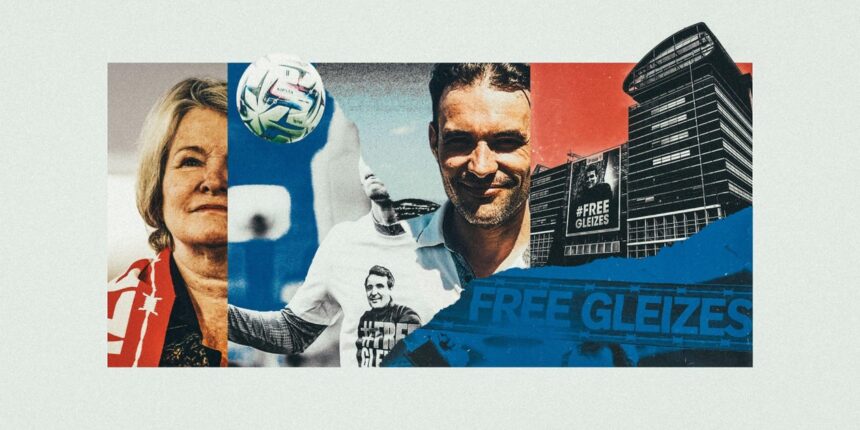
France’s Ligue de Football Professionnel and the French Football Federation have issued calls for Gleizes to be released, with the latter projecting an image of him on to the front of its Paris headquarters last December.
During its coverage of PSG’s Coupe de France tie with amateur side Vendee Fontenay shortly before Christmas, beIN Sports momentarily paused its commentary on the game to allow Sylvie to read out a message of support for her son.
🎙️ Vendée Fontenay – PSG : à la 7e minute du match, la voix de la maman de Christophe Gleizes résonne.
7e minute pour dénoncer 7 ans de prison ferme, la peine qu’il purge en Algérie pour avoir simplement exercé son métier.
✍️ Signez la pétition pour sa libération sur… pic.twitter.com/fQapQX2rmy
— SO FOOT (@sofoot) December 20, 2025
A number of Ligue 1 sides — most notably Nice, Lens and Paris FC — have rallied to Gleizes’ cause, along with well-known figures from the French game such as Vikash Dhorasoo, Rai, Dominique Rocheteau, Claude Le Roy, Pierre Sage and Franck Haise. A concert staged in his honour at the Bataclan concert hall in Paris in January, meanwhile, attracted more than 1,000 attendees.
When Lens’ league game against PSG was controversially postponed in April to give the Parisians more time to prepare for the second leg of their Champions League quarter-final second leg against Liverpool, the club from northern France arranged a friendly against Rouen and donated funds from the game to the campaign for Gleizes’ liberation.
“I have very moving memories of the match between Lens and Rouen,” says RSF director general Bruttin.
“It was extremely impressive — 20,000 people inside Stade Bollaert and they were there for Christophe. The kindness of the fans and the Lens directors is something we’ll remember all our lives.”

Lens arranged a friendly against Rouen and donated funds from the game to the campaign for Gleizes’ freedom (Sameer Al-DOUMY / AFP via Getty Images)
Sylvie and Francis were invited on to the pitch to perform a ceremonial kick-off live on TV prior to the Coupe de France final between Lens and Nice, while the hashtag #FREEGLEIZES was displayed pitch-side throughout the encounter.
Recent steps to improve relations between France and Algeria have raised hopes that an end to Gleizes’ ordeal could soon be in sight. France’s ambassador returned to Algiers at the beginning of May, having been recalled last year at the height of tensions between the two nations, and a number of high-ranking French government ministers — including interior minister Laurent Nunez and justice minister Gerald Darmanin — have visited Algeria since the turn of the year. Gleizes has also begun to receive consular visits.
Although they are encouraged by these developments, Gleizes’ parents say they have not yet dared to visualize the day of their son’s release.
“Once you’ve allowed yourself to start believing, the disappointments get even harder,” Sylvie explains.

Maxime Gleizes, Sylvie Godard, Francis Godard and Christophe Gleizes (Photo provided by Sylvie Godard)
Gleizes’ friend Pierre plans to throw “a party that Paris will remember for a long time” when the long-awaited day finally arrives. But he is not getting ahead of himself either.
“Everyone who’s working on this wakes up thinking: ‘How are we going to get him out?’ And they go to bed thinking the same thing,” he says.
“If Christophe hasn’t been freed before the World Cup, our objective will be to make sure his case is heard about all around the world.
“As a football journalist, he’s given so much to the sport. It wouldn’t be right if football didn’t give something back.”