

Get free access to the most comprehensive World Cup coverage in The Athletic app.
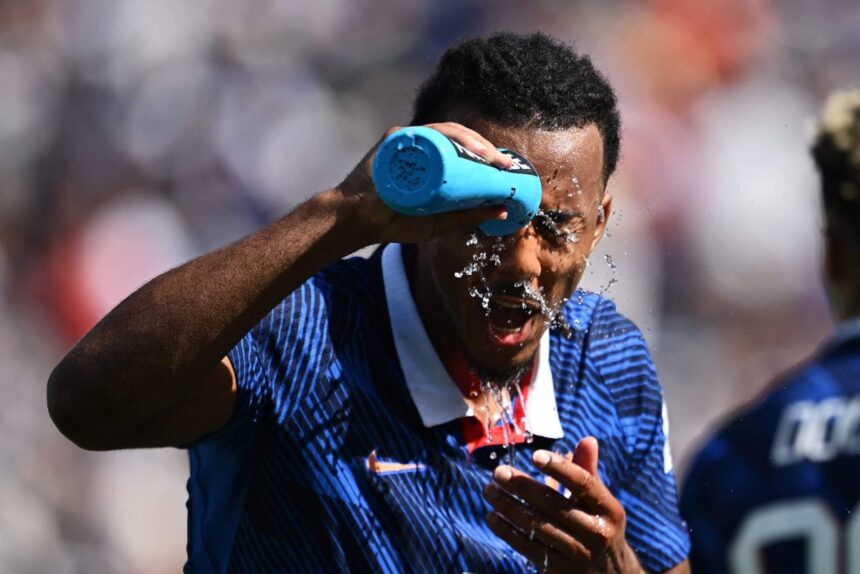
Of all the things FIFA expected to dominate the opening week of the World Cup, hydration breaks would not have been it. You’ll remember only mild discussion when the governing body first announced that matches at the 2026 finals would have interludes for drinks in each half. It sounded like common sense: a chance to take on fluids in what many expect to be searing North American temperatures.
(We do too, incidentally; so much so that Aaron Mentkowski, a certified broadcast meteorologist, has joined us for the tournament and is delivering daily weather reports for World Cup venues.)
To recap, football is a game of two halves, each lasting 45 minutes plus stoppage time. It’s not that matches never stop — they halt for injuries, substitutions, VAR reviews — but none of FIFA’s previous 22 World Cups have had scheduled or co-ordinated breaks in play (similar to basketball timeouts), only water breaks at the referee’s discretion. In 2026, however, there are pauses on or around the 22nd minute of the first half and the 67th minute of the second half, and they last for three minutes each. In effect, the match is effectively split into four quarters.
In theory, this sounded fine. Nobody disputed that temperatures in parts of the United States and Mexico in particular might call for rehydration in the interests of player welfare. But in practice, the reality of the stoppages has caused a stir.
There are lots of different strands to the debate, from hydration breaks opening the door to commercials on TV to the way in which pressing the pause button alters the momentum of a contest. When The Athletic’s daily World Cup Briefing newsletter asked readers to vote on what they thought of them, 76.4 per cent went with “problematic” as their response. Some 13.3 per cent said hydration breaks were no big deal, while 10.3 per cent went with the “kinda like them” option. Each to their own.
We’ll come to TV ads shortly, because people are gnashing their teeth about them, but the main gripe of the 9,000-plus who took part in the poll was that a three-minute break in either half makes a material change to the structure of a match. It can intervene, and has intervened, just when a team are on top or finding their flow. Germany crushed Curacao 7-1 in Group E on Sunday, a rout in the end, but there was a point in the first half when the Germans were on the ropes at 1-1, only for a hydration break to stop play. It won’t be the only time in this tournament when impetus turns on FIFA’s directive.
Moreover, the heat at many of this summer’s matches hasn’t justified hydration breaks so far. And some of the venues are indoors! A handful of host stadiums are enclosed and air conditioned, preventing the temperature from getting out of hand.
The complication? Having pre-arranged these breaks, it’s not easy to row back on them mid-tournament and you could argue that it would be unfair in a game-state sense if certain matches paused while others didn’t, purely based on the heat on any given day.
FIFA World Cup stadium cover-ups
But television commercials have raised hackles too, at least with U.S. broadcaster Fox Sports, which is cutting to them religiously during hydration breaks. Not every outlet is following suit. Telemundo hasn’t done and nor has the BBC or ITV in the UK (the BBC is a state-funded broadcaster and doesn’t actually show adverts at all, but that’s a discussion for another day).
The sense in keeping eyes on the field speaks for itself. In a warm-up friendly involving the United States, head coach Mauricio Pochettino was spotted using the short breather to show his team clips on a laptop. In Canada’s first World Cup fixture against Bosnia and Herzegovina, we saw Jesse Marsch geeing his players up in search of an equaliser. These can be interesting moments to analyse.

Jesse Marsch gives his Canada player a team talk during their 1-1 draw against Bosnia and Herzegovina (Alex Pantling/FIFA via Getty Images)
Fox, however, was straight into ad breaks when the first hydration break arrived in game one between Mexico and South Africa. It managed to return from the second one late, after play had restarted. In the face of criticism, it is persisting with its strategy, which must be fairly lucrative because, as the Briefing’s Chris Sprow worked out, six minutes of extra commercials across 104 matches is… 10 hours of sweet advertising revenue. Fox declined to comment when asked about its ad inventory.
It begs the question: might broadcasters lobby FIFA for hydration breaks to become the norm, on the basis that there is money to be made from them? Could it be that what started out with good intentions — focused on the safety of professional athletes — makes football a game of four quarters by stealth?
They’re here to stay for the duration of the 2026 World Cup but there might be a reckoning afterwards as the sport’s stakeholders ponder the value of them — and whether anybody asked for hydration breaks in this form.