


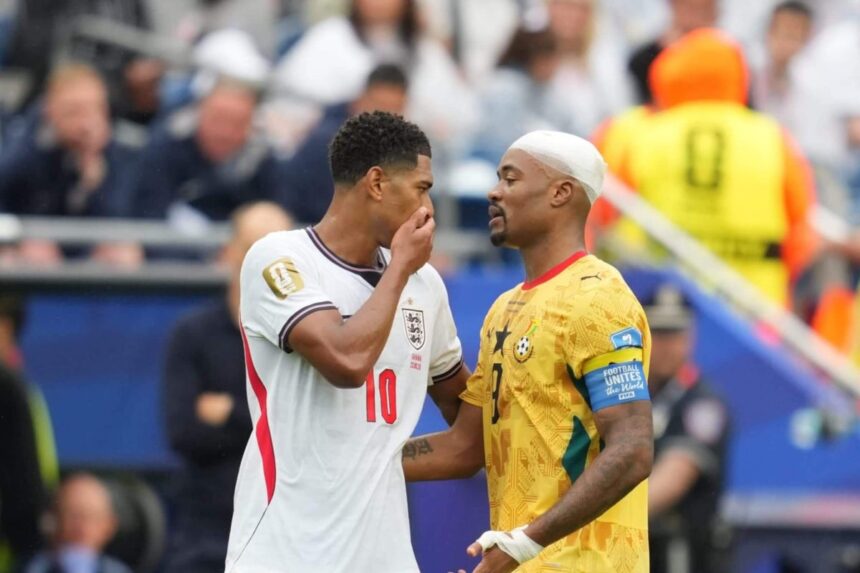
England midfielder Jude Bellingham was pictured covering his mouth while speaking to Ghana forward Jordan Ayew during Tuesday’s World Cup group stage fixture — an image that had some viewers revisiting the rulebook.
Paraguay forward Miguel Almiron was sent off when he covered his mouth while speaking to Turkey defender Mert Muldur on Friday — the first-ever red card for such an offence, after the introduction of a new rule ahead of this summer’s tournament.
This led to some viewers questioning why Bellingham, 23, did not receive the same punishment at Boston Stadium.
However, there is not a blanket ban on the gesture and the circumstances surrounding the exchange are key, meaning it was the correct decision to not dismiss the Real Madrid midfielder against Ghana. The Athletic explains the intricacies of the rule and why Bellingham stayed on the pitch.
Why was Bellingham not sent off and why was there confusion?
The law states that a red card is shown to players covering their mouths in instances of confrontation.
Covering the mouth has long been commonplace in football, with players using the gesture to prevent opponents and television cameras from identifying tactical instructions or private conversations.
FIFA has told referees not to punish the action automatically and instead assess whether the conversation forms part of a confrontation.
Bellingham and Ayew appeared to be sharing a relaxed conversation during the goalless draw with Ghana and there was no apparent confrontation or aggression between the pair, meaning the incident did not meet the threshold for a red card.
The image of Bellingham covering his mouth closely resembled pictures of the incident that led to Almiron’s dismissal, which in contrast had taken place on the edge of a more heated gathering of a group of players from both sides.
FIFA’s referees chief, Pierluigi Collina, explained before the tournament that players remained free to cover their mouths during normal conversations, in quotes carried by BBC Sport. A dismissal should be considered only when the exchange is confrontational.
What happened with Almiron?
Almiron became the first player to be shown a red card for covering his mouth during Paraguay’s match against Turkey. Paraguay forward Isidro Pitta had gone to ground following a challenge from Ismail Yuksek, leading to a confrontation between players from both teams.
Almiron was not directly involved in the pushing and shoving but covered his mouth while speaking to Turkey defender Muldur as the incident unfolded.

Almiron was sent off against Turkey (Stu Forster/Getty Images)
Muldur immediately brought the gesture to the attention of the assistant referee. VAR then reviewed the footage and advised the referee to send Almiron off.
The incident happened during first-half stoppage time, reducing Paraguay to 10 men for the remainder of the match. They nevertheless held on to secure a 1-0 victory.
The former Newcastle United winger received a one-match suspension and will miss Paraguay’s final group game against Australia. A longer punishment could have followed had officials found evidence of abusive or discriminatory language.
Why was the rule introduced?
FIFA president Gianni Infantino had called for changes to the rules following an incident during Benfica’s Champions League match against Real Madrid in February, involving winger Gianluca Prestianni and Vinicius Junior.
UEFA banned Prestianni for six matches after finding him guilty of homophobic conduct towards the Brazilian.
The World Cup regulation is intended to deter players from concealing potentially abusive or discriminatory remarks from match officials and television cameras.
Infantino said the measure was designed to promote respect and encourage players to set an appropriate example.
The rule has been introduced at the discretion of competition organisers. FIFA approved its use at the World Cup, but domestic leagues are not required to adopt it.