


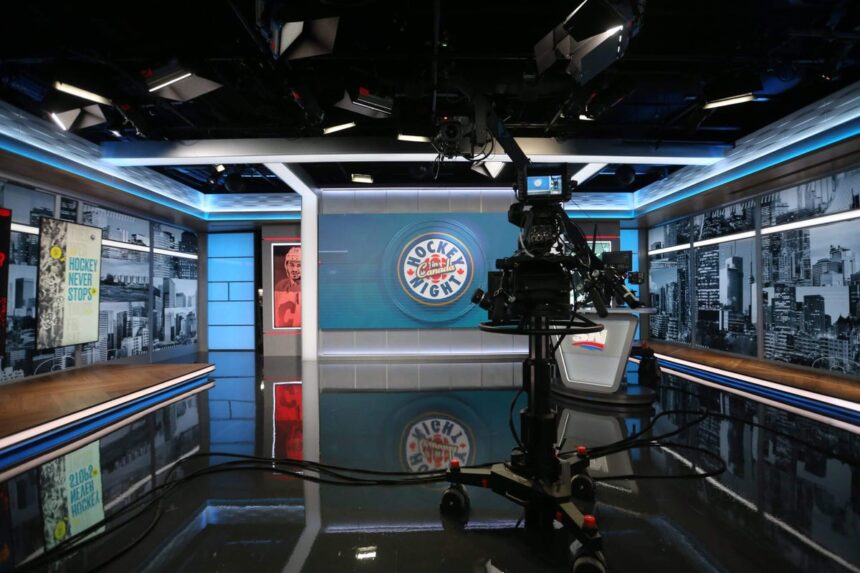
Chris Cuthbert was in denial about “Hockey Night in Canada” ever ending.
It was the place to go to watch the NHL, a national cultural institution that he enjoyed as a fan in his youth. He went on to spend decades as a host and play-by-play man for the iconic CBC-owned telecast, working alongside legends such as Ron MacLean and Bob Cole, to name two of many. Cuthbert even took pride whenever he introduced himself as a member of “Hockey Night in Canada” to players in team dressing rooms, seeing them light up and grow chattier about the game ahead.
“It always broke the ice to the point where I almost invariably would get a more in-depth, thoughtful answer,” said Cuthbert, who was recently named the winner of this year’s Foster Hewitt Memorial Award from the Hockey Hall of Fame for his broadcasting career.
But starting next season, fans won’t see the familiar “Hockey Night in Canada” logo when they watch NHL games.
Last week, CBC and Rogers Sportsnet announced that their 12-year-long sublicensing partnership, which had allowed the latter to air “Hockey Night in Canada,” wouldn’t be renewed. The move coincides with the end of Rogers’ previous deal as the NHL’s national rightsholder, a 12-year, $5.2 billion Canadian contract that will soon make way for a renewed 12-year, $11 billion Canadian agreement. As a result, the future of the iconic show has entered limbo.
Throughout its 74-year history, “Hockey Night in Canada” delivered national hockey broadcasts featuring the league’s Canadian teams, as the NHL’s biggest superstars and their biggest moments were beamed across the country. The sport’s most famed play-by-play voices, from Cole and Cuthbert to Foster Hewitt and Danny Gallivan, provided the soundtrack to many games.
The show’s style, from its baby blue jackets for broadcasters to its famed white towels given away to players after intermission interviews, enhanced the brand’s recognizability; even the show’s original theme song, “The Hockey Theme” by Dolores Claman and Jerry Toth, was seen by some as Canada’s unofficial national anthem. It was also a place for innovation. The first known use of instant replay occurred on one of its broadcasts, thanks to Canadian producer George Retzlaff.
For many who were involved with “Hockey Night in Canada,” the news that the show would no longer exist in its decades-long form was sad to process. But they also saw its demise as inevitable.
“This has been 12 years in the making,” longtime “Hockey Night in Canada” executive producer John Shannon said. “And when you invest that kind of money, Rogers wants to invest in its own brand, not somebody else’s brand, and you have to understand that.”
“It’s been a long erosion of what made ‘Hockey Night’ as unique as it was,” Cuthbert added. “And big business, and the cost of rights, and the success of such a wide broadcasting scope for all NHL games has kind of taken its toll.”
Which means fans, broadcasters, and producers and other staffers are left with nothing but memories of a show that has appeared on screens in Canada for a full quarter-century longer than its United States counterpart, “Monday Night Football.”
“It’s 74 years of a brand, disappearing,” Shannon said.
Infamous incidents, unforgettable moments
The date April 18, 1988, stands out most for Cuthbert. He was working as a reporter in Washington for a playoff game between the Capitals and the New Jersey Devils while CBC aired a Boston Bruins-Montreal Canadiens game for its national audience. But when a power outage interrupted the broadcast, they pivoted to Cuthbert, sitting in the stands at the old Capital Centre in Landover, Md., where he became a literal one-man show.
“I called two and a half periods and hosted both intermissions on my own,” Cuthbert said. “Which, at the time, was a big deal. So, it put me on the map and was a bit of a springboard for me to become a full-time play-by-play guy.”
Approximately two years later, broadcaster Ken Daniels — the current play-by-play man for the Detroit Red Wings — made his “Hockey Night in Canada” debut as a fill-in for MacLean ahead of a playoff game between the St. Louis Blues and Toronto Maple Leafs. He also subbed for MacLean alongside former coach Don Cherry on the “Coaches’ Corner” segment of the show.
Daniels was planning on working the game for a local Toronto station, but got a call from a “Hockey Night in Canada” producer telling him he’d be MacLean’s temporary replacement, right down to his clothes.
“He said, ‘We left Ron MacLean’s jacket for you,’” Daniels remembered. “And it wasn’t the baby blue (jackets). They had switched to the (dark) blue jackets then.
“‘So (they) left Ron MacLean’s jacket and (said) we’ll do up the sleeves … because obviously it was bigger than I was.”
There were more infamous incidents, such as when Hodge was visibly annoyed at the network cutting away from a Montreal Canadiens-Philadelphia Flyers game tied late in regulation to show a news broadcast. Hodge then flipped his pen as the camera cut to black, and he quit the show shortly thereafter.
“I think Dave got up at the end of the game and put his jacket on and left quietly,” remembered Joel Darling, executive producer of NHL special events for Rogers Hockey and a former CBC executive producer. “And that was the end of it.”
But many fans will simply remember the broadcast for showing many unforgettable moments in NHL history, with far too many to name, and as a weekly Canadian staple for seven-plus decades.
“In Canada, that’s what you grew up with,” Daniels said. “You had that on a Saturday night, and it brought the family together. I think that was a part of it.”
“When I think of my childhood, there weren’t that many options,” added Darling, whose father, Ted, worked as a “Hockey Night in Canada” broadcaster before moving on to call Buffalo Sabres games. “And ‘Hockey Night,’ in some ways, was the only option.”
However, viewing habits and brand loyalty have changed in recent years. Fans have more access to games across different platforms, whether through Sportsnet, TSN and even Amazon. But the shift away from publicly available NHL games on the CBC means that, to watch the league in Canada, fans now must pay for cable or a streaming service.
“Not good news for those in remote areas or with financial limitations, those who depended on CBC (and ‘Hockey Night in Canada’),” Hodge wrote in a message to The Athletic.
To Hodge, “most hockey fans” today don’t care about where they watch the NHL, “as long as the game is on and they can see it.” In his mind, “Hockey Night in Canada” and its brand clearly lost luster among a new generation with more options available to them, varying from broadcasters to podcasters to content creators hosting watch parties on YouTube.
“In many ways, and for many years, Saturday has been the same as any other night for hockey in Canada,” Hodge said. “The name stayed with CBC and Saturday, and now it remains there, in a dormant state, while NHL telecasts carry on elsewhere, without it. Shouldn’t come as a surprise.”
An uncertain future
Despite its exit from the NHL landscape, the CBC still retains proprietary ownership over “Hockey Night in Canada,” telling The Athletic in a statement that it plans to use the “iconic brand in different ways going forward” and would have more to announce in the coming weeks. But until its intentions are revealed, questions will persist over the public broadcaster’s plans.
The CBC holds broadcast rights to the Olympics until 2032, which means it could feasibly use “Hockey Night in Canada” for the Winter Games if it came to that. The CBC has also shown PWHL games in the past, though it’s not known if they’ll return for the 2026-27 season. There’s always a lane to be nostalgic and air old games. But not everyone might need the CBC to feed their yearnings for archival footage.
“It’s so easy to find the old games now, right?” Daniels said. “They’re all available on YouTube. There’s a way to find them in the highlights, and you can find all that stuff if you want to.”
Meanwhile, questions loom over the look of Rogers Sportsnet’s NHL coverage in a post-“Hockey Night in Canada” world, and who will be part of their broadcast team. Cuthbert acknowledged he does not have a contract currently for next season, but added that he’s been in discussions with Sportsnet and has been told he’s part of their future.
Meanwhile, nearly a dozen behind-the-scenes production staffers, including Darling, will revert to being employed by the CBC after their services were contracted out to Sportsnet through the previous media deal.
“There’s a lot of folks that loved working on hockey that are now going back to work on other shows at CBC,” Darling said.
It’s the end of a long-standing era in Canadian sports television, even if the transition is ongoing. But some, such as Shannon, will always hold the show’s glory days close to their hearts.
“It was a magical time to be part of television, be part of the NHL, and to be part of what I viewed as the most successful television show in sports history,” Shannon said.
“It wasn’t anybody else’s. It was ours. It was Canada’s. And the viewers made it special.”