

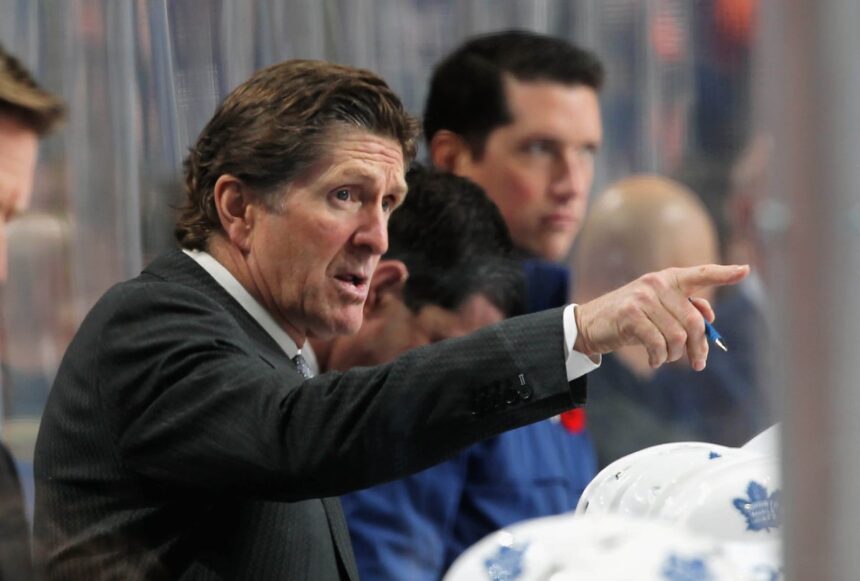
It was nearly seven years ago that Mike Babcock coached his most recent NHL game. His Toronto Maple Leafs, on the heels of three straight first-round playoff exits, were sputtering in November with a 9-10-4 record.
It would be disingenuous to liken those 2019-20 Maple Leafs to the 2026-27 Edmonton Oilers. Unlike that Toronto squad, the Oilers are a mature Stanley Cup contender. They’ve knocked loudly on victory’s doorstep. Their time is now.
So, while Babcock’s Toronto tenure is by no means a certain blueprint for potential Oilers success, it is still a window into his most recent coaching philosophy — discounting his brief return to collegiate hockey with the University of Saskatchewan. It is therefore worth studying.
This exercise does not seek to transplant the past Maple Leafs onto today’s Oilers, nor does it intend to directly address the controversial, off-ice narratives of his Toronto exit.
Instead, the purpose is to assess which of Babcock’s trademark tendencies apply to this roster and how they might shape his decision-making. The NHL has evolved since 2019, but the verdict is still out on whether Babcock’s hockey ideology has evolved without being in the league. That lingering question over whether he still clings to the same old-school principles makes the time capsule of his Toronto tenure highly relevant.
Oilers should be careful what they wish for
Sean Gentille and Sean McIndoe
Stars in check
Finding the exact balance of Connor McDavid and Leon Draisaitl has always been a challenge for Oilers coaches. One of Babcock’s most consequential choices in September will be whether they should drive separate lines, or team up for an unrivalled nuclear option. The effectiveness of that duo waned last campaign under Kris Knoblauch, to the point where the pain affecting the rest of the forward group wasn’t worth it. That makes Babcock’s decision even more compelling.
While not of the same calibre, Toronto’s equivalent duo, Mitch Marner and Auston Matthews, only began playing significant five-on-five minutes together following the firing of Babcock, who firmly believed that they should each drive their own lines. Between 2016-17 and 2018-19, the pair averaged just 1:07 per game together at five-on-five.
Babcock’s separation of Marner and Matthews was intended to spread the wealth across the forward group. As Matthews matured from a rookie to a consistent play driver, Babcock broke up his effective connection with Zach Hyman and William Nylander in favour of a more balanced three-line attack. Eventually, players like Patrick Marleau and Kasperi Kapanen joined Matthews while Hyman united with John Tavares and Marner.
But has Babcock changed his stance this time around? In an interview with Bob Stauffer on Oilers Now, the coach seemingly endorsed McDavid and Draisaitl playing together: “The problem with apart, and if you put (Ryan Nugent-Hopkins) in the mix too, and then (Jason) Dickinson, well there’s no ice time for anybody.”
It would appear that Babcock is at least wanting to try McDavid and Draisaitl together. Perhaps having two Hart Trophy winners — who controlled over 61 percent of five-on-five goals together over the last three seasons, via Natural Stat Trick — changes the equation. That strategy could also complement Babcock’s desire for every player to find a meaningful role — 97 and 29 sharing the same minutes could help distribute more minutes across the lineup. That would likely mean less overall ice time for McDavid and Draisaitl.
Babcock is no stranger to capping his best players’ minutes: during the 2019 playoffs against Boston, he strictly limited 21-year-old Matthews’ ice time while continuously trusting 39-year-old Marleau in critical situations. This controversial usage peaked in the final minutes of Game 7, when Babcock kept his franchise cornerstone on the bench while deploying the aging veteran as an extra attacker.
While it’s critical to note that Marner and Matthews were still very young players under Babcock, not grizzled veterans like McDavid and Draisaitl, Babcock has consistently kept his stars’ minutes in check. Neither Matthews nor Marner crossed the 20-minute average in their three full seasons with Babcock, even in 2018-19 when they had broken out into full-fledged superstars. Even as the league’s leading goal scorer, Matthews remained locked into a routine four-centre rotation down the middle.
That’s not something the depth-starved Oilers have practised with their top players, nor has it gone unnoticed by Babcock. In 2016, he criticized former Oilers coach Todd McLellan for heavily shifting a 19-year-old McDavid in a 3-2 loss to the Maple Leafs. Not much has changed in the decade since. Last season, McDavid led all NHL forwards in average ice time (22:59), while Draisaitl finished fourth (21:35).
While we probably shouldn’t expect their ice time to fall to the lows that young versions of Matthews and Marner experienced — that duo averaged 18:33 and 19:49, respectively, in their last full seasons under Babcock — a reduction certainly seems in order. That goes double if they play on the same line more often.
It shouldn’t be discounted that Edmonton’s best players have expressed faith in Babcock’s plan. In an exclusive with The Athletic, Draisaitl said the Oilers’ leaders “want to be coached” and “want to be held accountable.” So far, nothing suggests Babcock will be capitulating to his stars.
Defence structured
Reshaping the Oilers’ defensive identity is easily the single most important on-ice challenge Babcock faces. He has already made his desire for a cohesive, five-man defensive system clear, which will require more buy-in from the forward group. Centres, including McDavid and Draisaitl, will likely be expected to track lower in the defensive zone and break out as a single unit.
We also know from Babcock’s time in Toronto how much he likes a lefty-righty configuration for his defence pairs. This wasn’t a hard-and-fast rule, but he made his displeasure for same-handedness pairs well known. The complementary setup is intended to prevent defenders from being handcuffed and improve the success rate of their outlet passes.
Last season, the Oilers’ second-most common pair was an all-lefty combo of Darnell Nurse and Jake Walman, which had a 47.5 percent goal share at five-on-five, per Natural Stat Trick. Heading into this season, Babcock can balance his left- and right-shot defencemen without much trouble: Mattias Ekholm, Walman and Ryan Shea beside Evan Bouchard, Connor Murphy and Ty Emberson. Those pairs would also align with Babcock’s liking for offensive-minded puck-movers on their strong side.
Structure doesn’t mean less scoring
Nearly half of respondents in The Athletic’s Oilers fan survey believe McDavid will record between 120 and 129 points, down from 138 last campaign. Obviously, that’s a fair assumption if his ice time is meaningfully reduced, and the same goes for Draisaitl.
There seems to be a general perception that Babcock’s coaching limited the Maple Leafs’ natural offensive creativity in the name of defensive accountability. Still, his teams finished top five in goals each of the three seasons he guided them to the playoffs. In Toronto, Babcock favoured a structured system that emphasized five-man breakouts, an aggressive forecheck, and heavy cycling below the goal line to wear down opponents. McDavid and Draisaitl will earn their points regardless, but that approach could also stand to benefit those lower in the lineup looking for bounce-back seasons, like Trent Frederic.
Oilers fans might want to temper expectations for the high-octane, run-and-gun hockey they’ve become accustomed to, but betting on offensive regression shouldn’t be automatic.
Workhorse goalie philosophy meets a new NHL
In 2016, Frederik Andersen was acquired to be the Maple Leafs’ undisputed No. 1 goaltender. Under Babcock, he went on to play seasons of 66, 66 and 60 games, posting sparkling regular-season numbers but no playoff success.
A decade later, and with a Stanley Cup ring now in hand, Andersen will participate in a three-headed Oilers rotation with Tristan Jarry and Devon Levi, where he is still perceived as the top option, but also injury-prone. In the past three years, he has played seasons of 35, 22 and 16 games. He’s no longer built for those heavy workloads.
At the NHL level, Babcock has always found success through a workhorse goalie: Jean-Sebastien Giguere in Anaheim, Dominik Hasek and Chris Osgood in Detroit and Andersen in Toronto. In 2026, 60-game starters are nearly extinct — the Utah Mammoth’s Karel Vejmelka was the sole representative of that club last season. More recent champions, like the Carolina Hurricanes, relied on trios to get the job done. Babcock may be tempted to appoint his starter and forget about it, as he had the luxury of doing so in Toronto, but the limitations of his personnel in Edmonton will likely keep him on his toes.
Babcock also likes goalies with size. That could bode well for 6-foot-4 keepers Andersen and Jarry, while Levi’s 6-foot frame, combined with his professional inexperience, could hold him back.
The voice beside the voice
When the Oilers hired associate coach D.J. Smith alongside Babcock, many pundits were quick to suggest his player-friendly reputation was a curated match for the head coach’s more abrasive personality. Others have gone as far as to say he is an ideal insurance policy if things go off the rails for Babcock.
The two minds are very familiar with each other, having served from 2015-19 on Toronto’s bench. Smith’s presence could help prevent the friction that marred Babcock’s tenures in Toronto and Columbus.
Given Babcock’s stubbornness and past controversies, Smith may also be given more agency to question his head coach’s decisions. As mentioned previously, Babcock obstinately played a late-career Marleau in significant minutes during his time in Toronto with dragging results.
That is the type of trap that the Oilers won’t want to fall into with veteran forwards Hyman and Nugent-Hopkins, both of whom remain productive beside 97 and 29 but have shown signs of age-related decline. Of course, Babcock was arguably Hyman’s biggest advocate in Toronto, rewarding his relentless, hard-nosed play with a prominent role. It isn’t difficult to envision Hyman and players of his ilk seeing the ice more, but it will be important for Smith and assistant coach Paul McFarland to ensure the minutes remain consistent with merit.
And one more thing that I can’t stop thinking about: Last season, no defenceman scored as many points as Bouchard (95). He has never been a Norris Trophy finalist. His defensive game remains divisive. He is prone to making the “big mistake.”
Meanwhile, Smith has worked with young defencemen in Morgan Rielly, Thomas Chabot and Jake Sanderson, helping raise them into two-way, top-pair defenders. Bouchard is already established as a No. 1 blueliner, but could the influence of Babcock and Smith help take his game to the next level?
Smith already has experience with the 26-year-old through Team Canada at this spring’s world championship. Speaking with Stauffer on Oilers Now, Smith mused that Bouchard “might’ve been the best player in the tournament” before suffering an injury in the quarterfinal. I suspect there is more to extract from his game.