

It still seems scarcely believable that, eight years after some Australian cricketers were caught doing something that the world governing body only deemed punishable by what amounted to a slap on the wrist, the country is still tearing itself apart.
Australian cricket seemed very keen to let sleeping dogs lie and try as best they could to forget the whole thing — both the use of sandpaper to alter the condition of the cricket ball on the 2018 Test series against South Africa, and the calamitous way the affair was handled after they were caught during the third Test in Cape Town.
But they reckoned without Usman Khawaja, who woke those sleeping dogs with his memoir Sabr, which is an Arabic word meaning ‘patience’.
And after Khawaja spoke, most of the other people involved offered their own truths, too. We have heard from two of the three people punished for ‘Sandpapergate’: David Warner and Cameron Bancroft, the latter of whom wrote a 4,529-word piece for the West Australian.
Three of the team’s bowlers who claimed they did not know about the use of sandpaper — Mitchell Starc, Mitch Marsh and current Test captain Pat Cummins — have found themselves fronting press conferences. Another bowler who was with the squad eight years ago, Chadd Sayers, has spoken to Australian radio, while the coach at the time, Darren Lehmann, has been asked for his thoughts while working as a pundit.
Their testimonies have differed, sometimes markedly. This is how those involved have recalled the events of 2018, over the last couple of weeks.
Before the tour to South Africa
Australia arrived in South Africa off a convincing home Ashes win over England, but carried a burgeoning reputation for what you might generously call aggressive play. Or, perhaps a bit less charitably, being a thoroughly unpleasant team.
In Sabr, Khawaja writes about how Warner was encouraged by the Australian coaching staff to sledge or trash talk their opponents, a task he undertook with some gusto, in particular targeting South Africa wicketkeeper Quinton de Kock over his weight. He says that Warner was initially reluctant, but was “worn down” by the coaches, and when he agreed to do it, he was “relentless”.

Australia’s vice-captain David Warner was “relentless”, according to Usman Khawaja (Marco Longari/AFP via Getty Images)
Cummins, in a press conference last Friday that lasted 68 minutes and was called to rebut the account given by Khawaja, addressed this too. “My memories of coming back into that side was there was parts I didn’t really think was OK,” he said. “The way we acted on the field was quite abrasive. I didn’t like the way we spoke to umpires, the opposition.
“The environment was a win at all costs. There was an ugliness to it.” He went on to congratulate himself for “making sure that that’s not the case with this current Aussie team”.
Bancroft claimed this culture fed into their plans to use sandpaper to tamper with the ball, writing: “We were ruthless and willing to do these sorts of behaviours and cross boundaries to give ourselves an advantage, to win.”
Day two of the Second Test, Port Elizabeth
Everyone seems to agree that there was no ball tampering in the first Test in Durban, which Australia won by 118 runs.
However, when the second Test came around, Australia were behind in the game with South Africa batting well and the bowlers struggling to take wickets. Khawaja wrote that, on day two, an unnamed player in the dressing room started “experimenting” on a ball with a piece of sandpaper, which is not alien to a cricket dressing room and is typically used by players to maintain their bats. Roughing up one side of the ball would help it to reverse swing.
“The ball was completely dry and extremely scuffed on the side we’d sandpapered,” he wrote. “There was no way it wouldn’t reverse if we bowled with it. Everyone had a look at the ball and was laughing their heads off.”
The word “everyone” is key, because Cummins seemed to contradict it, saying in last Friday’s press conference: “We didn’t know it had been altered with sandpaper.”

Usman Khawaja batting at Port Elizabeth (Ashley Vlotman/Gallo Images/Getty Images)
Bancroft was a little more specific, pinpointing Warner as the team-mate who suggested using sandpaper. According to Bancroft, the vice-captain claimed he could not do it himself because too much attention was on him — as Australia’s attack dog by reputation — and with few other volunteers, it fell to Bancroft, the least experienced member of the team.
Recollections differ slightly here, because Khawaja said Bancroft volunteered to use sandpaper on the ball, whereas Bancroft suggests he was asked to do it.
“I felt uncomfortable and compromised,” wrote Bancroft, who was playing only his seventh Test in Port Elizabeth. “I knew it was wrong. I knew that using sandpaper was not simply pushing the boundaries of the laws of cricket. It was cheating. But I also saw an opportunity to contribute.”
Bancroft and Khawaja said that, at this point, Smith, the team’s captain, knew what they were planning but said he did not want to know about it. Smith has not yet addressed the latest round of revelations: he has not spoken at all, in fact, although he is due to play a domestic game for New South Wales against Queensland at the weekend.
The plan, according to Bancroft and Khawaja, was to pick up the ball from the boundary, where the umpires had left it, before the final session of day two. Bancroft says he picked it up and roughed it up with the sandpaper, and it worked a treat as Australia took four wickets for 28 runs, three of them falling to fast bowlers.
“It was moving so much that, at one point, one of the bowlers said in the huddle after a wicket, ‘Guys, it’s going heaps now. Just don’t do anything else to it, because it’s silly how much it’s going’,” wrote Khawaja.

The dismissed Kagiso Rabada walks off as Australia convene in a huddle on day two at Port Elizabeth (Marco Longari/AFP via Getty Images)
That idea that the bowlers knew what was happening is backed up by Bancroft, who wrote: “All the bowlers gave me feedback if my work on the ball was working. There was even a time I was told to stop out of fear that what I was doing was becoming too obvious. The conversations about the effect the sandpaper was having on the ball were regular, very natural and organic on the field.”
Sayers backed up the idea that the whole team knew. When asked on SEN radio when sandpaper was first used, Sayers said: “In Port Elizabeth. As it’s known now, it was used in two Test matches, and there were discussions in the changing rooms about how we were going to get the ball to reverse, and what was going to be used. I just knew that it was going to be used, as I believe everyone else did.”
This is contradicted by Cummins, who said: “When (Khawaja) says we all knew sandpaper was going out on the field, he’s 100 per cent wrong. I said that consistently for the last eight years. I did not know that was happening. Even the umpires had a look. We didn’t know it had been altered with sandpaper.
“Balls get roughened up every time we play. Whether that’s from a foreign object or something that’s totally legal and part of the game. Sometimes it’s hard to know. But out there in the field, I did not see anything on the ball.”
Asked if he was aware, at any stage, of any plans to tamper with the ball by whatever means on the tour, Cummins answered succinctly: “No.”

Pat Cummins addresses the media at Cricket Central in Sydney last week (David Gray/AFP via Getty Images)
Day three of the Second Test, Port Elizabeth
Bancroft further hammers home the idea that the whole group knew what was happening in his recollections of a meeting before play on day three of that Test match.
“We spoke about the second day, celebrated the moments that occurred, but more importantly, emphasised the key points for a successful day ahead,” he wrote. “I remember my ball tampering with the sandpaper the evening before being discussed and my role being acknowledged in front of the group. I received wraps and encouragement from members of the playing and coaching staff, especially David Saker.”
Saker was the team’s bowling coach on the tour. The experienced Saker has had roles with Australia, Sri Lanka and England over the years, and was working with England on an ad hoc consultancy basis as recently as at the white-ball tri-series tournament in Pakistan last month. That arrangement has now ended.
Starc contradicted the claim that everyone knew, telling a press conference last week that: “There’s differing opinions of eight years ago. We were heavily drilled through the process at the time and since — and I won’t speak on behalf of the bowlers — but my opinion hasn’t changed (since a joint statement issued by the bowlers in 2021 denying knowledge of the use of sandpaper on the field).”
Marsh, the current Australia white-ball captain, was name-checked by Bancroft as being involved in the discussions over reverse swing in South Africa. He was asked his opinion on what happened in his pre-series press conference for the one-day internationals against England last week, but played a very straight bat. “I’m not here to go back on my recollections of South Africa,” he said. “I’ve moved on. I respect that others probably haven’t, but I have, and I hope that’s respected.”

Mitchell Marsh inspects the ball on day two in Port Elizabeth (Marco Longari/AFP via Getty Images)
Bancroft also wrote that the one person who objected to what was happening was the team’s media manager at the time, Kate Hutchison, but her concerns were ignored.
In the end, South Africa won the Test convincingly, despite Australia using sandpaper on the ball. “We had compromised our integrity and still lost,” wrote Bancroft.
Second session of day three of the Third Test, Cape Town
In the third Test at Newlands in Cape Town, South Africa batted first and made 311. Neither Khawaja nor Bancroft specifically said whether Australia used sandpaper during this first innings.
After Australia were bowled out for 255 in their first innings on day three, Khawaja wrote that an unnamed coach approached Bancroft and insisted that, because the conditions were wet, he needed to do more of what he had been doing to rough up the ball and encourage reverse swing. Bancroft confirmed the coach in question was Saker, the bowling coach. Saker has yet to address these accounts publicly.

David Saker addressed a press conference at the end of day three in Port Elizabeth (Ashley Vlotman/Gallo Images/Getty Images)
This apparently took place in the dressing room at Newlands, where a solid wall separates the room into one large space and a smaller one. Bancroft, Khawaja and wicketkeeper Tim Paine were in the smaller section, where Saker supposedly spoke to Bancroft. Cummins cited this as a possible explanation of why recollections of these events differ.
“To think that: ‘Oh, it happened in the changing room so everyone must know’… it’s not how it works,” Cummins said. “There are different nooks and crannies. Like, that Cape Town week, half of the room is a totally separate changing room. We don’t see them unless you walk out on the field. So there are going to be different accounts. Some might match up. Some might be different. You might never know every single person’s story.”
At this point, Khawaja claimed he warned Bancroft to be careful. Until then, Khawaja wrote, Bancroft had only been using sandpaper on the ball during breaks, not on the field during play. He wrote that the “push from this coach, though, obviously made him feel like he had to do it more often. Outside of the breaks.”
Bancroft took a piece of sandpaper onto the field, and during the second session of the day with the hosts 129-2 and building up an imposing lead, he was caught on camera working on the ball with it, and then putting it in his pocket. Khawaja writes that Smith ran past Bancroft and told him to get rid of the sandpaper, which he then shoved into his underpants. This was also caught on camera.
This was relayed to the umpires, who challenged him, but he protested his innocence, claiming that the only thing he had on him was a sunglasses case.

Cameron Bancroft shows his sunglasses case to the umpires Nigel Llong (right) and Richard Illingworth (Peter Heeger/Gallo Images/Getty Images)
Bancroft wrote that after he was caught, reserve batter Peter Handscomb ran out onto the field and told Bancroft to give him the sandpaper, as directed by Lehmann via walkie-talkie. “If (Lehmann) didn’t know, he wouldn’t have said that,” Bancroft wrote. “And if it wasn’t clear enough before, then it was obvious now.”
Lehmann, speaking during his stint on commentary for ABC radio during the final one-day international against England this week, reacted to Bancroft’s article by saying: “It’s only just come to light. So I just need to sit back and process all that and work through each allegation. That’s what I will be doing over the next few days.”
Close of play on day three of the Third Test, Cape Town
Having been caught, there was debate about whether to address the media, and who should do it. Khawaja wrote that he told Smith not to do it that evening, to wait until the next day to see how things settled.
But Smith wanted to own up immediately to, in Bancroft’s words, “help contain the damage and allow us to move forward”.
The problem was that they didn’t really own up. They claimed they had used tape stuck with rough material from the ground, rather than sandpaper. According to Bancroft, this was on advice from Saker, who was concerned about the “implications” of using the word “sandpaper”.
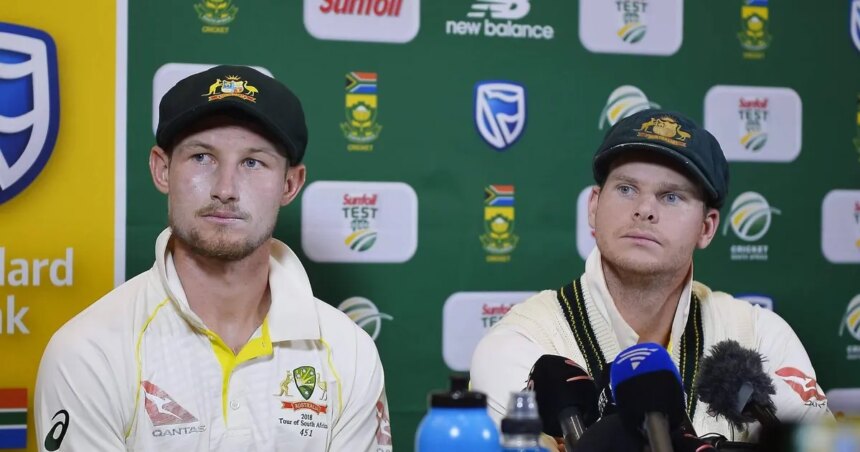
“It was another lie,” wrote Bancroft. “One told while we were supposedly taking responsibility. I look back at that press conference with enormous regret.”

Cameron Bancroft and Steven Smith face the media at the end of day three (Ashley Vlotman/Gallo Images/Getty Images)
Day four of the Third Test, Cape Town
The Test match was not yet over, and neither was the scandal.
On the field, Australia were dismissed for a paltry 107 in their second innings, losing by 322 runs and going 2-1 down in the four-Test series. Off it, Smith and Warner gave up their roles as captain and vice-captain and, according to Khawaja, were “in tears”.
Khawaja wrote that he was “flabbergasted” that Paine, the wicketkeeper, was made captain ahead of him. Khawaja claimed he was overlooked because he had been prominent in a recent pay dispute with Cricket Australia (CA), and because “they weren’t ready for a brown Australian cricket captain”.
Cummins addressed this in his press conference, saying: “Of the things I’ve read, it’s the most serious. To think that the job that I hold is quarantined from people based on their skin colour, it’s a pretty big statement. If you are going to say that, you need evidence. And I just don’t think that’s the case.”

Tim Paine speaks at the post-match presentation in Cape Town after Australia’s crushing defeat (EJ Langer/Gallo Images/Getty Images)
Khawaja said he suggested to the Australian team manager, Gavin Dovey, that “we need to cop this as a team”, and later raised the idea in a lengthy team meeting. Cummins claimed not to have any knowledge of this, saying in his press conference: “I don’t remember any conversation around collective responsibility.
“I don’t remember any team meeting where he’s stood up and said: ‘Let’s own this as a team’. I’ve spoken to quite a few other people, trying to piece it all together, and no one remembers a team meeting where someone stood up and said: ‘We’ve got to all own this’.”
While the punishments handed down by the ICC were relatively lenient — Smith was banned for one Test match and fined his match fee, while Bancroft was fined 75 per cent of his match fee and received three demerit points — a CA investigation concluded with one-year bans for Smith and Warner, and a nine-month ban for Bancroft.

A tearful Steve Smith is comforted by his father, Peter, at a press conference at Sydney airport upon his return to Australia (Peter Parks/AFP via Getty Images)
The aftermath
Bancroft and Khawaja’s accounts of what happened were backed up by Warner in a general sense. The former opener, who retired from Test cricket in 2024, posted a video to his Instagram in which he said: “It’s been eight years since I spoke on this topic. And Ussie, I throw my full support behind you. I thank you for what you’ve done. It’s 100 per cent accurate what you’ve said. Now everyone knows the truth.
“Perhaps it’s time people stop scrutinising the person asking for accountability and start asking those responsible for the investigation to provide it… a lot of statements and inaccuracies over the last eight years that were put in the media by people. And there were a lot of people who stayed silent.”
Warner also described taking the blame for the saga as “a life punishment”, and said that: “All three of us have paid a big price in this and I hadn’t spoken about it in eight years, but we’ve got to live with these consequences daily. Yes, we accepted it, but my wife and I as well pay the greatest price. We lost a baby during that time. And that’s why it really hurts me the most until the truth is accepted.”

David Warner conducts his own emotional press conference back in Sydney in March 2018 (Brendon Thorne/Getty Images)
Bancroft wrote that he was moved to tell his side of things after reading Khawaja’s account, which he described as “freeing to hear… the truth of the chronology of events finally out there”, and that the “final straw” was Cummins’ press conference. That had left him “angry, betrayed and alone”. Bancroft also said, rather poignantly, that he “sometimes felt that this incident has left me permanently an outsider”.
In that press conference, when it was put to Cummins that, given his and Khawaja’s recollections were so different, one of them must be lying, he said: “Well, that’s my story so I think he’s wrong.”