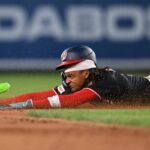



As the San Diego Padres muddle toward the summer solstice, they face what appears to be a window closing sooner than expected. Manny Machado and Xander Bogaerts, both 33, are signed to mega-contracts that run through 2033. Through the first 64 games of this season, the cornerstone infielders have combined for a .628 OPS.
The Padres, overall, have a .644 OPS — the lowest in the majors.
Yet somehow, after 11 losses in the past 13 games, they sit a half-game outside the National League wild-card picture. With the Aug. 3 trade deadline less than two months away, a pot-committed club figures to buy, not sell.
Outside of the trade market, president of baseball operations A.J. Preller has only so many options. Last week, the Padres lost Ramón Laureano to likely season-ending surgery, released Nick Castellanos and promoted unheralded outfielders Jase Bowen and Samad Taylor from a farm system that contains little big-league-ready talent.
Craig Stammen, Preller’s rookie manager, and Steven Souza Jr., Stammen’s rookie hitting coach, have overseen a disastrous offense. But, since 2015, Preller has already moved on from six managers and eight lead hitting instructors. Even if he is contemplating a potential change to the coaching staff, his hiring history does not inspire much confidence.
Meanwhile, his trading track record suggests this season is far from over. At each of the past two deadlines, Preller acquired significant help while operating with a strict budget and a seemingly depleted farm system. The executive might consider catcher Ethan Salas relatively untouchable — with Preller, no one is ever off the table — but he could dangle any number of lower-level prospects. And some teams have been led to believe that, this year, the Padres are willing to take on payroll.
Exactly how much flexibility Preller has remains to be seen. Major League Baseball’s owners have not yet held a vote on the Padres’ $3.9 billion sale to José E. Feliciano and Kwanza Jones; commissioner Rob Manfred told reporters last week that “it’ll probably be at some point this summer.” According to Cot’s Contracts, San Diego has an estimated payroll of $209 million and a projected luxury-tax number of $260 million, near the second tax threshold of $264 million.

General manager A.J. Preller much prefers to buy ahead of the trade deadline, but if star hitters like Manny Machado continue to struggle, it might not matter. (Bill Streicher / Imagn Images)
The Padres (33-31) are not playing as if they deserve additional investment. Since the team announced its sale agreement on May 2, it has gone 14-19. Since sweeping the Seattle Mariners last month, the Padres have lost 13 of 18 while averaging 2.6 runs per game and regularly running into outs on the bases. Machado and Bogaerts appear to be declining, as fellow stars Fernando Tatis Jr., 27, and Jackson Merrill, 23, are producing career-worst numbers. In Sunday’s 7-3 loss to the New York Mets and their 29th-place offense, catcher Freddy Fermin homered for a second consecutive day, drove in all of San Diego’s runs and improved his OPS to … .488.
“We’re waiting for a lot of guys to kind of break out,” Stammen told reporters after the game. “It’s fun to see one guy kind of break out.”
Still, unless the team’s spiral turns into a multi-month collapse, Preller will likely see little choice except to forge ahead. Aside from closer Mason Miller, the Padres do not have many attractive, presently performing assets that could be sold for top prospects. There is no guarantee that the core hitters will rebound in 2027, when games could be lost to baseball’s labor fight. There is no guarantee that Feliciano and Jones will go into next year with an inherited general manager whose default setting, regardless of his job security, is aggressiveness.
Behind the scenes, Preller might be trying to convince the incoming owners that no one is better equipped for a certain balancing act: keeping the Padres competitive while repeatedly restocking the farm system with projectable talent. It was less than a year ago that Preller traded six players drafted in 2024 in exchange for Laureano and Ryan O’Hearn. After the trade deadline, the two veterans helped San Diego go 30-23 ahead of an early postseason exit.
That team featured a slightly above-average offense that was far more competent than the current edition. It also had a deeper starting rotation than this season’s makeshift unit. The Padres need more help than they did a summer ago, and if a star-centric lineup continues to be one of this century’s bigger disappointments, Preller could be forced to stand pat, buy around the edges or sell what he can.
“When you’re a superstar, it means you’ve been very consistent over the course of your career, and it’s always a shock when you’re not as consistent as you’ve always been,” Stammen said when asked about his top hitters’ ongoing struggles. “They’re the ones trying their hardest and they’re hanging their heads right now, but we got to lift them up and know that better days are ahead.”
Preller’s preferred path remains clear. His latest coaching staff has not elevated the roster since a winning April. By August, the general manager could attempt another heavy lift.