

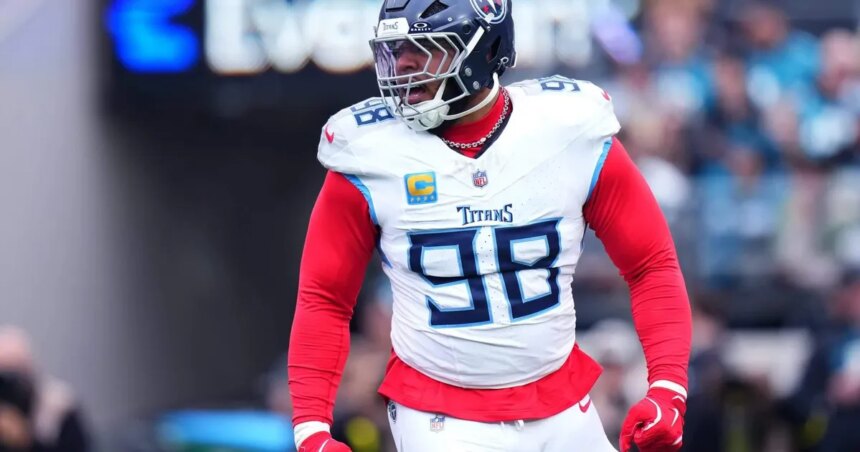
The most zealous Chicago Bears fans have been demanding a trade in recent weeks, pleading with general manager Ryan Poles to take a swing and make a big splash that would strengthen the Bears’ legitimacy as Super Bowl contenders. On Thursday morning, the Bears made that wish a reality with an attention-grabbing trade to acquire Tennessee Titans All-Pro defensive tackle Jeffery Simmons.
The Bears received Simmons plus a 2028 fifth-round pick from Tennessee while sending away their first-round picks in the next two drafts and a 2027 fourth-rounder.
The long-term impact of the trade will take years to assess. But there’s no question the immediate news created a surge of energy and excitement across Chicago as the 5-2 Bears prepare for Monday’s prime time clash with the Seattle Seahawks.
So just what should we make of Simmons’ addition, the price of the trade and what it all means for the Bears? Athletic writers Kevin Fishbain and Dan Wiederer tackle five key questions.
How will this move help the Bears – now and in the future?
Fishbain: Simmons had 11 sacks last season. The Bears’ entire group of interior defensive linemen combined for 10.5. The franchise hasn’t had an interior defensive lineman with double-digit sacks since Jim Flanigan in 1995. Justin Jones is the only Bears defensive tackle with at least 10 tackles for loss in a season since 2014. Akiem Hicks did it, but he was technically a defensive end in the Bears’ 3-4 defense.
That’s all to say it’s been years since the Bears had someone with this kind of production potential on the interior of the defensive line. Remember Matt Eberflus needing a three-technique to be the “engine” for his defense? Simmons suddenly becomes someone opposing play callers have to circle in their game planning. He’s someone right on the ball who quarterbacks have to be aware of before and after the snap. He’s an imposing player who will alter opposing offenses in a way the Bears haven’t been able to do up front.
Grady Jarrett has played at a much higher level than last year. Advanced stats and what coaches have seen from him back that up, and now he gets to play next to Simmons. Coach Ben Johnson said Wednesday they’re hoping for more one-on-one opportunities for defensive end Montez Sweat — Simmons’ college teammate at Mississippi State. Well, more attention on Simmons could create more advantageous reps for Sweat.
Jarrett and Sweat could become cap casualty candidates next offseason, but the Bears can enter 2027 with a little more comfort on the defensive line knowing they have a game-changer in Simmons. Edge rusher could still be a top 2027 need, but the interior pass rush question has been answered for as long as Simmons is in Chicago, healthy and playing at the level he has in his career.
Bears acquire All-Pro DT Jeffery Simmons from Titans
Kevin Fishbain
What was the Bears’ incentive to be so aggressive?
Wiederer: First and foremost, when an impact playmaker like Simmons becomes available, it’s mandatory to dive deep into the due diligence and see what could make sense. Proven defensive line disruptors don’t grow on trees. And given the Bears’ need to enliven their defensive front, Simmons registers as a massive upgrade who should make an instant impact.
It’s also worth emphasizing that the NFC seems to be wide open. The Vikings are the NFL’s last undefeated team and the current owners of the conference’s No. 1 seed. But it’s difficult to find anyone who sees Minnesota as a runaway train. And, in league circles, the consensus is that the NFC West may ultimately produce the conference’s Super Bowl participant, with the division-leading San Francisco 49ers, defending champion Seahawks and preseason favorite Los Angeles Rams all major factors.
The 49ers and Seahawks, for what it’s worth, were already active on the trade market earlier in the week. San Francisco sent a fourth-round pick to Indianapolis to reunite with defensive tackle DeForest Buckner. The Seahawks used a third-rounder plus a 2028 fifth to land All-Pro guard Quenton Nelson. Perhaps Poles felt urgency to keep up, particularly while trying to compete in an ultra-strong NFC North in which all four teams currently reside inside the playoff picture.
What to make of the big-picture acquisition cost?
Wiederer: Without question, a trade like Thursday’s provides an immediate sort of sugar rush. And with good reason. Simmons is an undeniable difference maker at a position of need and should be in line to produce quickly.
Still, the Bears are making a big bet on Simmons sustaining his career excellence into his 30s, and the premium draft capital they spent to land him is significant, removing them for the time being from the first round of the next two drafts. That’s two opportunities the team won’t have to address other major needs.
Simmons will turn 30 next July, right around the start of training camp. And the structure of his current contract makes it such that, in March, the Bears will effectively be on the hook for his services through the end of the 2028 season. (On the fifth day of the next league year, $29.8 million of Simmons’ 2028 salary becomes fully guaranteed. In mid-March of 2028, $10 million of his 2029 salary becomes guaranteed)
Simmons is signed through 2030. And in the four seasons following this one, he will carry salary cap hits of $22.6 million, $30.9 million, $29.1 million and $33.1 million. That’s money the Bears must now account for, which becomes a factor as they work through future free agency budgeting and as they formulate a vision to extend other in-house standouts, most notably Caleb Williams. The Bears quarterback will become eligible for his second contract after this season and is on track to be in line for a historic pay day. The team, however, can enjoy the perks of its starting quarterback being inside of his rookie contract window through the end of the 2028 season.
Still, for this trade to qualify as an undeniable success, a Super Bowl appearance might be the bar to clear.
How does this compare to the 2018 Khalil Mack trade?
Fishbain: It’s the biggest trade since Mack, the last time the Bears sent two first-round picks for a game-wrecker. Mack was 27, while Simmons is 29, but the thought process for the moves is similar. Then-GM Ryan Pace saw in the summer of 2018 an above-average Bears defense and an ascending offense with a new head coach, and a quarterback on a rookie contract. Eight years later, Poles has an offense that’s one of the better units in the league and a defense that’s improved but lacking star power, not to mention a quarterback on a rookie contract.
It’s not only Williams who’s on his rookie deal. So are wide receivers Rome Odunze and Luther Burden, and tight end Colston Loveland, plus starting safety Dillon Thieneman, left tackle Ozzy Trapilo, running back Kyle Monangai and defensive end Austin Booker. Similarly in 2018, Pace had notable, non-quarterback starters on rookie deals (Leonard Floyd, Cody Whitehair, Tarik Cohen, Anthony Miller, Jordan Howard, Eddie Jackson, Roquan Smith).
While Simmons is older and this trade took place in-season as opposed to before Week 1, there are other major differences — this team has already been to the playoffs and has a quarterback who is starting to leave little-to-no doubt about his potential. Ben Johnson already has shown his chops as a head coach, and there’s a more solid foundation. That means the expectations also differ. Bears fans can talk Super Bowl, while in 2018 it was such an accomplishment to win the division.
The Mack trade was a win in ‘18. And while he never replicated his stats from that season, he still made the Pro Bowl the next two seasons while leading the team in sacks before injuries derailed him in ‘21. The Bears’ hope will be Pro Bowl-type seasons from Simmons for the next few years.
Like Mack, Simmons has a loaded resume that can give the Bears comfort. They’d never find someone in the 2027 or ‘28 drafts who could be as much of a sure thing as Simmons. They also don’t have to sign him to an extension, like they did with Mack. The Titans took care of that. Two first-round picks is a massive price, and Simmons is the first defensive tackle to ever get that compensation. Now the hope is what it often is with such blockbusters: that he can stay healthy and remain productive while making his new team a consistent winner.
Chicago Bears trade for Jeffery Simmons is ‘about the next two years’
Robert Mays, Dave Helman and more
How does this fit into Ryan Poles’ trade deadline track record?
Wiederer: Following a leaguewide trend, the Bears have been much more active around the deadline in recent years and have made a trade at this part of the calendar every season under Poles’ watch.
In the GM’s first season in 2022, the Bears were both sellers and buyers, sending away linebacker Roquan Smith and defensive end Robert Quinn while acquiring receiver Chase Claypool.
The Smith trade, it’s worth noting, netted the Bears second-and fifth-round picks plus backup linebacker A.J. Klein. (Poles ultimately used those draft picks on Gervon Dexter and Noah Sewell.) The Quinn deal brought back a fourth-rounder that turned into Tyler Scott.
The big swing on Claypool, meanwhile, cost the Bears the top pick in the second round of the 2023 draft and has been widely lampooned. (Pittsburgh selected Joey Porter Jr. with the Bears’ pick at No. 32).
Claypool, meanwhile, recorded only 18 catches and 191 yards in his 10 games across two seasons in Chicago and was launched to Miami in a “good riddance” pennies-on-the dollar trade less than a year after his arrival.
In 2023, Poles remained fearless and took another big swing, spending a second-round pick to get defensive end Montez Sweat and then quickly giving Sweat a four-year, $98 million extension. Sweat was terrific over the next two months, recording six sacks in his first nine games and earning a Pro Bowl invitation.
Three years later though, as Sweat returns from a two-game suspension, it’s debatable — and trending in the wrong direction — whether the Bears actually realized an acceptable return on investment. (The second-round pick the Bears dealt to Washington for Sweat eventually made it to Philadelphia, which selected defensive back Cooper DeJean at No. 40)
In 2024, the Bears traded running back Khalil Herbert to Cincinnati for a Round 7 selection. Last year, Poles made an early November trade to acquire defensive end Joe Tryon-Shoyinka, flipping sixth- and seventh-round picks with the Browns. Shrugs all around there.
On Thursday, Poles chose to take his biggest swing yet.