


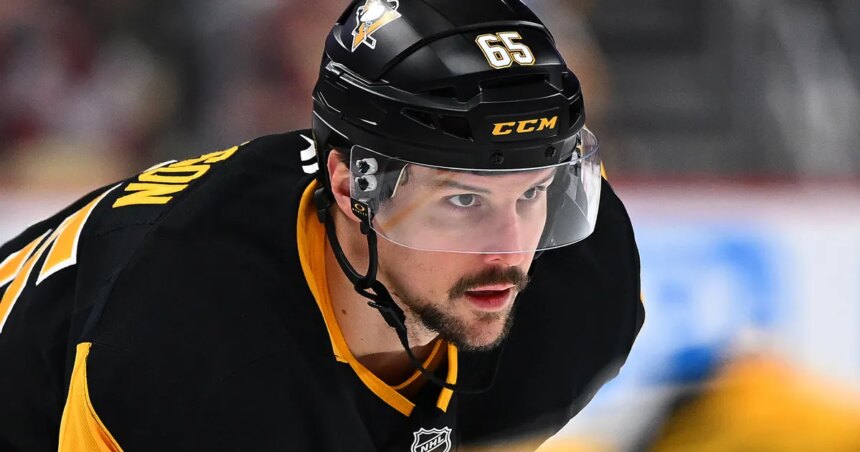
CRANBERRY TOWNSHIP, Pa. — Cam York had just ended the Pittsburgh Penguins’ season about 10 minutes earlier, and Erik Karlsson, sitting in the far corner of the visitors’ locker room in Philadelphia, patiently and politely answered reporters’ questions.
When the questions were over and the cameras had left, Karlsson, sitting alone at his locker, put his head in his hands and unleashed a primal scream that could probably have been heard in Landbro, Sweden, where he was born 36 years ago. The private moment revealed a side to the star defenseman that many people don’t see or acknowledge.
Karlsson is one of hockey’s coolest men. When he strolls through the Penguins’ locker room, his swagger is hard to miss.
“Kind of like James Bond,” Penguins center Tommy Novak said. “Yeah, that’s probably the right comparison. He is cool like that.”
All of that coolness, however, has created the perception that winning doesn’t matter to Karlsson, that all of his riches, individual statistics and Norris trophies are enough for him. Karlsson appears to enjoy living his life so much that his naysayers think winning isn’t his priority.
“I think,” Penguins forward Bryan Rust said, “some people don’t know him at all.”
Karlsson is a lock for the Hockey Hall of Fame someday, but he has never been synonymous with winning.
The closest he ever came, incidentally, was in 2017, when his Ottawa Senators took the Penguins to double overtime in Game 7 of the Eastern Conference final. He could only sit helplessly on the bench when Chris Kunitz’s knuckleball broke Ottawa’s heart.
Karlsson admitted that when he steps onto the PPG Paints Arena ice, his mind still occasionally drifts back to that moment.
“The Penguins had the 10-year reunion for the 2016 team last year,” he said. “That one didn’t bother me. The one they’re doing this season will.”
And yet, the reputation that so many who know Karlsson believe to be unfair — the one that says winning isn’t his priority — gained momentum in the moments after that game. With many of the Senators looking stoic in the handshake line, Karlsson greeted the Penguins’ stars with a big smile.
Sidney Crosby was the last person in the handshake line. Karlsson grinned and hugged him in a glorious display of sportsmanship.
“At least I lost to the best, eh?” Karlsson said to Crosby that night. “Good job. Get another one. I hope you’re healthy.”
Karlsson remembers the exchange like it was yesterday. He says he isn’t lacking in competitiveness; he just prefers to handle losing with class.
“Someone is going to win and someone is going to lose,” he said. “Unfortunately, I’ve been on the losing side too much in my career. We’re both striving for the same things. Eventually someone is going to come out on top. If you do everything you can do, and you still lose, you aren’t happy for the other guys. You’re sad. But you can still respect the joy that they’re feeling. There was nothing I could do to change the result at that moment.”
Karlsson has perspective on his career. His Ottawa and San Jose teams never had Stanley Cup-caliber rosters, and he knows it. He showed up in Pittsburgh about a decade late.
Once upon a time, he let his reputation eat him alive.
“It used to a lot,” he said. “I don’t think about it as much anymore. I’ve been dealt the hand I’ve been dealt throughout my career. I bounced around more than I was planning on. I had to deal with things that weren’t in the plans. I’ve tried to deal the best in the situations I’ve been in. There have been a lot of times in my career that I wasn’t on the top team in the league. I think it’s made it very easy for people to go that direction on me. We’d all wish to be Sid, Geno and Tanger, and play for the same organization for 21 years and win three Cups. That’s not reality for 99.9 percent of the NHL. I’m one of those guys. It doesn’t bother me the way it used to. But that doesn’t mean I don’t want to win.”

Though he is often funny, like when he posed with these characters before the Penguins’ “Star Wars” night, he has a serious side. (Justin Berl / Getty Images)
It’s often said that more than one thing can simultaneously be true.
Karlsson is the life of the party, yet is also a family man. He drives a Ferrari but said the most enjoyable part of his summer came when he and his wife, Melinda, took their children to Disney World. He very much enjoys his life. But something is still missing, and it haunts him the way it haunts any great player who has never lifted the Stanley Cup.
His personality simply often makes people miss it.
“I don’t know anyone like him,” Penguins forward Egor Chinakhov said. “He’s never in a bad mood, that guy.”
Karlsson insists that, like anyone else, his mood can turn sour. His true skill, though, is the ability to pull himself out of it. Even his explanation of this came with a grin.
“Usually my wife tells me I’m an idiot,” he said. “Or I tell myself I’m being an idiot. I frequently do find myself in a bad mood, but I snap out of it pretty fast. I have a pretty good sense of knowing when I’m wrong in the moment. I’ve learned to acknowledge it, move on. Most of the time, it works pretty good.”
Karlsson does have a serious side, his teammates say. Losing puts him in a bad mood, but he wouldn’t want anyone to know it. His teammates can’t talk about Karlsson’s serious side without first breaking into laughter.
“He’s all right, that guy,” countryman Rickard Rakell said. “I love hanging out with him so much. I feel like his energy is so good at all times. He makes life a little more fun. Makes me laugh all the time. But the thing about him is, when it’s time to go, he goes.”
Rakell raises his voice a notch when speaking of Karlsson’s eagerness to win. Karlsson noticeably elevated his game in February’s Winter Olympics and the previous year’s 4 Nations Face-Off. True to form, he was on the ice when a Quinn Hughes overtime goal for the U.S. denied Sweden a trip to the Olympic semifinals. That goal wasn’t Karlsson’s fault, but he had a front-row seat for it.
“Ask anybody in this room. They’ll tell you,” Rakell said. “His honesty about making plays, doing the right things for us to win hockey games. I think people don’t always understand that. He’ll get into discussions with teammates, coaches. He’ll argue with you. A lot, in fact. It’s a good thing to have someone like him, who isn’t afraid to speak up. He keeps everyone accountable. It’s a false idea that he doesn’t care about winning. He’s talking during games, before every play. He cares about winning so much. He just wants to be the best and wants to find a way to win at the same time. When you get to know him, you understand this. So many people don’t understand this about him.”
When it comes to competitiveness, Rust, a 12-year NHL veteran and two-time Stanley Cup winner, has few peers. He recognizes his own. Karlsson has been a hit since he joined the Penguins more than three years ago, in more ways than one.
“There’s something about him,” Rust said. “He carries himself with a certain confidence. I definitely wouldn’t call it being cocky or arrogant. But he knows who he is. He knows what he brings as a person and a hockey player. He’s not afraid to be authentically himself. It gives off a very strong persona. He’s easy to be around.”
Karlsson is the life of the party, after all.
“I just think he likes having a good time,” Rust said. “And when you’re Erik Karlsson, having a good time is a little easier.”
It wasn’t always this way, Karlsson insists.
“I always tried to be so cool,” he said. “I don’t think I always was, actually. Looking back at myself as a teenager, I was a big loser. I tried too hard. But I’ve always been a social guy.”
Somewhere along the way, he figured it out. He wants badly to figure out how to win a championship, too.
“I think that’s the furthest from the truth, is that he doesn’t take winning seriously,” Rust said. “His personality and how he carries himself comes across as being laid-back. That helps him be at his best. But when push comes to shove, he just cares so much. We all see it.”

Erik Karlsson, left, and Sidney Crosby are nearing the last stages of their careers, but nobody — including themselves — knows exactly how long they’ll play. (Ronald Martinez / Getty Images)
So, what comes next?
Karlsson is no spring chicken at 36. He enjoyed a magnificent 2025-26 campaign, showcasing his Hall of Fame form while delivering 66 points in 75 games. On a team with Crosby still producing huge numbers and in a season when Evgeni Malkin put up more than a point per game, Karlsson was voted team MVP, and nobody batted an eye. He was that good. Without him, the Penguins almost assuredly would not have qualified for the postseason.
Entering the final season of his contract, Karlsson and the Penguins have had discussions about his future. But they haven’t talked about a new contract yet. Karlsson isn’t sure how much longer he wants to keep playing, but he isn’t done yet.
“I don’t have a number,” he said. “It’s what Sid has been alluding to. As long as I can feel good and still play at a level that I’m happy with — it will look different than 15 years ago, when you could skate up and down the ice like it was nothing — I’ll play. Hopefully another five or six years.”
Malkin is 40. Crosby and Kris Letang are 39. They’re all coming toward the end at some point, even if they don’t talk about it. The notoriously chatty Karlsson keeps some things quiet.
“It’s an internal thing,” he explained. “We don’t really talk about it. We all enjoy the game and want to play as long as we possibly can. Eventually, it won’t be as much fun because your body won’t allow you to do things you’ve always been able to do. Right now, though, my body feels so great. Barring mishaps, I think I can go on for a while longer. I don’t think I’m running out of time. I was closer to retiring at 30 than I am now.”
Karlsson insists he means it when he says he no longer lets critics bother him. A chip on his shoulder remains, though. His greatness was on full display late last season, when Crosby was out with an injury and Malkin was suspended. He put up seven points in those five games. In fact, the stretch ignited Karlsson to an outrageous month of nine goals and 23 points in the following 16 games.
Karlsson is used to being the guy on ordinary teams. Without Crosby and Malkin, the Penguins’ lineup can look pretty ordinary. So, he took over. The muscle memory surfaced, as did that chip on his shoulder.
“It was a situation I’ve been in most of my career,” he said. “Sometimes I’ve had to do extraordinary things for a team to do well. That’s probably the only time I’ll ever get positive recognition, during those times. Good enough isn’t good enough for me. I have to do things that not many players have done in a long time. Then, people out there will say I’m really good. If I just play steady, good hockey, then I’m just average and am the guy who has never won anything.”
Karlsson was the 15th pick in the 2008 draft, landing in Ottawa with a Senators team that has been average for most of its existence. He sounds like a guy who knows his reputation would be different had he landed elsewhere in the draft. Karlsson, who can go from serious to funny in the blink of an eye, then showed his complexity.
For just a moment, he daydreamed about what it would’ve been like if the Penguins drafted him and he spent his whole career in Pittsburgh with Crosby, Malkin and Letang. He turned serious.
“People wouldn’t say the stuff about me then,” he said. “Three championships they won.”
Then, the devilish grin returns.
“That would have been fun.”