


Underestimate Bosnia and Herzegovina at your peril.
The United States’ World Cup round-of-32 opponent is among the supposedly less impressive teams to emerge from the group stage, but Mauricio Pochettino’s side need only ask Italy about the dangers of taking it lightly.
When Bosnia beat Wales away on penalties in March to set up a qualification play-off final against the four-time World Cup winners a few days later, Italy’s players were filmed celebrating — clearly viewing it as the easier opponent. Now, after another shootout win, Italy is watching this tournament from home as Bosnia’s North American adventure rolls on.
Pochettino will be guarded against similar complacency for the match at Levi’s Stadium, south of San Francisco, on Wednesday (early Thursday UK time), affording it the respect of detailed analysis and a tailored tactical plan.
In the opposite dugout will be Sergej Barbarez, appointed in 2024 to what was his first coaching job at any level. A 54-year-old former Borussia Dortmund striker who spent a decade playing professional poker after retiring, he knows a thing or two about strategy.
Here, The Athletic breaks down the strengths and weaknesses of his tactical approach and explains how the USMNT might find a way past Bosnia to reach the World Cup’s last 16.
USMNT prepares for Bosnia knockout match
Get free access to the most comprehensive World Cup coverage in The Athletic app
Bosnia is not the most glamorous side to watch. It struggles to dominate games, averaging 44 per cent possession across the three group stage games (the Americans were at 60 per cent). Nor does it create many chances, with just four shots inside the penalty area per match compared to the United States’ 12.
Expected goals, or xG, is a statistical metric that measures chance quality, giving each shot a value between zero and one, based on its likelihood of going in. Bosnia have generated just 1.87 xG, the second-lowest total among the teams to reach the knockouts (Paraguay are bottom).
That bluntness in attack is partly down to a lack of quality. Few in the Bosnia team are household names, with Edin Dzeko, the now 40-year-old former Manchester City, Roma and Inter striker, the most recognisable. But attacking caution is a deliberate trade-off in an approach that prizes solidity.
Bosnia sets up in a 4-4-2 and, unlike the more fluid USMNT, rarely rotates positions to try to unsettle opponents — but that rigidity helps it keep good defensive cover and structure behind the ball when possession is lost.

It is not completely static, though, with full-backs offering overlapping runs to free up tricky wingers, particularly ex-Arsenal man Sead Kolasinac down the left for gifted youngster Kerim Alajbegovic.
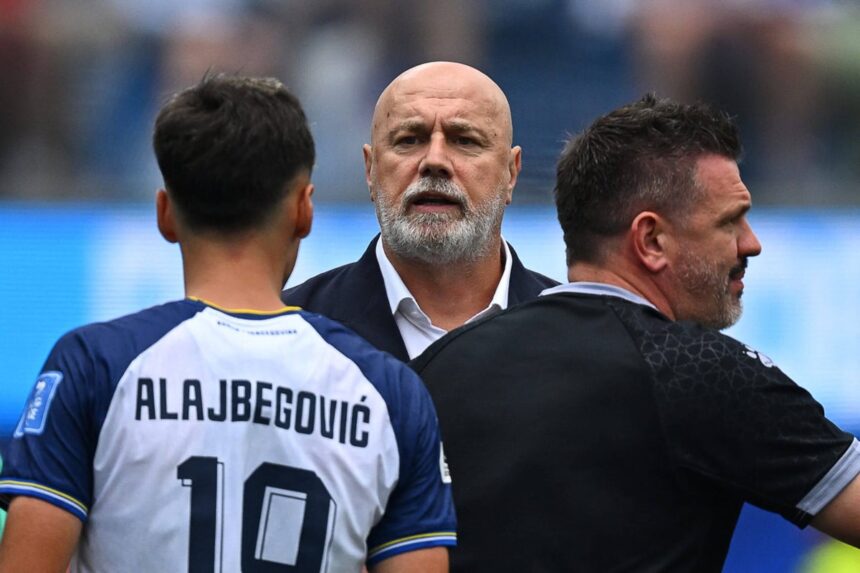
While Dzeko is the squad’s established leader, 18-year-old Alajbegovic is the star. He boasts wonderful dribbling ability and is comfortable with both feet, allowing him to glide past defenders in either direction. In the 3-1 win against Qatar in the last group game, Alajbegovic completed six take-ons, the second-highest total by any player in a game at this tournament.

He possesses a thunderous shot, as shown by his strike from outside the area for the opening goal in that match.
Set to join Germany’s Bayer Leverkusen this summer from Red Bull Salzburg of Austria, Alajbegovic is Bosnia’s chief creator, having completed a team-high 16 passes into the opposition penalty area in the three group games. Given his eye-catching talents, it is unsurprising that Bosnia funnels 46 per cent of its attacks down his left flank, the highest share down that side of anyone at this tournament.

On the opposite wing is likely to be Esmir Bajraktarevic, the Wisconsin-born 21-year-old who developed in MLS, playing three seasons for New England Revolution before moving to PSV of the Netherlands in January last year. Not quite as technically gifted as Alajbegovic, Bajraktarevic is still a threat the United States need to be cautious of, particularly on the counter-attack with his blistering pace.
Nullifying its threat out wide will be the USMNT’s defensive priority.
In attack, the challenge for the USMNT will be breaking down a stubborn, committed and physical defence. In the opening 1-1 draw against Canada in Toronto, Bosnia had just 39 per cent of the ball and frustrated the tournament co-hosts, as Jesse Marsch’s side struggled to find space against a compact, deep-lying back line. Ermedin Demirovic regularly dropped from centre-forward into midfield to help clog things up, and at times Bosnia had six players strung across the pitch in a resolute defensive wall.
The good news is the best way to prise Bosnia open is with sharp, unpredictable movement and slick interplay, which is exactly the kind of football the USMNT has championed under Pochettino. Barbarez’s side is not blessed with pace at the back and has been exposed by quick one-touch passing moves, such as the one below by Qatar.

A brute-force approach, by contrast, is unlikely to make much of a dent in a sturdy Bosnian side. At an average height of 6ft 1in (185cm), it is aerially dominant and have won 65 per cent of its aerial duels at this World Cup. Canada tried this route, putting in 30 crosses, but Bosnia made first contact on 23 of them.
That physicality doubles as an attacking weapon, as they are among this World Cup’s strongest set-piece sides, scoring a tournament-high three goals from corners.

Finally, there is the lurking presence of Dzeko up top.
Now with German side Schalke in the twilight of his playing days, he has enjoyed a glittering club career, helping win multiple trophies at Wolfsburg, City and Inter. His inevitable physical decline means he is now more selective with his movements, but he still retains those masterful centre-forward instincts for creating space, linking play and timing penalty-box runs.
That nous is shown below, where Dzeko, despite his lack of pace, manages to beat Qatar’s offside line near the centre circle, finding himself clear to drive towards the box and take a shot that cannons off the post.

At the heart of the U.S. defence sits 38-year-old Tim Ream, who is hardly a greyhound, so Pochettino would be wise to hand responsibility for marking Dzeko to his more sprightly center-back partner Chris Richards.
With the stakes suddenly raised and the threat of elimination looming, knockout football can devolve into a tetchy, uncomfortable affair.
Bosnia thrive in an attritional battle, and if the USMNT is not wary of that, the World Cup campaign could come to an abrupt, anti-climactic end.