

The reality is that Washington has a losing record after three weeks. But after their upset win over the Seattle Seahawks last Sunday, the Commanders boarded a flight to London sitting 1-2 instead of 0-3.
And that matters.
“Both don’t sound great on paper,” coach Dan Quinn admitted Sunday night. “But they feel a lot different.”
Only seven teams in NFL history made the playoffs after starting a season 0-3. The Commanders don’t have to try to be the eighth. Instead, they have a legitimate chance to reach .500 when they “host” the Colts at Tottenham Hotspur Stadium on Sunday (Washington is the designated home team).
Three weeks of play isn’t a huge sample size, but we’ve seen enough from these Commanders to know what’s working and what isn’t.
Working (quite well): The run defense
This has been among the team’s unfortunate consistencies over the past three seasons. The Commanders ranked near the bottom of the league in rushing yards allowed, and their 137.5 rushing yards allowed per game in 2024 were the third most in the league, prompting the team to bulk up its defensive line ahead of the 2025 season — to little avail.
But through three weeks this season, per TruMedia, the Commanders have given up the third-fewest rushing yards per game (82.0). They also boast the lowest rate of first downs on opponent runs (15.6 percent), have the second-highest rate of opponent runs for zero or negative yards (28.1 percent) and are one of only five teams to not give up a rushing touchdown.
Eagles running back Saquon Barkley averaged 136.5 rushing yards and two rushing touchdowns in his four previous meetings with the Commanders (including the playoffs). But in the season opener, he totaled only 83 yards — 42 of which came on one run. He had four negative-yard rushes.
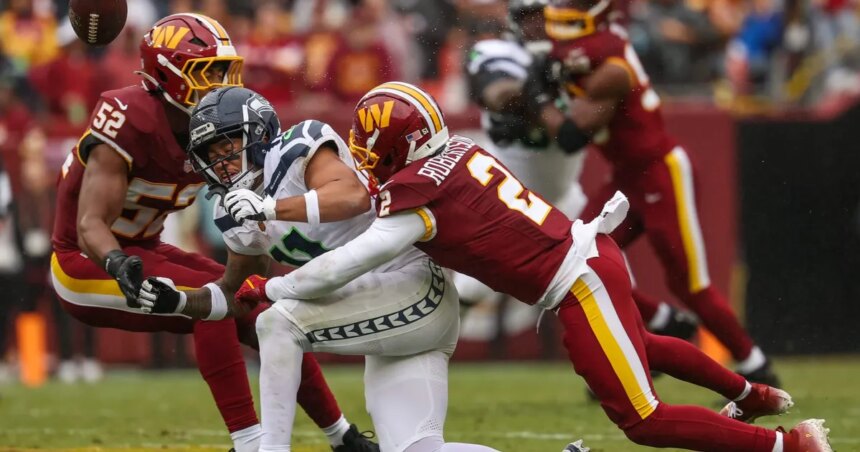
In Week 3, the Commanders gave up only 44 rushing yards to the Seahawks, only the second time since the start of the 2023 season that they allowed fewer than 50 in a game.
The biggest differences this season? The Commanders have given up only 2.9 yards per run on first and second downs, compared to 4.9 and 4.8 yards in 2025 and ‘24, respectively. They’ve also gotten to opposing rushers quickly, hitting them at or behind the line of scrimmage on 56.3 percent of their runs to yield only 0.61 yards before contact per rush.
Mariota leads Commanders to upset of Seahawks
Not working: Pre-snap and post-touchdown penalties
Eliminating pre-snap penalties was a point of emphasis for Quinn throughout the offseason and remains so three weeks into the regular season. Eight of the team’s 20 accepted penalties have been pre-snap, such as false start or illegal formation. (Rookie receiver Antonio Williams didn’t move up to the line when the Commanders shifted out of an empty look last week, negating Jacory Croskey-Merritt’s 48-yard touchdown run.)
Two other penalties were from antics after touchdowns. In Week 3, linebacker Frankie Luvu, who was inactive because of a groin injury, rushed onto the field after Kain Medrano’s pick six. Players not in uniform are prohibited from leaving the sideline to celebrate. Drew Stevens’ extra-point attempt was pushed back 15 yards and sailed wide left, leaving Seattle within 9 points instead of 10.
“You can imagine my thrill with that,” Quinn said with a laugh on Monday. “So, we had a good discussion about that in the meeting today. …”
In Week 1, Stefon Diggs jumped on the goalpost after his fourth-quarter touchdown in Philadelphia and drew a flag for unsportsmanlike conduct. That pushed the Commanders back 15 yards and eliminated their hope of going for two after the touchdown.
Working: David Blough’s play calling
The entirety of offensive coordinator David Blough’s NFL coaching career has been with quarterbacks Jayden Daniels and Marcus Mariota. That continuity and familiarity has shown up often. So, too, has Blough’s playing experience, which ended only two years ago. His offense incorporates more under center and huddling, but it’s not a complete departure from what the Commanders ran with Kliff Kingsbury the previous two seasons. Blough kept many of the concepts that worked well while adding bits and pieces from the coordinators he played for and learned from.

Commanders offensive coordinator David Blough stuck with the run game against the Seattle Seahawks. (Scott Taetsch / Getty Images)
The quarterbacks’ trust in Blough and Blough’s trust in his quarterbacks was especially evident late against the Seahawks. Seattle showed all-out pressure on a Commanders third-and-9 from their own 34-yard line during their final drive. Mariota made a check and Washington’s O-line blocked it perfectly, giving running back Rachaad White just enough room to cut to the right and pick up 19 yards and a first down.
Three plays later, on a third-and-7, Mariota sealed the win on a keeper, gaining nine yards to put Washington in victory formation.
“He really stuck with the run,” Quinn said of Blough. “And if we’re going to be a complementary team, (Seattle’s) not an easy group to do it against, especially with the interior of their group. So, staying into that, I thought, was a big deal.”
Worked (and might work again?): Lucas Patrick at center
The 10-year veteran signed with the Commanders on Sept. 16 and was thrust into the starting lineup 11 days later as Mariota’s center.
Guard Sam Cosmi was out with a concussion, so instead of turning to rookie Matt Gulbin or elevating Julian Good-Jones from the practice squad, the Commanders put Patrick at center and shifted Nick Allegretti to right guard.
Patrick fought through an ankle injury to play 65 of the team’s 69 offensive snaps, and allowed two pressures and zero sacks.
“He sits in my row (in meetings) during the week, so you kind of had to fast-track it,” Allegretti said of Patrick. “Kinda just threw everything at him. The good thing is, at the end of the day, football is football. The hardest thing for him was probably learning the terminology. Not learning the plays; he’s run all these plays in different offenses. It was just learning what we call them.”
Cosmi was also ruled out of Sunday’s game against the Colts (he did not travel with the team to London), so if Patrick’s ankle can hold up, it’s possible Washington again turns to him while Allegretti stays at guard.
Working: Sonny Styles
The rookie linebacker was overly scrutinized in his limited preseason snaps, but he has already proved any doubters wrong. He hasn’t been flawless, but he’s been impactful against the run and pass. In 194 defensive snaps, Styles has recorded one sack, one forced fumble, an interception and two passes-defended. He also wore the green dot for most of the last two games while Luvu was out with an injury.
Starting to work … some: Communication in the secondary
The back end of Washington’s defense looked confused for much of the first two games, contributing to a league-high 137.1 opponent passer rating and zero takeaways (among other issues).
Quinn and defensive coordinator Daronte Jones cited communication as a primary culprit, so last week the defense added extra meetings to their usual preparation.
Quinn and Jones also made a personnel change. Rasul Douglas started outside at cornerback in place of Mike Sainristil when the Commanders were in their base defense (Sainristil moved to the slot in nickel packages).
The improvement in Week 3 was obvious, though it was still far from perfect. Washington totaled 10 passes-defended, including two interceptions, against Sam Darnold.
“I thought in the first half it went better than the second, but I definitely felt that things, although they had a lot of yards throwing, there were definitely some things that I liked better,” Quinn said. “I liked our aggressiveness, our chances at the ball to create some takeaways. So, I felt that there was definitely significant improvement upon our communication in the back end. And that was one of the things that we were really targeting this week. So that was good to see.”