

The 2025 NWSL Championship rematch at Citi Field between Gotham FC and the Washington Spirit on Wednesday night is on track to break the record for the highest attendance at a women’s professional sporting event in New York City, with more than 40,000 tickets sold.
It also marks Gotham’s first home match in Queens, after recently announcing a planned 2028 move to the borough’s Etihad Park — currently under construction right next to Citi Field — from the team’s current base in Harrison, New Jersey.
As exciting as this match at the home of baseball’s New York Mets is likely to be, the players will be met with unfavorable weather conditions.
Temperatures are expected to near 100 degrees Fahrenheit (38C) in New York City today. There are also alerts in the region over poor air quality, as smoke from Canadian wildfires spreads across the northeast of the U.S., in addition to the ongoing heatwave. The area is under an extreme heat warning until around kickoff, which is set for 8 p.m ET, with the game to be broadcast on ESPN.

New York City is under an Air Quality Health Advisory as the Canadian and Great Lakes wildfire smoke gradually moves through the area. (Spencer Platt / Getty Images)
When reached ahead of the match, an NWSL spokesperson confirmed the league has been monitoring weather conditions closely. The NWSL took Wet Bulb Globe Temperature readings on Tuesday at times and under conditions similar to those expected on Wednesday. The field was fully shaded by the projected warm-up time, with readings ranging from 76.0 to 79.0 degrees Fahrenheit, well below the league’s threshold for delaying matches.
The league said it will follow normal game day procedures for responding to heat.
Around 1:30 p.m. local time Wednesday, Mayor Zohran Mamdani cautioned New Yorkers through social media that the air quality had reached “unhealthy levels” in parts of the city, adding that people should “avoid unnecessary outdoor activities”. Free filtration masks were available for locals, with cooling centers also open across New York.
Smell smoke this morning? Its coming from a wildfire outbreak in Ontario. While it should not impact air quality much today, smoke at the surface could increase Wednesday into Thursday, potentially reducing visibilities and air quality. High temperatures may also be limited. pic.twitter.com/6QdV5965nt
— NWS New York NY (@NWSNewYorkNY) July 14, 2026
A clause in the league’s procedures states that the delay, postponement or cancellation of a game in the case of emergencies includes “unfavorable weather and/or other adverse conditions beyond the control of the participating teams” that render the match dangerous or impractical for players, participants and fans.
An air quality index (AQI) of 100 to 150 triggers a hydration break per half, while a reading of 150 to 180 means two breaks per half, according to the league. An AQI of 180-200 is when the league considers a delay. Anything over 200 would trigger a cancelation. The current AQI in New York City is 161, which is considered unhealthy by the U.S. government’s measures.
The league will take another reading about an hour before pre-game warm-ups to determine if any further steps are needed, according to a league spokesperson.
The NWSL recently updated its policies to provide more clarity and simplicity. Here is what you need to know about how the league handles extreme heat conditions.
What is the NWSL heat protocol?
The NWSL updated its gameday heat safety policy in June, as part of a slew of changes announced ahead of the Challenge Cup in Columbus, Ohio, between Gotham and the Kansas City Current.
The NWSL said changes to the heat policy were made in consultation with players, clubs and competition stakeholders to “simplify” hydration break procedures by creating a “more consistent approach”. Any mandatory hydration break will now last between 2.5 and 3 minutes. This, the league said, eliminated its previous two-tiered approach that included a five-minute break if the Wet Bulb Globe Temperature (WBGT) readings exceeded 87.1 degrees Fahrenheit.
This was the only change made to the league’s existing heat protocol, the league previously said.
The nearly six-pages-long policy establishes procedures for assessing environmental heat risk and determining appropriate actions, from hydration and cooling breaks to match delays, with the goal of protecting the health and safety of players, officials and other match personnel. The policy also establishes that a cooling tub or similar cold immersion method must be set up and accessible for players prior to each game.
All teams are required to designate one senior member of their gameday staff to be their primary point of contact for coordinating with the league during these moments. This person is responsible for coordinating between the league and a designated NWSL official and/or match officials, as required.
The policy outlines in detail when extreme heat will trigger a match delay or hydration breaks, depending on the WBGT readings on gamedays. If “ambient air temperatures” are forecast to be 72 degrees Fahrenheit or higher at any point from two hours before the game through two hours after its anticipated end time, the WBGT must be taken. The policy advises monitoring website weather.gov for the “hourly weather forecast”.

A Wet Bulb Globe Temperature measures multiple elements of the impact of heat in a particular environment. (Getty Images)
What is Wet Bulb Globe Temperature?
The pure temperature may differ from the Wet Bulb Globe Temperature, which is “a measure of heat stress felt while in direct sunlight, which considers air temperature, humidity, wind speed, sun angle, and cloud cover (solar radiation)”, as outlined by league policy.
The policy centers around WBGT readings and their accuracy, outlining meticulously how often, when and where on the pitch a reading should be taken on dates where extreme heat is a concern. When a match is delayed, fans may notice this device out on the pitch repeatedly until officials conclude a match can resume.
The WBGT measurements must be administered by officials, with the home team responsible for ensuring measurements are conducted on a timely basis and in accordance with league policy.
When triggered, the first measurement must then be taken 60 minutes before the match at the center mark on the pitch. If the WBGT reading is greater than or equal to 92.1 degrees Fahrenheit, the team’s designated heat policy contact will report the NWSL designated official upon reading.
A second measurement must be taken 45 minutes before the game, again at the center mark, and if the reading remains at or is higher than 92.1 degrees Fahrenheit, then a game will officially be delayed. If temperatures drop below that threshold then warms-up may continue, subject to the following, per the policy:
“If the measurement is greater than 91.1°F / 32.8°C but less than 92.1°F / 33.4°C, the heat policy contact shall report the reading to the NWSL representative immediately upon the recording. After consulting with the home and visiting teams and the officials, the NWSL may delay warm-ups if WBGT measurements are expected to exceed 92.1°F / 33.4°C or may increase the frequency of subsequent WBGT measurements if warranted based on current forecasts.”
Once a game is delayed, the WBGT reading will be taken every 15 minutes. Warm-ups may start when readings drop below 92.1 degrees Fahrenheit. The NWSL has the authority to, per the policy, postpone, suspend, or abandon a match if it deems it appropriate, based on the duration of the delay and current WBGT forecast after consulting both teams and officials.

The NWSL determines whether a hydration break is necessary during a match. (Dustin Bradford / Getty Images)
How do hydration breaks work in NWSL?
Once temperatures reach a threshold suitable for warm-ups, a third measurement will be taken at the center mark of the pitch immediately after warm-ups conclude to ensure another delay is not warranted. This is when officials will determine if hydration breaks are required, should temperatures exceed 82.3 degrees Fahrenheit.
The policy allows for a hydration break to still be authorized even if temperatures are below that threshold.
Temperature readings are required to continue throughout the match at various points. Any failure to follow the protocol may subject teams to disciplinary actions or sanctions.
Match officials are responsible for implementing and managing hydration and cooling breaks, which allow teams to pause briefly midgame. They have been controversial in the ongoing men’s World Cup in North America, after FIFA mandated hydration breaks at every match, even for those held indoors. This essentially splits games into quarters. In the NWSL, they are only required when league policy deems them necessary.
The breaks can only begin when the ball is out of play or when there is a “natural break” in play, according to the match official’s judgement. The match clock will continue to run, with the allotted time for the break later added into the amount of stoppage time.
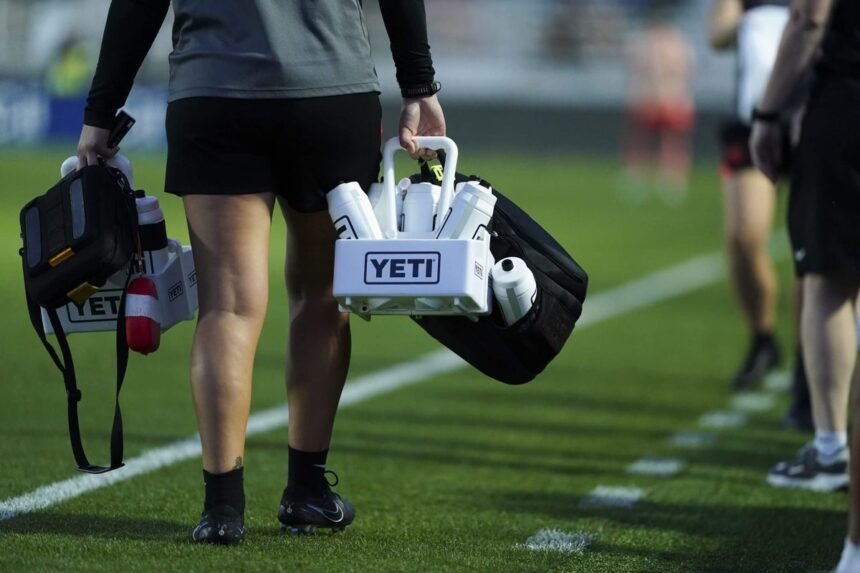
Players are required to remain on the field of play, and coaches should not leave their respective technical areas, according to league policy. Bench personnel should also not enter the field of play during these breaks, except for those distributing fluids or other medical needs.

A match between the Kansas City Current and Orlando Pride last August was delayed over three hours due to heat. (Kylie Graham / Imagn Images)
How has NWSL handled heat incidents in the past?
The NWSL came under fire last year after a three-and-a-half-hour match delay in Kansas City in late August, when the Current were set to face Orlando Pride in a match set to kick off in the afternoon. It was a highly anticipated game between the table-topping Current and the defending NWSL champion Pride. The match was set to kick off at 3 p.m. local time, but instead began at 6:28 p.m., after earlier temperatures were deemed too dangerous to play under NWSL policy.
The match was delayed several times before temperatures fell below the league’s threshold of 92.3 degrees Fahrenheit. Many questioned why the game had not been postponed sooner, considering a moderate heat advisory had been issued for most of the state of Missouri that day.
“The league aims to play matches as scheduled whenever safely possible. While forecasts guide planning, we primarily rely on real-time, on-site weather data to make informed decisions following our inclement weather policies and protocols. Based on those inputs, the league decided to delay today’s match,” an NWSL spokesperson told The Athletic at the time.
Players were seen warming up and preparing for kickoff when the first heat-related weather delay hit. Orlando head coach Seb Hines said in post-match availability that he was “disappointed” with how those three hours unfolded, describing the uncertainty as the match was repeatedly pushed back.
“It was too hot to play, and we would have liked that decision to have been made earlier on, before warm-up, so they can probably prep a little bit better,” Hines said. “It was a lot of waiting around … and there’s a lot of confusion and lack of communication as well on what the next steps were.”
As The Athletic reported days later, NWSL commissioner Jessica Berman threatened to fine the Current after a disagreement over extreme heat procedures that delayed the match, multiple sources briefed on the matter told The Athletic.
Both teams were concerned about the extreme heat. The league wanted the game to proceed when possible, so it could be televised.