

After three days of competition, three riders remained tied.
The Aachen Rolex Grand Prix, one of show jumping’s four majors and the event every rider wants to win, would come down to a jump-off, the ultimate test of nerve.
Tennis has the final-set tiebreak, a first-to-10-point shootout that decides the victor; golf has the play-off, where players tied at the end of 72 holes go head-to-head, sometimes in sudden death. The NBA and NFL have overtime, while soccer has the penalty shootout. In equestrian sports, it’s the jump-off.
In Aachen last month, in front of 40,000 fans in one of the sport’s finest arenas, riders Sophie Hinners, Richard Vogel and José María Jr. Larocca needed to go again against the clock. The scene was set for a thrilling finale.
Hinners first put down a clear round in a time of 51.62 seconds, placing the pressure squarely on Vogel and his powerful stallion United Touch S as they entered the stadium.
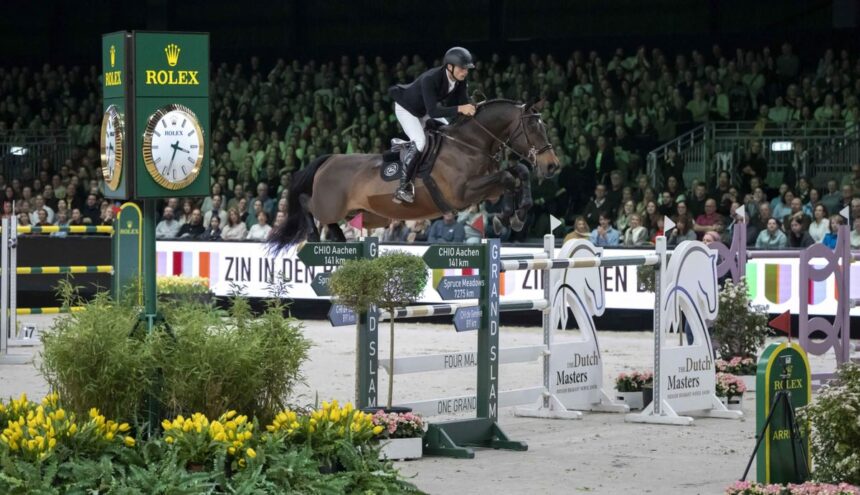
Taking advantage of United’s huge stride, Vogel put down a flawless, blistering round, picking up speed after the third jump to shave six seconds off the lead time as the crowd erupted. The clock stopped on 45.57 seconds.
Final rider Larocca of Argentina and his 16-year-old bay gelding Finn Lente never came close as they finished second, almost two seconds back. In Vogel’s words, a “childhood dream” had come true.

Richard Vogel on United Touch jumps over an obstacle in Aachen. (Uwe Anspach / picture alliance via Getty Images)
The key to surviving a jump-off is calmly handling pressure.
International show jumping events typically consist of a two-stage, high-stakes battle, that tests accuracy, risk-taking and speed. In the first round, the rider’s main aim is to navigate the horse around the course within the time limit and without any penalties for knocking down a pole, going off course, a refusal or falling off. To read more about the rules, click our guide here.
If two or more horse-rider combinations are tied for first, or with matching clear rounds, a jump-off is held over a shortened course. The rider with the fewest penalties and fastest time is crowned the winner.
With more shows on the calendar, including five-star events such as this weekend’s €500,000 ($577, 808) Rolex Grand Prix Ville De La Baule, on the west coast of France, both athletes and horses are gaining more experience, according to Vogel.
“There’s not three weekends in this year so far that I haven’t been on a show yet,” Vogel told The Athletic. “If you want to be one of the best riders out there and want to compete on the best tracks and in the quickest jump-offs, that’s something you need to practice,” he said.
Changes in breeding practices have also made a difference, according to Vogel.
“Back in the day, we had a lot of horses that had a lot of scope, a powerful stride, but they were maybe not the smartest, maybe not the most careful, and also not the quickest,” he said.
In recent years, faster horses that can handle the speed and precision required in modern jump-offs, including Vogel’s own wonder horse, United Touch S, have emerged.
But mastering the jump-off is less about blind speed and more about understanding a complex mix of variables, according to Cameron Hanley, who represented Ireland twice at the World Championships and three times at the European Championships.
“It depends on what kind of competition it is, how many are in the jump-off and, most importantly, your horse’s experience level,” he said. “What is it capable of doing? Do you have a quick horse capable of winning? Or maybe you realize you don’t end up winning the class, and you are trying to do your best performance that is comfortable for your horse.”
Hanley is clear about who he regards as the current standout jump-off riders: world champion Julien Epaillard of France and triple major winner Vogel.
What sets them apart, he said, was the positivity they ride with.
“They’re not riding a course thinking, ‘Oh, I have to be careful here, I’m going to knock this, I might knock that.’ They ride with a lot of freedom, and they have a clear goal in their mind,” Hanley said.
Just as important is how they manage failure.
As a member of one of sports’ most famous dynasties, William Whitaker had a ringside seat to what it takes to become a top rider. As he embarked on his riding career, his famous uncles, John and Michael Whitaker, who dominated the sport in the 1980s and 1990s, gave him one piece of simple advice.
“I like to have a good plan in place about the course and how I was going to basically go out there and execute it,” William Whitaker told The Athletic.
“The advice from my uncles was, ‘Just have a go. You’re not going to win every time, but as long as you go in there and do your best, you can’t ask any more and don’t get too upset.’ I think that’s what’s given them basically such longevity in the sport.”
While there is no substitute for experience, being “young and a little carefree” can be an advantage for younger riders, according to Hanley. The key to putting down a great jump-off starts with good preparation at home for every scenario.
“The more you can be prepared for something, the more you can relax,” he said. “Horses are so sensitive to everything that you feel. If you can portray a feeling of confidence and you know what you’re doing to your horse, they’ll definitely pick up on that.”