


Get free access to the most comprehensive World Cup coverage in The Athletic app
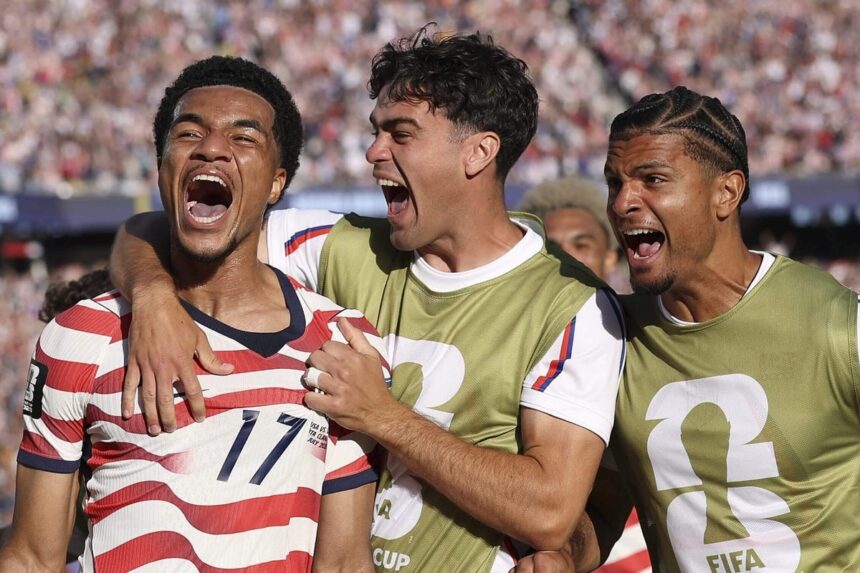
There’s only one place to start when it comes to day 21 of the World Cup: Levi’s Stadium in California. On a seminal night for Mauricio Pochettino and his players, the United States men’s national team won their first World Cup knockout match since 2002, and their third game at these finals, setting up a last-16 tie against Belgium in Seattle on Monday.
Not even the red card that Folarin Balogun was shown after a VAR review midway through the second half could knock the U.S. off course on an evening when Pochettino’s team played with courage, intensity and unwavering belief. Balogun scored the first and Malik Tillman converted a free kick to double their lead.
England also claimed their place in the next round courtesy of a Harry Kane-inspired comeback against DR Congo. Trailing 1-0 deep into the second half, Thomas Tuchel’s side were facing the prospect of a humiliating defeat until Kane struck twice, first with a header and then with a ferocious shot. Mexico at the Azteca will be England’s next opponents.
The game of the day took place in Seattle, though, where Belgium were 2-0 down with four minutes remaining but scored twice in 161 seconds to force extra time. Youri Tielemans got his second and Belgium’s third with a penalty right at the death. What is it with late goals at this World Cup?
Matchday 21 results
England 2-1 DR Congo
Belgium 3-2 Senegal
USMNT 2-0 Bosnia and Herzegovina
Has there been a better USMNT?
Those who know their history and are familiar with the story of the 1930 U.S. team, who reached the semi-finals of the inaugural World Cup, might have something to say, and there’s also the 2002 quarter-finalists.
But it’s hard not to get swept along by the way that the U.S. has played as individuals and as a team this summer, showing togetherness and grit when it was required — the response to Balogun’s red card against Bosnia and Herzegovina was particularly impressive — but also producing moments of quality and brilliance too.
Despite all the concerns and reservations coming into the tournament — and there were plenty — everything has spectacularly fallen into place for the U.S. when it mattered. It’s almost like a switch was flicked from the moment that the players walked out of the changing room on the day of that Paraguay game, when the U.S. put four past a team that have since eliminated Germany.
Balgoun scored twice that afternoon and it’s a crying shame that a striker who has been playing at the top of his game, and who brings so much to the U.S. attack through the intelligence of his movement and the quality of his finishing, will be suspended for the Belgium game.

USMNT striker Folarin Balogun comes to terms with his red card against Bosnia and Herzegovina (Matthew Huang/Icon Sportswire via Getty Images)
His presence as the focal point of the attack feels transformative for the U.S., providing a cutting edge that it has often lacked, notably at the World Cup four years ago.
There’s a lot to like about the rest of the team too, whether that’s the emergence of talented 21-year-old right-back Alex Freeman, Antonee Robinson’s tireless running on the left, or the midfield trio of Weston McKennie, Tyler Adams and Tillman, who complement each other so well, bringing a mix of energy, dynamism and flashes of class. Their aggressive counter-press is hugely impressive and makes life uncomfortable for any opponent, but the three of them can play too.
McKennie, who is enjoying an excellent tournament, has made 13 defensive line-breaking passes in the World Cup – four more than any other player. As for Tillman, the beautiful backheel that released Christian Pulisic in the Bosnia penalty area in the first half provided a measure of his confidence, and then there was that late free kick to settle any U.S. nerves.
Perhaps it says everything that it has taken so long to mention Pulisic, the poster boy of U.S. soccer. That’s not to overlook his ability to influence matches — the U.S. is unquestionably a better team with Pulisic on the pitch. But the reality is that it is exactly that: a team. And a damn good one too.
Is Kane late to greatness? Or late to it being recognised?
It’s easy to forget the narrative surrounding Harry Kane looked very different at England’s last major tournament, when there were calls for him to be dropped rather than knighted.
The 2024 European Championship in Germany put Kane under the spotlight — and not a particularly favourable one, either. He shared the Golden Boot with five players after scoring three times, but it wasn’t a tournament that Kane would reflect on with any joy or satisfaction. In fact, he was widely criticised.
“I am conscious of the summer and talk about myself physically,” Kane told the media before England faced Finland in a friendly a few months later. “Perception is a big thing in football. As a nation, and as media or pundits, we were trying to find a reason why we weren’t playing as well as we had in other tournaments. Maybe my form took the brunt of that. It was like: ‘Why is he not scoring goals?’.”
Kane, in other words, had become a bit of a scapegoat. He looked fatigued and leggy at the Euros. By the final, it was no surprise when manager Gareth Southgate substituted him shortly after the hour mark, even though England were losing 1-0 to Spain and badly needed a goal.

Aged 30 at the time, Kane was a prolific striker — his country’s captain, the all-time leading goalscorer for England and an elite footballer. He was highly respected, of course, but never really belonged in a conversation about the four or five best players in the world. Great but not that great.
Perhaps the fact that it took Kane 15 years in professional football to win a trophy — something that says more about the time he spent with Tottenham Hotspur than his ability to score goals — was a factor. Either way, Kane’s highest ranking for the Ballon d’Or is 10th, and nobody would have argued with that a couple of years ago.
Older and wiser, Kane has taken his game to another level over the past two years, entering football’s stratosphere by scoring goals at an astonishing rate for Bayern Munich and influencing games for club and country in such a way that his name deserves to be mentioned in the same breath as the superstars of the game.
It’s hard to remember a time England were so dependent on one individual. Kane’s two goals against DR Congo — the first a trademark header and the second a venomous strike that exploded off his right boot — single-handedly turned the game around. Without Kane, England were going home. With Kane, there’s always hope.

Harry Kane inspired England to a thrilling 2-1 comeback win over DR Congo (Europa Press Sports/Europa Press via Getty Images)
That double takes him up to five goals and joint-third in the race for the Golden Boot, behind only Lionel Messi and Kylian Mbappe. He has also surpassed Pele on the list of all-time leading World Cup scorers, where Kane is joint-sixth. “Sir Harry” is how Thierry Henry referred to him in his punditry work with Fox.
It makes you wonder if some people in England have taken Kane for granted over the years.
Are more win-or-go-home matches a success?
It feels like we’re straying into deeply uncomfortable territory by daring to suggest that anything the FIFA president Gianni Infantino has proposed is a good idea.
But maybe — maybe — the expansion to 48 teams wasn’t such a bad thing after all, purely so we can enjoy (or endure, depending on your allegiances) 16 extra knockout matches and all the drama that comes with them.
That already includes two stoppage-time winners, two penalty shootouts, all three hosts making it through to the round of 16, and an epic comeback that featured the latest goal in World Cup history — a record now belonging to Belgium captain Youri Tielemans. His nerveless penalty with 124 minutes and 44 seconds on the clock in Seattle broke Senegalese hearts in a five-goal thriller.
Less can often be more, and there were certainly games during the group stage — you can look them up in our match ranking here — when you questioned the merits of inviting another 16 teams to the greatest sport show on earth.

Youri Tielemans’ extra-time winner sent Belgium into the last 16 (Jane Gershovich/ISI Photos/ISI Photos via Getty Images)
Why did we have to go through 72 group-stage matches to get down to the same number of teams that played at the start of the last World Cup? And aren’t you in danger of rewarding failure by allowing eight third-placed teams to go through?
Those questions remain valid, but there’s also no escaping the benefits of extra win-or-go-home games, especially when seven of the 10 knockout matches have been decided by goals scored in the 86th minute or later.
The other three fixtures — the USMNT creating history in California, Mbappe and Michael Olise putting on an attacking masterclass for France, and Mexico reminding everyone why the Azteca is such a special place for their national team — have not been short of storylines either.
Maybe it won’t carry on like this. Maybe the quality will drop when everyone is running on empty because the schedule has been so unforgiving. But right now it’s good fun, not least because there’s so much jeopardy — and modern football (picture that 36-team Champions League table… and don’t get any ideas, Infantino) doesn’t have enough of that.
What to know about Thursday’s games
The standout match is in Toronto, where Portugal takes on Croatia. Or, to put it another way, Cristiano Ronaldo comes up against Luka Modric – combined age 81. Combined caps – and this really is a ridiculous figure – 432.
Former Real Madrid team-mates and two of the greatest players of their generation, Ronaldo and Modric are coming towards the end. Or are they? Modric will almost certainly walk away from international football after this World Cup but you wouldn’t put it past Ronaldo screaming, “I’m back” into a television camera in four years.
What is clear is that it’s not clicked for Portugal or Ronaldo, who has played every minute for his side. Portugal were poor in their opening 1-1 draw against DR Congo, then beat Uzbekistan 5-0, prompting Ronaldo to announce his second coming (Uzbekistan, for the record, went home with zero points and conceded 11 goals), and then drew, rather fortunately, with Colombia.
Earlier in the day, Spain will face Austria in Los Angeles. It’s a favourable tie for the 2010 World Cup winners, who got off to a slow start against Cape Verde but have beaten Saudi Arabia and Uruguay since, aided by Lamine Yamal’s return to fitness.
The late kick-off brings together Switzerland and Algeria.
Today’s games
Spain vs Austria (3pm ET; 8pm BST)
Portugal vs Croatia (7pm ET; midnight BST)
Switzerland vs Algeria (11pm ET; 4am BST)