

Red Light newsletter 🏒 | This is The Athletic’s hockey newsletter. Sign up here to receive Red Light directly in your inbox.
Good morning! Max Bultman here, filling in and writing to you from Windsor, Ont., where I can confirm that hockey — World Junior Summer Showcase hockey, to be exact — is being played. Consider that your first sign of the upcoming season cresting over the horizon.
Let’s get into it.

Macklin Celebrini is raising the bar for the NHL’s young stars. (Ezra Shaw / Getty Images)
Payday
Celebrini gets paid
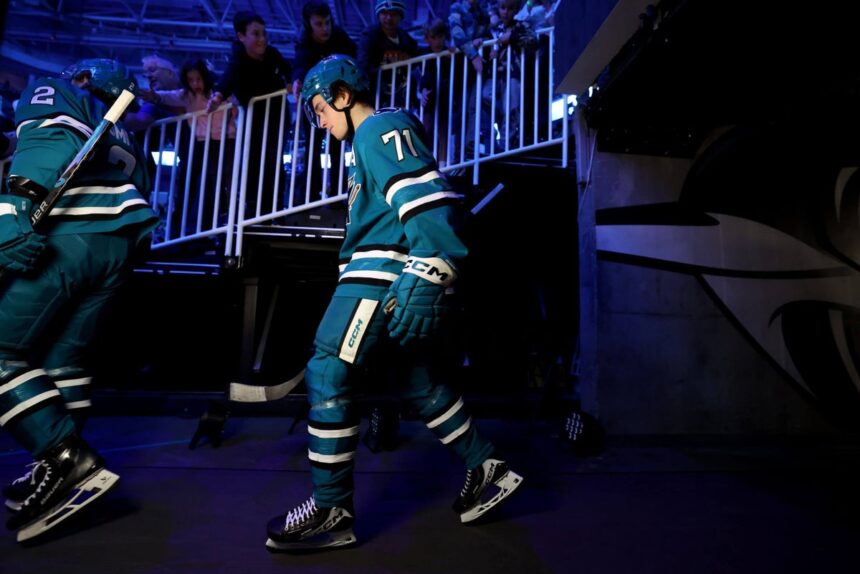
For the second time this summer, we’ve got a new record average annual value (AAV) in the NHL. Fittingly, that title will now belong to the player with the best chance to become the next face of the sport: the San Jose Sharks’ Macklin Celebrini.
Yesterday, Celebrini signed a five-year extension with an $18.8 million AAV that begins in 2027-28 and keeps him in San Jose through 2032. Once it kicks in, it will surpass the previous high-water mark of $18 million, set earlier this summer by the Anaheim Ducks’ Leo Carlsson (via Flyers offer sheet).
And this time, there was no offer sheet necessary: San Jose took care of business with Celebrini a year before his entry-level contract was set to expire and eliminated the possibility of any offer-sheet shenanigans in 2027.
Celebrini made perfect sense as the next bar-setting player — though we’ll see what happens when Quinn Hughes and Cale Makar sign their next deals. And just as with Carlsson’s deal, it begins to define a contention window for one of the sport’s most promising young teams.
Anaheim’s window was already open — the Ducks went to the second round of the playoffs last season — but the Celebrini-led Sharks are now officially on the clock to get into that mix. Their deep prospect pool features a ton of rising young talent that could contribute as soon as this season, but whether it’s immediately or in the five additional years he just signed for, the time to compete is approaching in San Jose.

Leo Carlsson. (C. Morgan Engel / Getty Images)
New trend for second contracts?
While the dollar amount on Celebrini’s new deal is indeed massive, the five-year term might be the more interesting aspect of Wednesday’s news.
Anaheim had no choice but to match the Flyers’ five-year offer to Carlsson earlier this summer. But for San Jose, going even longer would have been ideal. Instead, the five-year term means Celebrini will be eligible to become an unrestricted free agent in 2032, when he’s just 26 years old.
And he and Carlsson are far from the only young players to take that path coming out of their ELCs. Connor Bedard also signed a five-year extension at a $15 million AAV earlier this month, and young defensemen Brandt Clarke, Pavel Mintyukov and Šimon Nemec all also went for the mid-term length, forgoing the more conventional options of a long-term pact or a two- or three-year bridge contract.
It’s easy to see the logic for the players here. Celebrini, Bedard and Carlsson in particular will be in line for market-topping deals once again, becoming free agents when they are squarely in their prime. If the dollars look gaudy now, imagine what they’ll be on a (theoretically) open market, and with several more years of salary cap growth in between.
But those same factors are why a seven- or eight-year deal — like Montreal did with Ivan Demidov — would have been far preferable for San Jose and Chicago, locking in their franchise centerpieces for as long as possible. That kind of deal had been the standard procedure in recent years, with teams paying players big money early and reaping the benefits of those extra prime years before a third deal comes around.
The trend this summer, though, points toward young players looking for those medium-length deals — setting them up for potentially massive windfalls in their primes.

Wayne Gretzky. (Robert Laberge / Allsport / Getty Images)
Trivia Time
Because we’re talking dollars, let’s flash back to 1993, when Wayne Gretzky became the league’s highest-paid player on a three-year deal with the Los Angeles Kings.
How much was The Great One’s then-sport-topping deal worth?
The answer is below.

Jackson Blake’s contract is an A-plus. (Bruce Bennett / Getty Images)
Efficiency Rankings
Hurricanes on top again
I hate to make this whole newsletter into a bank statement, but it’s summer, Dom Luszczyszyn’s annual contract efficiency rankings are out and they’re revealing.
No single contract makes or breaks an NHL team. Even the top-ranked Carolina Hurricanes have a D-plus on their ledger (sorry, Jesperi Kotkaniemi). But there sure seems to be a correlation between the teams that consistently avoid bad deals and the ones that challenge for the Stanley Cup.
The top eight teams in Dom’s contract efficiency rankings:
- Carolina Hurricanes
- Montreal Canadiens
- Ottawa Senators
- Dallas Stars
- Tampa Bay Lightning
- Colorado Avalanche
- Buffalo Sabres
- Florida Panthers
That’s not every inner-circle contender in the league, but it’s a whole lot of them. And Nos. 9 (Washington) and 10 (Utah) are no slouches, either.
There’s a lot to learn from this list — the full story is worth your time.
Coast to Coast
🏒 Where does your team’s top-six center duo rank league-wide? Harman Dayal tiered them all out. McDavid and Draisaitl are expected winners here, but there are some surprises along the way.
🇨🇦 Hockey Canada has named Danièle Sauvageau general manager of its women’s hockey national team through the 2030 Olympics. Canada won four straight Olympic golds from 2002 through 2016 but has come away with silver at two of the last three Games, including 2026. Can she get the Canadians past Team USA?
🚨 John Tortorella still wants to coach after the Vegas Golden Knights opted not to bring him back, even though he nearly led them to the Stanley Cup. Read Joe Smith’s exclusive interview with Torts here.
🏛️ This is a moment of big change in college hockey, especially at Harvard, where longtime coach Ted Donato has stepped down and been replaced by former assistant Rob Rassey. He’ll be charged with navigating a challenging landscape for the Crimson.
📋 Could Joel Ward become the NHL’s second Black head coach? His peers certainly think so.
📺 Aaron Portzline has some big broadcast news out of Columbus, where the Blue Jackets parted ways with radio voice Bob McElligott as part of a decision to simulcast their TV broadcast over radio.
🎙️ “The Athletic Hockey Show” rolls on this week with its “How To Fix” series, with Thomas Drance on the Vancouver Canucks and Peter Baugh on the New Jersey Devils. Plus, the Prospect Series crew took a way-too-early look at Canada and US World Cup of Hockey rosters, including an epic debate about whether Quinn Hughes or Lane Hutson is Team USA’s best option to quarterback their first power-play unit. Watch or listen here.

Wayne Gretzky. (USA Today Sports)
Trivia Answer
So, how much was Gretzky making to become the league’s highest-paid player back in 1993?
That three-year deal carried a total value of $25.5 million (or $8.5 million per year, the same annual rate that current Islanders forward Bo Horvat earns).
Some of that money was reportedly deferred, so if you said he made more like $6 million per year, we’ll still give it to you.
In either case, it’s not Celebrini money. But you know what? I’d still take it.
How are we doing? We’d love to hear from you. Email your feedback or corrections to redlight@theathletic.com.
📫 Love Red Light? Check out The Athletic’s other newsletters.