

ATLANTA – Thank you for coming to the WNBA Finals! Also, please leave the building.
Now.
The circus surrounding the moving of this game to a 12:30 p.m. start time on a Thursday was bad enough, but I’m not sure we talked enough about the circus going on inside the building in order to pull this off.
Game 6, won by the Dream 80-69, was a major-league event with a minor league schedule.
Saturday’s Game 4 gave us a preview. That game began at 1 p.m. and all working media and staff were required to leave the building by 4:30 p.m. to accommodate the Hawks-Rockets game taking place immediately afterward. Generally, if you’re a burgeoning league trying to increase awareness and interest, it’s not a great idea to shoo all your media partners out the door right as they’re trying to tell the world all about your product. Logistically, it worked out, barely, as writers scattered off to assorted hotels and coffee bars to finish their stories, and happy fans had at least a few minutes to whoop and holler before exiting into a glorious 70-degree day … but imagine if it had gone to overtime?
With a 12:30 p.m. start time and an 8 p.m. Hawks-Cavs game slated for later in the day, the get-out time for Game 6 was 4 p.m., with the league pushing it to 4:30 p.m. if the Valkyries had won the championship.
That possibility — as well as the more haunting possibility of overtime(s) — almost immediately went away after Atlanta began the game with a hailstorm of 3-pointers and led by 21 after just nine minutes.
Still, the odd juxtaposition of a major league event and rec-league semifinal was hard to ignore.
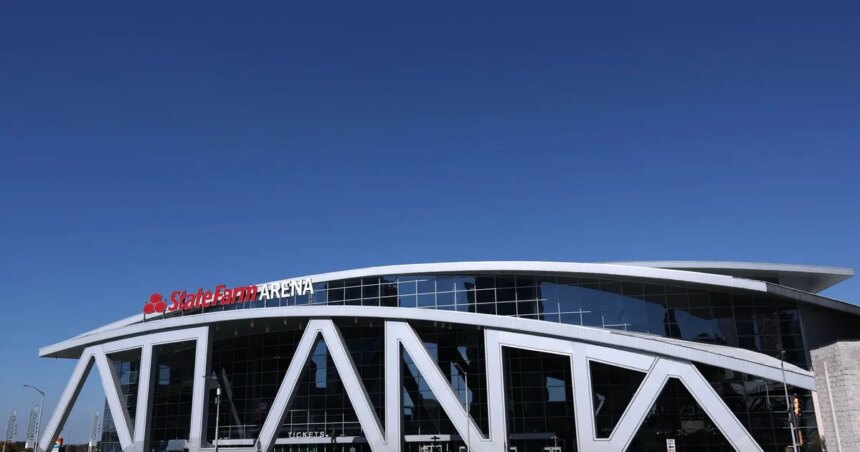
First, the good news. The WNBA continued to leave no doubt that this is not a league that should be playing at mid-morning on The Ocho. Despite Game 6 being a day game announced on short notice, it was a hard sellout at State Farm Arena with standing room only seats in both end zones filled, a raucous crowd for the opening tip, and T-Pain performing at halftime. The fan support in this series could hardly be any better.
It would have been nice for the locals to revel in victory for a bit, but that wasn’t happening.
The game ended at 2:51 p.m.; by 2:55 p.m., the arena video board advised fans to leave as quickly as possible so the court could flip for the Cavaliers-Hawks game schedule later in the evening. A raucous bar area for the expensive seats located next to the interview room, filled with celebrating Dream fans, abruptly went quiet at 3:20 p.m. as everyone was told to leave.
By the time the last player, Atlanta’ s Jordin Canada, left the court at 2:58 p.m., barely an hour remained for everyone to get out. Media were blocked from the court area within 10 minutes, as workers began turning the floor for the Hawks game.
Meanwhile postgame interviews for the league’s biggest event were served buffet-style, with Atlanta’s coach and two of its key players taking the podium together while the “mixed zone” with other players ran concurrently. Both teams’ players took the podium in uniform and then dressed, with Golden State’s team bus pulling out at 4:15 p.m. (Side note: If only NBA players could dress this quickly).
A sellout crowd of 17,000 fans 🔊 https://t.co/ULklIo5Wuc
— The Athletic (@TheAthletic) October 29, 2026
The whole scene reminded me of one of my more unusual memories from the team side – Winning the Orlando Summer League title, trying to get the team together for one photo on the court, and almost immediately being whisked off so that they could get the next game in.
But hey, that was summer league, not the world championship. I was home in Atlanta for dinner that night. But the Valkyries? Had they won, they would have been dunking themselves in champagne at Atlanta airport gate D-7.
So … how did we get here? A failure of foresight, obviously. When I worked for the Grizzlies we had to get a hold on the arena for potential playoff dates, as did every team in the league. The WNBA had the same requirement, as The Athletic reported this week.
However, the unusual situation here is that the Dream’s home arena in the regular season was not the one they wanted for the postseason; teams were required to put holds on their arenas for all the projected playoff and finals dates, but in this case that meant Atlanta’s Gateway Center, a 3,500-seat shoebox where the Hawks G League team also plays. (In addition to the obvious capacity issues, the arena’s location is only desirable if you happen to be returning a rental car to Hartsfield at the same time.)
Moving Thursday’s Hawks-Cavs game to a different location or date might have been simpler with more lead time, and the WNBA certainly had it, given it was clear either New York or Atlanta would be hosting Games 3, 4 and 6 once the first round ended. One option, for instance, would have been swapping the location to Cleveland then moving the Hawks’ Cleveland game on March 6 back to Atlanta. Even if the Dream didn’t make the finals, it would have been an easy contingency to lock in if it had been done far enough in advance.
Alas, waiting and hoping the problem would go away did not, in fact, make it go away. The Dream said in a statement that they alerted the WNBA to the potential problem two months ago. The Hawks did not make anyone available for comment.
However, once the game was less than a week away, the simplicity of moving a Hawks-Cavs game turned into major surgery. Swapping the location on short notice turned into a non-starter, moving the WNBA game to Friday was a conflict with USA Network’s WWE “Smackdown” and would have pushed a potential Game 7 to election night. Shifting the Cavs-Hawks game to Friday night created an issue for the Cavs on Saturday, because that game, in Milwaukee, might have needed to move to the day if the Milwaukee Brewers played in Game 7 of the World Series that night. (Sadly, nobody from the league office called me about this; I would have assured them that my Brewers would wrap things up sooner).
In negotiations that I’m told went up high in the NBA office — the league still has a major stake in the W — the eventual conclusion was that playing the game at 12:30 p.m. was bad, but that all the other alternatives were worse.
If there’s a silver lining from this story, it’s that it almost certainly will never happen again. For starters, WNBA teams aren’t playing regular-season games in bandbox arenas anymore because the league is too popular. The Dream, for instance, will move full-time to State Farm Arena next year.
Dream beat Valkyries 80-69 to force Game 7
Moreover, the league will be all too aware of the potential for this type of situation and more aggressively plan ahead, including possibly coordinating with the NBA to schedule home games for teams who share arenas in ways that don’t create conflicts. (Irony alert: The Atlanta Hawks have only three home games between Oct. 13 and Nov. 5. All three created massive conflicts with the WNBA Finals).
But the biggest reason this won’t happen again is that the WNBA is showing it is not a league to be treated this way. The best way to show you aren’t a league that should be shoved to noon on a Thursday is to get 17,099 people to show up at noon on a Thursday. Between the crowds, the fan interest, and the quality of the product on the floor, the WNBA is a prime-time league now.
Consider this the WNBA’s “tape delay” moment (when Magic Johnson’s 1980 Lakers won the clinching Game 6, it wasn’t shown live nationally). It was bad, yes, but the reason it was so bad was actually good: The W is a prime time league now.